


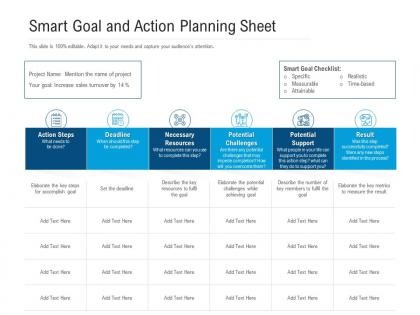
Smart goal and action planning sheet




Try Before you Buy Download Free Sample Product
 Impress Your
 Audience
 100%
100% Editable
 Save Hours
 of Time


Our Smart Goal And Action Planning Sheet are topically designed to provide an attractive backdrop to any subject. Use them to look like a presentation pro.
People who downloaded this PowerPoint presentation also viewed the following :
Smart goal and action planning sheet with all 2 slides:
Use our Smart Goal And Action Planning Sheet to effectively help you save your valuable time. They are readymade to fit into any presentation structure.
FAQs for Smart goal and
SMART goals are basically Specific, Measurable, Achievable, Relevant, and Time-bound. They force you to nail down details instead of setting wishy-washy objectives. Trust me, they're lifesavers in project management - no more "wait, what are we actually doing here?" moments that kill momentum. You'll get clear deliverables, real success metrics, and deadlines people can actually hit. I've watched so many projects crash because nobody agreed on what "finished" meant. Seriously frustrating. Next time you're planning something, just run each goal through SMART. It prevents tons of confusion down the road.
SMART goals are honestly a game changer for team stuff. You know how projects always get messy because nobody's really sure what they're doing? This fixes that. Specific, Measurable, Achievable, Relevant, Time-bound - sounds corporate but it actually works. Everyone knows their piece and when it's due. No more of those weird meetings where you ask about progress and people just stare at you. The measurable part is clutch for tracking things. I'd say try splitting your next big project into maybe 2-3 SMART goals. Your check-ins will be so much less painful.
Honestly, most people mess up by going way too vague or unrealistic. Like jumping from zero workouts to "I'll exercise daily" - yeah right, that's not happening. Don't make goals super rigid either because life gets messy. I learned this the hard way lol. Also tracking progress is huge - without it you'll lose steam by February. Oh, and here's the big one: trying to change everything at once. Pick 1-2 SMART goals max, nail those first, then add more. Trust me on this.
Here's the thing with SMART goals - timing changes everything. Short-term ones need to be super specific with tight deadlines, like "boost email opens 15% in 3 weeks." Long-term goals? Give them room to breathe. I learned this the hard way by making year-long goals way too rigid. Now I do quarterly check-ins and 90-day sprints within bigger annual targets. Honestly, the mini-goals keep me from getting overwhelmed. You can always tweak the approach as you go - that's kind of the whole point.
Oh this actually works really well! Have your team write 3-5 SMART goals at the start of each review period, then check progress quarterly. So instead of saying "get better at communication" (which means nothing tbh), you'd set something concrete like "lead 2 client presentations monthly with 90% satisfaction scores." When review time comes, you're looking at real data vs. targets - way less weird than those vague conversations nobody enjoys. People stay way more motivated because they can actually see their progress. I've seen teams completely turn around once they start tracking specific stuff like this. Makes the whole process feel fair instead of just your manager's random opinion.
SMART goals are game-changers for strategic planning - they turn your big vision into actual steps you can check off. I've watched so many strategies crash because they stayed way too abstract. Your team needs to know exactly what winning looks like and when deadlines hit. Small businesses? You'll finally prioritize your limited resources properly. Big companies use them to get all departments rowing in the same direction (which is harder than it sounds). Next time you set a quarterly goal, just run it through the SMART checklist. Trust me, you'll spot the holes in your planning immediately.
SMART goals work way better than vague stuff like "get better at math." Have your kids set concrete targets - like "I'll nail 15 word problems by Friday" instead of just "improve problem-solving." Make the goals realistic though, because failed goals just crush motivation. Weekly check-ins help you tweak things if needed. Honestly, the magic happens when students actually own their progress - they need those clear wins they can see and celebrate. It's pretty cool watching them get excited about hitting their own milestones.
Honestly, I'd say check in monthly or quarterly - whatever feels right for your schedule. Set a phone reminder though, because I always forget this stuff! When you do review, just ask yourself: does this goal still make sense? Has anything changed with your priorities or timeline? Build in some wiggle room from the beginning too. Like instead of "lose exactly 10 pounds," maybe aim for 8-12 pounds. Goals should be flexible, not these rigid things you beat yourself up over. Actually, you should probably set that reminder right now while you're thinking about it.
Dude, tracking SMART goals becomes so much simpler when you let tech do the heavy lifting. I personally love using Asana or Trello to break everything into bite-sized tasks with actual deadlines. Google Analytics or even basic spreadsheets can automatically grab your metrics - no manual number crunching required. Those progress bars filling up? Weirdly addictive, I won't lie. The reminder notifications keep you honest too, which is clutch when you're prone to forgetting stuff like me. Just pick one tool that connects to whatever you're measuring and set up weekly reports. You'll actually stay on track for once.
Okay so SMART goals are actually game-changers for your headspace. Breaking stuff down into specific chunks gives you those satisfying dopamine hits when you check things off - honestly, I'm lowkey addicted to crossing items off lists. Your brain gets a clear roadmap instead of that awful "wtf do I even start?" spiral. You'll feel way more in control, which does wonders for anxiety. The realistic + time-bound part is clutch too because you won't destroy yourself mentally when things don't go perfectly. Seriously, try making just one SMART goal this week and see how much clearer everything feels.
Honestly, SMART goals can get weird when you're dealing with global teams. Different cultures see time totally differently - like, some treat deadlines as suggestions while others would rather die than miss one. The whole "measurable" thing gets tricky too because high-context cultures often care more about relationships than hitting specific numbers. I watched this blow up once when our US managers kept pushing these super rigid KPIs on our Asian team who valued group harmony way more than individual metrics. You've gotta keep the SMART structure but be flexible about what "achievable" actually means in different places. Oh, and "relevant" hits different depending on local work styles too.
Dude, so many big companies nail this! Google's OKRs are basically SMART goals but way more intense - they'll set stuff like "boost user engagement 15% by Q3." Microsoft completely flipped their culture using this approach when Nadella came in. Buffer's pretty cool about it too, they actually publish their goals online which feels kinda risky but I respect it. The pattern you'll see? They all use real numbers and hard deadlines. Makes everything way less wishy-washy. Oh and definitely peek at Buffer's setup - gives you solid ideas for your own team's goals.
Yeah, totally doable! I used to struggle with this too. Try focusing on skill milestones instead of just churning out work - like "master 3 new digital techniques this month" or track engagement rates if you're posting online. Honestly, quantifying art feels super weird at first. But you can use softer metrics too - peer feedback, client happiness, even just noting improvements in your portfolio quality. The trick is finding what actually motivates you rather than making it feel like homework. Set up something simple to track progress. Don't overthink it.
SMART goals and Agile mesh together better than you'd think. Basically, your SMART goals become the big picture stuff - what you're actually trying to accomplish. Agile handles the how. I like to think of it as having your destination mapped out while staying flexible about the route. Break those bigger goals into sprint-sized pieces your team can chew through. You get clarity without being stuck in concrete. Honestly, most people overthink this combo. Just try mapping your next SMART goal across 2-3 sprints and see what happens. The adaptability piece is clutch when things inevitably shift.
SMART goals are honestly a lifesaver when your relationship feels like chaos. You know how you'll be like "I need to communicate better" but then... nothing actually changes? That's where being specific helps. Try something like "I'll ask my partner about their day every Tuesday and actually listen without checking my phone." The measurable part is key - you can see if you're actually doing it or just telling yourself you are. Oh, and don't go crazy trying to fix everything at once. Pick one tiny thing first. I learned that the hard way lol.
-
Great product with effective design. Helped a lot in our corporate presentations. Easy to edit and stunning visuals.
-
Perfect template with attractive color combination.