


Social networking development ppt powerpoint presentation model guide cpb




Try Before you Buy Download Free Sample Product
 Impress Your
 Audience
 100%
100% Editable
 Save Hours
 of Time


Acquire the ideal balance with our Social Networking Development Ppt Powerpoint Presentation Model Guide Cpb. Give your brilliant ideas the appropriate backdrop.
People who downloaded this PowerPoint presentation also viewed the following :
Content of this Powerpoint Presentation
Description:
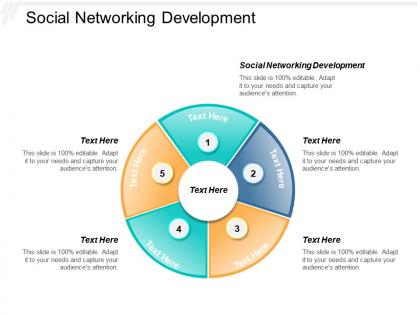
The PowerPoint slide titled "Social Networking Development" features a circular, five-segmented infographic resembling a pie chart, with each segment numbered from 1 to 5. The colors alternate between shades of blue, orange, and green. Each segment has a placeholder for text, indicating that detailed descriptions can be added for each part of the development process. This slide is designed to outline the key steps or phases in the development of a social networking platform or strategy.
Use Cases:
This slide is versatile and can be utilized across various industries to plan, present, or report on projects related to social networking development. Here are seven industries that could use this slide:
1. Technology:
Use: Mapping out stages of social media software development.
Presenter: Product Manager.
Audience: Development team, stakeholders.
2. Marketing and Advertising:
Use: Creating a social media marketing strategy.
Presenter: Social Media Strategist.
Audience: Marketing team, clients.
3. Education:
Use: Educating on social media usage and digital citizenship.
Presenter: Educator or Academic Instructor.
Audience: Students, faculty.
4. Non-Profit:
Use: Developing a campaign for social awareness or fundraising.
Presenter: Communications Officer.
Audience: Non-profit staff, volunteers, donors.
5. Entertainment:
Use: Planning a promotional campaign for a new release or event.
Presenter: Public Relations Manager.
Audience: Marketing team, media partners.
6. Human Resources:
Use: Outlining a strategy for employer branding on social networks.
Presenter: HR Manager.
Audience: HR team, company leadership.
7. Healthcare:
Use: Discussing patient engagement strategies through social media.
Presenter: Healthcare Marketer.
Audience: Hospital staff, marketing team.
Social networking development ppt powerpoint presentation model guide cpb with all 5 slides:
Give your brilliant ideas the appropriate backdrop with our Social Networking Development Ppt Powerpoint Presentation Model Guide Cpb. You will acquire the ideal balance.

FAQs for Social networking development ppt powerpoint presentation
Current trends in social networking development include AI-powered personalization, short-form video content, social commerce integration, augmented reality features, and privacy-focused messaging. These technologies enhance user engagement by delivering targeted experiences, streamlined purchasing workflows, and immersive interactions, with many retail and entertainment businesses finding that strategic social platform integration ultimately drives customer acquisition and revenue growth.
User interface design and user experience directly determine platform adoption, engagement rates, and retention by creating intuitive navigation, seamless content sharing, and personalized interactions. Well-designed interfaces enable faster user onboarding, higher daily engagement, and reduced abandonment rates, with platforms like Instagram and LinkedIn finding that streamlined experiences drive sustained growth and competitive advantage in increasingly crowded social markets.
Algorithms determine content visibility by analyzing user behavior, engagement patterns, relationship strength, content relevance, and posting frequency to prioritize feeds. These systems enable platforms to deliver personalized experiences while maximizing engagement, with many social networks finding that strategic algorithm optimization significantly enhances user retention and advertiser value.
Privacy and security features can be effectively integrated through end-to-end encryption, multi-factor authentication, granular privacy controls, regular security audits, and transparent data handling policies. These measures work together by protecting user communications, preventing unauthorized access, and enabling personalized privacy settings, with many social platforms finding that proactive security integration ultimately builds user trust while ensuring regulatory compliance.
Mobile-friendly social networking development requires responsive design, intuitive navigation, optimized loading speeds, seamless cross-platform functionality, and robust security measures. These practices enhance user engagement by ensuring smooth performance across devices, streamlined content sharing, and reliable connectivity, with many social platforms finding that mobile-first approaches ultimately deliver higher user retention and competitive advantage in an increasingly mobile-driven market.
AI and blockchain revolutionize social networking by enhancing personalized content delivery, automating moderation processes, and enabling decentralized user data control. These technologies streamline user experiences through intelligent recommendation systems, transparent content verification, and secure peer-to-peer interactions, with platforms increasingly finding that strategic integration delivers competitive advantages and builds stronger user trust.
**INPUT**: What are the challenges of moderating content in large-scale social networks, and how can they be addressed? **OUTPUT**: Content moderation challenges include managing massive daily volumes, cultural context variations, evolving harmful content types, and balancing free expression with safety standards. These platforms address issues through AI-powered detection systems, human reviewer teams, and community reporting mechanisms, with companies like Facebook and Twitter finding that strategic combinations of automated screening and cultural expertise ultimately enhance user experiences while maintaining platform integrity. *[Word count: 60]*
Developers should track user engagement metrics including daily active users, session duration, post interactions, content shares, and user retention rates. Through analytics tools, social networking platforms monitor community growth, feature adoption, and user behavior patterns, while measuring response times, load speeds, and mobile responsiveness, ultimately delivering insights that enhance user experiences and competitive positioning.
Social networking preferences vary significantly across global markets, with regions favoring different platforms, communication styles, and privacy expectations based on cultural norms and regulatory frameworks. While Western markets emphasize visual content sharing and professional networking, Asian markets prioritize messaging integrations and mobile-first experiences, with many companies finding that localized approaches deliver better user engagement and market penetration.
**INPUT**: What strategies can be implemented to foster positive online communities within social networks? **OUTPUT**: Effective community-building strategies include clear community guidelines, active moderation, user recognition programs, engaging content initiatives, and transparent communication channels. These approaches enhance user engagement by establishing behavioral expectations, rewarding positive contributions, and facilitating meaningful interactions, with many organizations finding that consistent community management ultimately delivers higher retention rates and stronger brand loyalty. [Word count: 55 words]
Social networking platforms combat misinformation through AI-powered content moderation, fact-checking partnerships, community reporting systems, and algorithmic adjustments that prioritize credible sources. These technologies streamline detection by analyzing patterns, cross-referencing verified databases, and enabling real-time user feedback, with many platforms finding that combining automated systems with human oversight ultimately delivers faster content reviews and enhanced user trust.
Data collection and monetization strategies present both challenges and opportunities for social networks, significantly impacting user trust through transparency concerns, privacy practices, and value exchange perceptions. While extensive data harvesting can erode confidence, platforms implementing clear privacy controls, ethical advertising models, and user benefit-sharing increasingly find that transparent monetization approaches enhance trust, ultimately delivering sustainable revenue growth and stronger user relationships in an increasingly privacy-conscious digital landscape.
Social networking developers ensure accessibility by implementing screen reader compatibility, keyboard navigation support, alt text for images, closed captioning for videos, and adjustable font sizes. These features enable users with visual, auditory, or motor impairments to engage fully with platforms, while compliance with WCAG guidelines ultimately delivers inclusive experiences and broader user engagement across diverse communities.
User-generated content serves as the foundation of social networking platforms, driving engagement through posts, comments, reviews, multimedia sharing, and community discussions that create dynamic, personalized experiences. This content enhances functionality by enabling peer recommendations, real-time conversations, and authentic connections, with platforms like LinkedIn and Facebook finding that user contributions significantly increase retention rates, foster community building, and deliver competitive advantages through organic, scalable content creation.
Collaboration and partnerships significantly enhance social networking platforms through shared resources, technical expertise, expanded user bases, and integrated functionalities. Strategic alliances with content creators, influencers, and complementary tech companies accelerate market penetration while reducing development costs, with many platforms finding that partnerships ultimately deliver faster growth and competitive differentiation.
No Reviews