


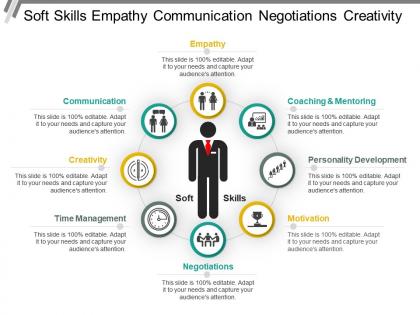
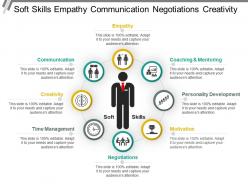
Soft skills empathy communication negotiations creativity




Try Before you Buy Download Free Sample Product
 Impress Your
 Audience
 100%
100% Editable
 Save Hours
 of Time


Be found fit for the job with our Soft Skills Empathy Communication Negotiations Creativity. Instill belief that yo have the credentials.
People who downloaded this PowerPoint presentation also viewed the following :
Soft skills empathy communication negotiations creativity with all 5 slides:
Our Soft Skills Empathy Communication Negotiations Creativity improve intake. Folks are able to absorb more ideas.


FAQs for Soft skills empathy
Essential soft skills for effective presentations include active listening, emotional intelligence, adaptability, storytelling ability, and confidence building. These skills enhance presenter credibility by fostering audience connection, managing presentation anxiety, and adapting messaging in real-time, with many organizations finding that employees with strong soft skills deliver more persuasive, memorable presentations that drive business outcomes.
Emotional intelligence enhances public speaking by enabling speakers to read audience reactions, manage their own nervousness, and adapt their delivery in real-time. Through heightened self-awareness and empathy, speakers can connect more authentically with their audience, adjust their tone and pace accordingly, and deliver more persuasive presentations that resonate emotionally, ultimately building stronger professional relationships and influence.
Active listening enhances interpersonal relationships during team presentations by fostering trust, encouraging open dialogue, and demonstrating respect for diverse perspectives and contributions. Through attentive body language, thoughtful questioning, and acknowledging team members' input, presenters create collaborative environments where colleagues feel valued and heard, ultimately strengthening team cohesion and presentation effectiveness.
Developing adaptability requires cultivating curiosity through continuous learning, embracing feedback for self-improvement, practicing flexibility in problem-solving approaches, and maintaining resilience during transitions. Organizations increasingly find that employees who actively seek new challenges, cross-train in different departments, and view change as opportunity rather than threat ultimately deliver enhanced performance and strategic value in dynamic business environments.
**INPUT**: What techniques can help improve conflict resolution skills during group discussions? **OUTPUT**: Effective conflict resolution techniques include active listening, reframing perspectives, finding common ground, managing emotions, and facilitating structured dialogue. These approaches streamline group dynamics by encouraging empathy, reducing defensiveness, and promoting collaborative problem-solving, with many organizations finding that structured conflict resolution training ultimately enhances team productivity and workplace relationships.
Storytelling engages audiences by creating emotional connections, simplifying complex concepts, making information memorable, and building trust through relatable narratives. Through compelling anecdotes and structured narratives, organizations in sectors like healthcare, education, and corporate training deliver key messages more effectively, while enhancing retention rates and driving behavioral change, ultimately strengthening communication impact and audience engagement.
**INPUT**: What strategies can enhance non-verbal communication in presentations? **OUTPUT**: Effective non-verbal communication strategies include maintaining steady eye contact, using purposeful gestures, adopting confident posture, strategic positioning, and facial expressions that align with content. These techniques enhance audience engagement by building trust, reinforcing key messages, and creating memorable connections, with many presenters finding that coordinated body language significantly improves message retention and professional credibility. [Word count: 54 words]
Building rapport with an audience significantly enhances presentation success by fostering trust, increasing engagement, and improving message retention through emotional connection and active participation. When presenters establish genuine connections, audiences become more receptive to ideas, ask meaningful questions, and retain information longer, with many organizations finding that rapport-building ultimately delivers stronger buy-in, clearer communication outcomes, and more successful project implementations.
Critical thinking enhances team meeting problem-solving by encouraging systematic analysis, questioning assumptions, evaluating evidence objectively, and considering multiple perspectives before reaching conclusions. These cognitive approaches streamline decision-making processes by reducing bias, improving solution quality, and fostering collaborative reasoning, with many organizations finding that structured critical thinking frameworks ultimately deliver faster consensus and more innovative outcomes.
Assess persuasion skills through audience feedback, presentation recordings, and measuring outcome success rates like approvals or buy-ins achieved. Improve by studying audience needs beforehand, crafting compelling narratives with clear benefits, practicing active listening during Q&As, and incorporating storytelling techniques. Many executives find that combining data-driven arguments with emotional appeals ultimately delivers stronger stakeholder engagement and more successful presentation outcomes.
Key components include clear communication protocols, defined role allocation, synchronized timing coordination, shared visual consistency standards, and collective audience engagement strategies. These elements streamline collaborative efforts by establishing unified messaging, leveraging individual strengths, and maintaining professional presentation flow, with many organizations finding that structured teamwork approaches ultimately deliver more compelling presentations and stronger stakeholder buy-in.
Effective feedback for soft skills improvement involves being specific, timely, and constructive, focusing on observable behaviors rather than personality traits, and creating safe spaces for open dialogue. Through regular check-ins, 360-degree assessments, and structured feedback sessions, organizations enable continuous development while fostering trust, ultimately delivering enhanced communication, collaboration, and leadership capabilities across teams.
Cultural differences significantly impact soft skills interpretation, as eye contact, gestures, vocal tone, and personal space vary across cultures, with direct communication valued in Western contexts while indirect approaches are preferred in many Asian cultures. These variations affect audience engagement and credibility perceptions, making cultural awareness essential for presenters working with diverse audiences to ensure their intended message resonates effectively across different cultural frameworks.
Effective time management significantly enhances presentation impact by ensuring balanced content delivery, maintaining audience engagement, and allowing adequate time for key messages and interaction. Well-timed presentations demonstrate professionalism while preventing rushed conclusions or lengthy segments that lose audience attention, with many speakers finding that structured timing ultimately delivers clearer communication and stronger audience connection.
Confidence serves as the foundation for effectively demonstrating soft skills like communication, leadership, and emotional intelligence in professional settings. It enables individuals to engage authentically in workplace interactions, present ideas persuasively, and navigate challenging conversations with composure, while confident professionals often find that their enhanced presence accelerates career advancement and strengthens team dynamics.
-
Great designs, really helpful.
-
Wonderful templates design to use in business meetings.