


Software System Testing Result Reporting




Try Before you Buy Download Free Sample Product
 Impress Your
 Audience
 100%
100% Editable
 Save Hours
 of Time


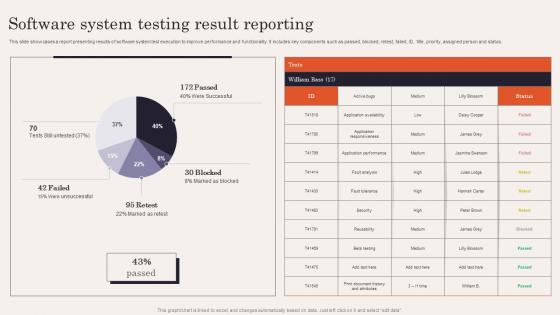
This slide showcases a report presenting results of software system test execution to improve performance and functionality. It includes key components such as passed, blocked, retest, failed, ID, title, priority, assigned person and status.
People who downloaded this PowerPoint presentation also viewed the following :
Software System Testing Result Reporting with all 7 slides:
Use our Software System Testing Result Reporting to effectively help you save your valuable time. They are readymade to fit into any presentation structure.





FAQs for Software System
Key factors include defining clear objectives, identifying target user segments, selecting appropriate testing methodologies, establishing success metrics, and determining timeline and resource allocation. These elements work together by ensuring comprehensive coverage of functionality, usability, and performance requirements, with many organizations finding that early stakeholder alignment and iterative feedback loops ultimately deliver faster market readiness and reduced post-launch issues.
Measuring testing methodology effectiveness involves comparing defect detection rates, development velocity, maintenance costs, code coverage metrics, and time-to-resolution for identified issues. Organizations typically find that unit testing excels at early defect prevention and faster debugging cycles, while integration testing delivers superior system-wide validation and user experience assurance, ultimately enabling strategic resource allocation across comprehensive testing strategies.
Automated testing accelerates development cycles by enabling continuous integration, reducing manual testing overhead, and catching bugs earlier in the development process. Through automated test suites, development teams streamline code validation, enhance deployment frequency, and maintain higher code quality standards, while minimizing release risks and ultimately delivering more reliable software products faster.
User feedback integration enhances testing through surveys, beta programs, usability sessions, A/B testing, and continuous monitoring systems. These approaches streamline product development by identifying real-world pain points, validating feature effectiveness, and prioritizing improvements based on actual user behavior, with many organizations finding that direct feedback loops ultimately deliver faster iterations and significantly improved customer satisfaction rates.
Common testing challenges include inadequate test coverage, time constraints, unclear requirements, resource limitations, and environment inconsistencies. These obstacles can be mitigated through strategic test planning, automated testing frameworks, clear requirement documentation, and dedicated testing environments, with many organizations finding that early stakeholder involvement and continuous integration ultimately streamline processes while delivering higher-quality outcomes.
Internationalization and localization testing differ from standard practices by evaluating language support, cultural adaptations, date formats, currency displays, and regional compliance requirements. While standard testing focuses on functionality and performance, these specialized approaches examine how applications perform across diverse markets, with many global organizations finding that comprehensive cultural testing streamlines international expansion and enhances user experiences worldwide.
Teams should ensure thorough test coverage by implementing risk-based testing, creating comprehensive test matrices, establishing clear traceability between requirements and tests, and incorporating both positive and negative scenarios. These practices enable organizations to systematically validate functionality while minimizing gaps, with many development teams finding that structured coverage analysis ultimately delivers higher software quality and reduced post-release defects.
Performance testing effectively simulates real user experiences by incorporating realistic user scenarios, varying network conditions, geographic distribution patterns, and actual data volumes that mirror production environments. Through load testing tools and user journey mapping, organizations can replicate peak traffic conditions, mobile device constraints, and concurrent user behaviors, ultimately identifying bottlenecks while ensuring applications deliver seamless experiences under real-world conditions.
Exploratory testing complements scripted testing by uncovering unexpected defects, validating user experience scenarios, and providing creative problem-solving approaches that automated scripts cannot anticipate. This strategic combination enables development teams to achieve comprehensive coverage, faster feedback cycles, and enhanced product quality, with many software organizations finding that exploratory methods reveal critical usability issues while scripted testing ensures consistent functionality verification.
Early testing in agile environments significantly reduces project timelines and budgets by identifying defects during development cycles, minimizing expensive late-stage fixes, and enabling faster iteration cycles. Through continuous integration and automated testing frameworks, development teams streamline quality assurance processes, reduce deployment risks, and deliver more reliable products, with many organizations finding that early testing ultimately cuts overall project costs by 40-60%.
Teams can ensure security testing integration by incorporating automated security scans into CI/CD pipelines, conducting regular code reviews with security focus, implementing threat modeling during planning phases, and establishing security checkpoints at each development stage. Through DevSecOps practices, organizations streamline vulnerability detection, reduce remediation costs, and maintain continuous security validation, with many development teams finding that early integration ultimately delivers faster releases and enhanced application resilience.
Well-documented testing frameworks deliver reduced maintenance costs, faster onboarding of new team members, consistent quality standards, improved debugging efficiency, and enhanced regulatory compliance. These frameworks enable organizations to scale their testing operations seamlessly while minimizing technical debt, with many software companies finding that comprehensive documentation ultimately accelerates development cycles and strengthens competitive positioning.
Testing for accessibility can be incorporated through automated scanning tools, manual keyboard navigation checks, screen reader testing, color contrast validation, and compliance audits integrated at each development phase. By embedding these practices into continuous integration pipelines, teams streamline accessibility verification while ensuring WCAG compliance, ultimately delivering inclusive digital experiences that reach broader audiences and reduce legal risks.
Continuous testing enhances product quality assurance by identifying defects early, reducing bug-fixing costs, accelerating release cycles, and ensuring consistent performance across development stages. Through automated testing pipelines, organizations streamline validation processes, minimize production issues, and deliver more reliable software, with many development teams finding that continuous feedback loops ultimately enable faster time-to-market and enhanced customer satisfaction.
Testers should develop automation skills, API testing capabilities, security testing knowledge, performance analysis expertise, and cloud platform familiarity to remain competitive. These competencies enable professionals to streamline testing processes, enhance software quality, and deliver faster deployment cycles, with many organizations finding that versatile testers who combine technical proficiency with analytical thinking ultimately provide greater strategic value in increasingly complex development environments.
-
The templates are the best in class. Very clear and innovative graphics! I am excited to explore and download more presentations.
-
“Love it! I was able to grab an exciting proposal because of SlideTeam.”