


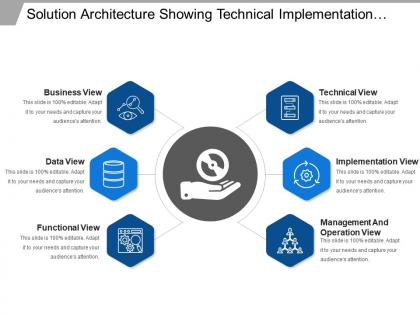
Solution architecture showing technical implementation management operational view




Try Before you Buy Download Free Sample Product
 Impress Your
 Audience
 100%
100% Editable
 Save Hours
 of Time


Make your goods appear extremely attractive with our Solution Architecture Showing Technical Implementation Management Operational View. Convince folks to actually buy.
People who downloaded this PowerPoint presentation also viewed the following :
Solution architecture showing technical implementation management operational view with all 5 slides:
Our Solution Architecture Showing Technical Implementation Management Operational View leave your brain free to think. They absorb every other burden.


FAQs for Solution architecture showing technical implementation
Key components of a robust solution architecture include enterprise service bus, data management layers, security frameworks, integration middleware, and scalability infrastructure. These components work together by ensuring seamless data flow, maintaining security protocols, and enabling system interoperability, with many organizations finding that strategic architecture planning ultimately delivers enhanced operational efficiency and competitive advantage.
Determining appropriate architectural style involves analyzing project requirements, scalability needs, team expertise, performance constraints, and integration complexity. These factors guide selection between microservices, monolithic, event-driven, or layered approaches, with many organizations finding that matching architectural patterns to specific business objectives, regulatory requirements, and operational capabilities ultimately delivers better maintainability and competitive advantage.
Stakeholder analysis identifies key individuals, groups, and organizations affected by solution architecture decisions, including business users, technical teams, executives, and external partners. This analysis enables architects to understand diverse requirements, manage competing priorities, and ensure solutions deliver value across different organizational levels, ultimately reducing implementation resistance while enhancing user adoption and business alignment.
Optimizing solution architecture for scalability and performance involves implementing microservices, load balancing, caching strategies, database optimization, and cloud-native designs that adapt to demand fluctuations. These approaches enable organizations to handle increased user loads, reduce response times, and maintain system reliability while minimizing infrastructure costs, ultimately delivering enhanced customer experiences and competitive advantage.
Effective solution architecture visualization tools include Lucidchart, Visio, Draw.io, Enterprise Architect, and ArchiMate frameworks, along with cloud-native tools like AWS Architecture Center and Azure diagrams. These platforms streamline complex system documentation by enabling collaborative design, standardized notation, and real-time updates, with many organizations finding that visual clarity accelerates stakeholder alignment and implementation timelines.
Integration challenges in solution architecture require systematic assessment of data flows, API compatibility, security protocols, and system interdependencies across existing infrastructure. Successful architects typically employ phased integration strategies, standardized middleware platforms, and comprehensive testing frameworks, with many organizations finding that this approach minimizes disruption while delivering seamless connectivity and operational efficiency.
Best practices for documenting solution architecture include creating clear architectural diagrams, maintaining comprehensive component specifications, establishing decision rationale records, documenting integration patterns, and ensuring stakeholder-accessible formats. These practices streamline development processes by enhancing team collaboration, accelerating onboarding timelines, and reducing maintenance overhead, with many organizations finding that structured documentation ultimately delivers faster project delivery and improved system reliability.
Solution architecture contributes to cost management by establishing clear technical frameworks, identifying reusable components, and preventing scope creep through detailed planning. These structured approaches streamline development processes, minimize redundant work, and optimize resource allocation, with many organizations finding that strategic architecture decisions ultimately deliver significant budget savings and improved project predictability.
Security considerations in solution architecture include data encryption, access controls, authentication mechanisms, network security protocols, and compliance frameworks. These measures enhance organizational resilience by protecting sensitive information, preventing unauthorized access, and ensuring regulatory compliance, with many enterprises finding that comprehensive security integration ultimately delivers reduced risk exposure and sustained competitive advantage.
Cloud computing transforms solution architecture design by enabling scalable, flexible, and distributed systems through microservices, containerization, serverless functions, and API-driven architectures. These cloud-native approaches streamline deployment, enhance resource optimization, and deliver cost-effective scalability, with many organizations finding that hybrid and multi-cloud strategies ultimately provide greater resilience and competitive advantage.
**INPUT**: What metrics can be used to evaluate the effectiveness of a solution architecture? **OUTPUT**: Solution architecture effectiveness metrics include performance benchmarks, scalability measurements, cost efficiency ratios, system reliability scores, and user satisfaction indices. These evaluation frameworks streamline assessment by tracking response times, resource utilization, and integration success rates, with many organizations finding that comprehensive metric analysis ultimately delivers enhanced operational visibility and strategic optimization opportunities. **Word count: 54 words**
Ensuring regulatory compliance in solution architecture involves implementing robust governance frameworks, automated compliance monitoring, comprehensive audit trails, and regular security assessments across all system components. Through strategic design patterns, organizations in healthcare, finance, and manufacturing can seamlessly integrate regulatory requirements while maintaining operational efficiency, ultimately delivering both compliance assurance and competitive advantage.
Prototyping in solution architecture enables teams to validate design concepts, identify technical constraints, and reduce implementation risks before full-scale development. Through rapid prototyping, organizations can test integration points, evaluate performance bottlenecks, and gather stakeholder feedback early, ultimately streamlining development cycles and ensuring architectural decisions align with business requirements.
Agile methodologies influence solution architecture by promoting iterative design, continuous stakeholder feedback, and adaptive planning throughout development cycles. Through sprint-based architecture reviews, cross-functional collaboration, and incremental delivery approaches, organizations streamline architectural decisions, reduce development risks, and enhance system flexibility, ultimately delivering more responsive solutions that align closely with evolving business requirements.
Emerging trends shaping solution architecture include cloud-native architectures, microservices, artificial intelligence integration, edge computing, and containerization technologies. These approaches streamline scalability, enhance system resilience, and enable faster deployment cycles, with organizations across financial services, healthcare, and retail finding that strategic adoption delivers competitive advantage and operational efficiency.
-
Nice and innovative design.
-
Graphics are very appealing to eyes.