

Spotify Company Profile Powerpoint Presentation Slides CP CD




Try Before you Buy Download Free Sample Product
 Impress Your
 Audience
 100%
100% Editable
 Save Hours
 of Time


Spotify is a Swedish based music streaming and media services provider founded in April 2006 by Daniel Ek and Martin Lorentzon. It revolutionized the way people listen to music by offering on demand access to a vast library of songs from various genres and artists. This Spotify company profile provides executive summary details, including legal name, headquarters, year of foundation, founders, stock symbol, and product service offerings. It then outlines business operations details mission and core values, facts and statistics, unique selling points, business model, global presence, history, awards and achievements, employee count, and workforce diversity. After this, it showcases the competitive landscape of the company. It also includes yearly comparisons of monthly active customers, trips, and gross bookings. Further, it showcases an overview of the financial position through revenue, operating income, net income, balance sheet, and cashflows. Lastly, it showcases business combinations, SWOT analysis, organizational structure, future strategy and goals, future expansion plans, SWOT analysis, sustainability initiatives, and case studies.
People who downloaded this PowerPoint presentation also viewed the following :
Content of this Powerpoint Presentation
Slide 1: This slide introduces the Spotify Company Profile. State Your Company Name and begin.
Slide 2: This slide exhibit table of content.
Slide 3: The slide showcases the executive summary to provide brief insights of Spotify company.
Slide 4: This slide showcases overview of Spotify company that offers high quality music streaming services to customers.
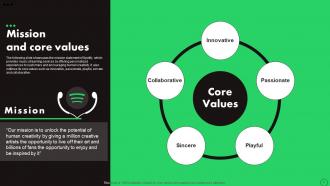
Slide 5: This slide showcases the mission statement of Spotify, which provides music streaming services by offering personalized experiences to customers.
Slide 6: This slide highlights various stats about Spotify company.
Slide 7: This slide highlights various features of product/services of Spotify company for music streaming.
Slide 8: The slide showcases Spotify company unique selling points that differentiate the business from its competitors and establish the brand as a global leader.
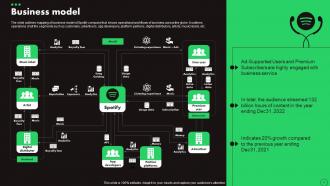
Slide 9: The slide outlines mapping of business model of Spotify company that shows operational workflows of business across the globe.
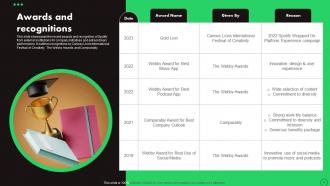
Slide 10: This slide showcases the recent awards and recognition of Spotify from external institutions for company initiatives and extraordinary performance.
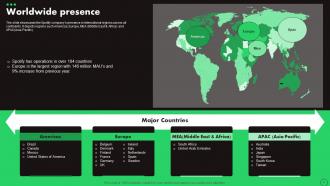
Slide 11: The slide showcases the Spotify company’s presence in international regions across all continents.
Slide 12: This slide highlights the Spotify company journey from 2006 to the present, which showcases information on the foundation of business, expansion, partnerships.
Slide 13: The slide showcases various customer segments of Spotify company that outlines key personnel to which business offers its products and services.
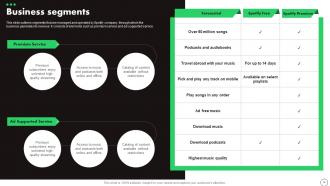
Slide 14: This slide outlines segments that are managed and operated by Spotify company, through which the business generates its revenue.
Slide 15: This slide provides an overview of the premium services that Spotify offers to generate revenue for business.
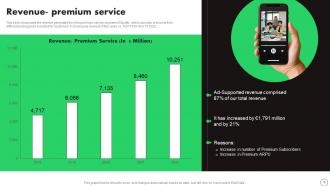
Slide 16: This slide showcases the revenue generated from the premium service segment of Spotify, which consists of income from different pricing plans provided for customers.
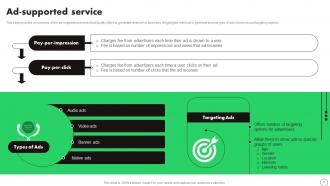
Slide 17: This slide provides an overview of the ad-supported services that Spotify offers to generate revenue for business.
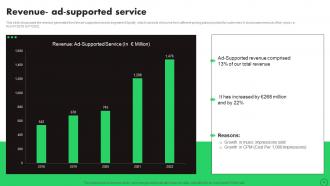
Slide 18: This slide showcases the revenue generated from the ad-supported service segment of Spotify, which consists of income from different pricing plans.
Slide 19: This slide outlines the number of employees of Spotify Company for five consecutive financial years i.e. from FY2018 to FY2022.
Slide 20: The following slide outlines the number of employees of Spotify Company for five consecutive financial years i.e. from FY2018 to FY2022.
Slide 21: The following slide outlines organizational structure of Spotify company that showcases its principal subsidiaries.
Slide 22: This slide consists of executive team members at Spotify company responsible for providing strategic and operational leadership to the business.
Slide 23: This slide outlines competitor businesses that operate in similar markets and serves similar customer base as Spotify does.
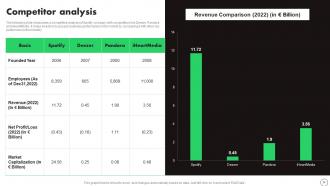
Slide 24: This slide showcases a competitive analysis of Spotify company with competitors like Deezer, Pandora and iHeartMedia.
Slide 25: This slide showcases a competitive analysis of Spotify company with competitors like Deezer, Pandora and iHeartMedia.
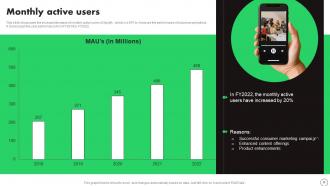
Slide 26: This slide showcases the increase/decrease of monthly active users of Spotify, which is a KPI to measure the performance of business operations.
Slide 27: This slide showcases the increase/decrease of premium subscribers of Spotify, which is a KPI to measure the performance of business operations.
Slide 28: This slide showcases the increase/decrease of ad-supported monthly active users of Spotify, which is a KPI to measure the performance of business operations.
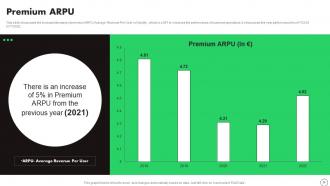
Slide 29: This slide showcases the increase/decrease of premium ARPU (Average Revenue Per User) of Spotify, which is a KPI to measure the performance of business operations.
Slide 30: The slide showcases the total revenue gained by Spotify company for five consecutive years, i.e. from FY2018 to FY2022.
Slide 31: This slide showcases Spotify company’s gross profit and margin for five consecutive financial years i.e. from FY2018 to FY2022.
Slide 32: The slide showcases operating profit/loss of Spotify company for five consecutive years i.e. from FY2018 to FY2022.
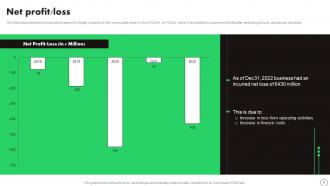
Slide 33: The slide showcases the net income/loss earned by Spotify company for five consecutive years i.e. from FY2018 to FY2022.
Slide 34: This slide shows position of total current and non-current assets for five consecutive financial years i.e. from 2018 to 2022 of Spotify company.
Slide 35: This slide shows position of capital structure for five consecutive financial years i.e. from 2018 to 2022 of Spotify company.
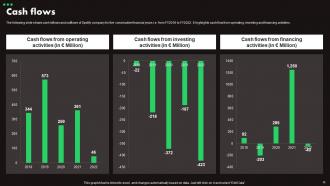
Slide 36: The following slide shows cash inflows and outflows of Spotify company for five consecutive financial years i.e. from FY2018 to FY2022.
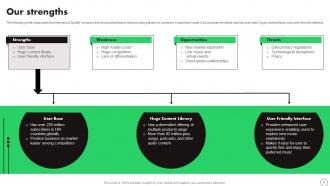
Slide 37: The following slide showcases the strengths of Spotify company that showcases factors that are strong factors of company’s business model.
Slide 38: The following slide showcases the weakness of Spotify company and showcases internal factors that are limitations of company’s business model.
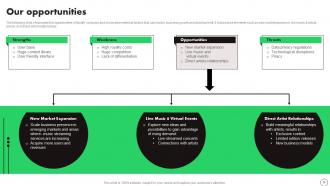
Slide 39: The following slide showcases the opportunities of Spotify company and showcases external factors that can lead to business growth and development.
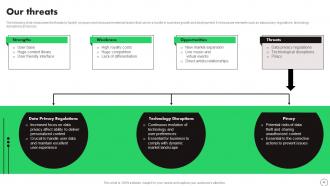
Slide 40: This slide showcases the threats to Spotify company and showcases external factors that can be a hurdle in business growth and development.
Slide 41: The following slide showcases various acquisitions made by Spotify company to enhance its capabilities in audio and podcast discovery.
Slide 42: This slide highlights various objectives of Spotify company to be achieved in upcoming years and strategies to attain goals.
Slide 43: The slide outlines climate data of Spotify company showing the performance comparison FY2022 from FY2021.
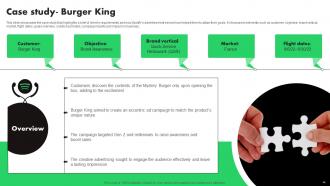
Slide 44: This slide showcases the case study that highlights a brief of client’s requirements and how Spotify’s advertisement service has helped them to attain their goals.
Slide 45: This slide showcases the case study that highlights a brief of client’s requirements and how Spotify’s advertisement service has helped them to attain their goals.
Slide 46: This slide showcases the case study that highlights a brief of client’s requirements and how Spotify’s advertisement service has helped them to attain their goals.
Slide 47: The following slide highlights the various platforms to follow and contact Spotify company.
Slide 48: This slide shows all the icons included in the presentation.
Slide 49: This slide is titled as Additional Slides for moving forward.
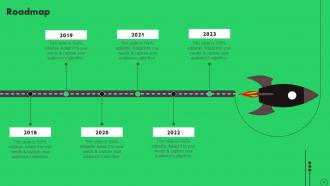
Slide 50: This slide presents Roadmap with additional textboxes.
Slide 51: This slide shows Post It Notes. Post your important notes here.
Slide 52: This slide depicts Venn diagram with text boxes.
Slide 53: This is a Financial slide. Show your finance related stuff here.
Slide 54: This is Our Target slide. State your targets here.
Slide 55: This is a Thank You slide with address, contact numbers and email address.
Spotify Company Profile Powerpoint Presentation Slides CP CD with all 63 slides:
Use our Spotify Company Profile Powerpoint Presentation Slides CP CD to effectively help you save your valuable time. They are readymade to fit into any presentation structure.
































FAQs for Spotify Company Profile Powerpoint Presentation
Spotify's been around since 2006 but really took off when they hit the US in 2011. That was massive for them. They went public in 2018 through this direct listing thing (kinda unusual). But honestly, the biggest shift has been their move into podcasts - they bought Gimlet and Anchor, then dropped crazy money on Joe Rogan's show. Hit 100 million subscribers in 2019, now they're at 500+ million total users. The whole strategy now is becoming an audio platform, not just music streaming. That's where all their money's going these days.
So basically Spotify nailed the freemium thing - you can listen to their entire catalog for free with ads, while Apple Music barely tries with that approach. Pretty smart actually, since they hook way more users upfront instead of demanding payment right away. Then they convert the hooked ones to premium later. Their playlist algorithms are honestly just better too - like Discover Weekly actually finds stuff I want to hear, which is wild. Oh and their whole strategy seems focused on growing users first, making money second. That's probably why they're everywhere now.
Spotify's whole thing is analyzing your listening habits to predict what you'll vibe with next. They track skips, replays, playlist adds - even what time you listen to different genres. Pretty creepy when you think about it lol. All that data feeds their machine learning for Discover Weekly and those personalized playlists. What's really smart is they analyze the actual audio features of songs too, not just user behavior. Combining collaborative filtering with content-based approaches is genius if you're building recommendation systems. Honestly wish more apps were this good at knowing what I want.
Spotify's partnership game is honestly pretty smart. They bundle premium subs with Verizon and T-Mobile, which gets them into people's phone bills automatically. Device integrations with Tesla and Samsung make the app feel native everywhere. The Joe Rogan deal was huge for podcasts, plus they do co-marketing with big brands. Record labels give them exclusive drops too. What's clever is they're basically borrowing other companies' customer bases instead of paying crazy acquisition costs. If you're planning any expansion stuff, bundling deals are gold - both sides win and it feels natural to users.
Dude, Spotify's freemium thing is genius for getting users. No upfront cost means people will actually try it, you know? The ads are annoying as hell but that's literally the strategy - make it just irritating enough that you'll pay to make them stop. They convert like 25-30% of free users to premium, which is pretty decent when you've got 500+ million people using it. Once someone spends time making playlists and gets used to everything, they're hooked. If you're thinking about doing freemium, make the free version addictive but frustrating enough that upgrading feels worth it.
So Spotify basically uses three tricks for Discover Weekly. First, it finds people who listen to similar stuff as you. Then it scrapes what people are saying about songs online - like reviews and social media posts. The third thing is analyzing the actual audio to understand tempo, mood, all that technical music stuff. Honestly it's kind of creepy how good it gets at reading your vibe. Your skips and saves train it constantly, so if you keep interacting with the recommendations it'll dial in on exactly what you want. Though sometimes I swear it just throws random indie bands at me.
So Spotify's pretty smart about this - they give artists that dashboard where you can see all your streaming data and who's listening. The playlist thing is huge too, like getting on Discover Weekly or Release Radar. Oh and those Wrapped campaigns? Pure genius, everyone shares them like crazy. Artists can also pitch songs directly for playlists now, which is cool. There's fan insights, funding programs, all sorts of stuff. Honestly if you're helping musicians out, just send them straight to Spotify for Artists - that's where everything lives.
So Spotify basically saw everyone stuck at home during COVID and thought "okay, music's not enough anymore." People weren't driving to work, so they went all-in on podcasts and audiobooks instead. Makes sense when you think about it - podcast deals are way cheaper than music licensing too. They added more social stuff since we were all lonely, plus those work-from-home playlists (which honestly saved my sanity). The whole thing was really about becoming THE audio app, not just music. Pretty genius timing if you ask me.
So Spotify makes money two ways - subscriptions and ads from the free users. Subscriptions are like 90% of their revenue now, which is wild considering they started way more ad-heavy. Way better for them since subscription money's predictable. They're dabbling in podcasts and audiobooks too, plus some random merch stuff through artist pages, but honestly those barely move the needle. Oh and if you're digging into their numbers, watch subscriber growth and how much each user spends on average. Those two metrics basically tell the whole story about where they're going.
Ugh, Spotify's licensing situation is such a mess. They basically have to cut deals with record labels, music publishers, AND performing rights orgs in every single country. The worst part? You need separate licenses for the actual recordings AND for playing them - like, why make it that complicated? Different regions have totally different laws too, which is probably why that one song you love just vanishes from your playlist sometimes. They literally couldn't get the rights sorted. If you're doing anything with music licensing, definitely check what's available where before you promise people anything.
Dude, Spotify's basically trying to become the everything app for audio. They bought Gimlet and Anchor, threw crazy money at Joe Rogan and Michelle Obama for exclusives. Smart move tbh - podcast listeners are way more engaged than music streamers. Now they're doing audiobooks too, plus some video stuff to compete with Clubhouse (remember when that was a thing?). The bundling strategy is genius though. Instead of people jumping between apps, they're building this sticky ecosystem where you can't really leave. Worth studying if you're working on content strategy.
So Spotify basically nails this by thinking locally instead of just pushing their US playlists everywhere. Their "Today's Top Hits" in Brazil? Completely different from ours, and for good reason. They've got regional teams who actually understand what people want to hear in each market. Plus they work directly with local artists and labels to promote talent that'd never make it onto global charts otherwise. It's honestly pretty smart - they respect that music taste varies wildly by culture rather than assuming everyone wants the same stuff. If you're expanding anything internationally, that's the move right there.
Honestly, their recommendation stuff is insane - Discover Weekly and those Daily Mixes somehow know exactly what I want to hear. They analyze your listening habits against millions of other users to predict your next obsession. The social features are pretty cool too, like Blend playlists, though sometimes I turn off friend activity because nobody needs to see me playing Taylor Swift at 2am lol. Voice search works great now. Oh and they've gotten really good at mixing podcasts with music seamlessly. Check out your Spotify Wrapped sometime - it's wild how they turn all that data into something actually fun to look at.
Oh man, Spotify's basically tracking everything you do on there. Skip rates, how many times you replay songs, how long you actually listen before bouncing. They're watching when you pause stuff, what device you're on, even what time of day you're most active. It's honestly kind of creepy when you think about it? But yeah, all that data gets fed into their algorithms to build these super detailed profiles of your music taste. That's how they nail your Discover Weekly recommendations and put together those scary-accurate Wrapped summaries at the end of the year.
Yeah so Spotify's main problem is getting crushed by Apple Music and Amazon - they're all throwing cash at exclusive stuff and cutting prices. Royalty payments are still brutal too, eating up their profits. But honestly? Their discovery algorithms are way better than everyone else's. They're going hard on podcasts and audiobooks now, which is smart. Plus tons of growth potential in emerging markets still. Oh and if you're thinking about their stock - I'd watch how well this whole diversification thing works out for them beyond just music.
-
I’ve been your client for a few years now. Couldn’t be more than happy after using your templates. Thank you!
-
“I always have a wonderful experience with SlideTeam. It's my ""go to"" when I need a template.”