


Cisco Company Profile Powerpoint Presentation Slides CP CD





Try Before you Buy Download Free Sample Product
 Impress Your
 Audience
 100%
100% Editable
 Save Hours
 of Time


Cisco Systems, Inc., headquartered in San Jose, California, is a multinational American technology conglomerate established in 1984. Since its inception, the company has emerged as a prominent player in networking hardware, software, telecommunications equipment, and various high tech services and products. Check out our professionally designed Cisco Company Profile PowerPoint Presentation. This corporate overview delves into an executive summary containing key details such as the legal name, headquarters location, founding year, founders, stock symbol, and the range of products and services. The PPT bundle provides insights into the companys operations, covering mission and core values, facts and statistics, unique selling points, business model, global presence, historical background, awards and achievements, employee count, and workforce diversity. Additionally, it examines the competitive landscape, incorporating an annual comparison of monthly active customers, trips, and gross bookings. Furthermore, the Network PPT templates present an overview of Ciscos financial position, presenting key metrics such as revenue, balance sheet details, cash flows, etc. It also touches upon business combinations, conducts a SWOT analysis, delves into the organizational structure, and outlines future strategies, goals, expansion plans, and corporate social responsibility CSR initiatives. Download this 100 percentage editable and customizable PowerPoint, compatible with Google Slides, to streamline your presentation process.
People who downloaded this PowerPoint presentation also viewed the following :
Content of this Powerpoint Presentation
Slide 1: This slide introduces Cisco Company Profile. State your company name and begin.
Slide 2: This slide shows Table of Content for the presentation.
Slide 3: This slide continues showing Table of Content for the presentation.
Slide 4: This slide showcases the executive summary to provide brief insights of Cisco Systems, including company outline, CEO, international areas, business competitors etc.
Slide 5: This slide shows the company introduction of Cisco Systems which includes the company name, CEO, founders, founded year etc.
Slide 6: This slide showcases the guiding principles of Cisco Systems, which consists of a global mission statement and commitment of business to provide enhanced customer experience.
Slide 7: This slide displays various statistics outlining an overview of Cisco company to gain an understanding of business performance. It consists of revenue, operating cash flow etc.
Slide 8: This slide showcases categories of products, services and solutions that are offered by Cisco Systems to its customers.
Slide 9: This slide displays Cisco Systems USP which differentiates the business from its competitors and establishes the brand as a global leader in its industry.
Slide 10: This slide focuses on the business model of Cisco Systems which covers elements like key partners, key activities, value proposition, customer relationships etc.
Slide 11: This slide showcases various awards and achievements achieved by Cisco Systems for developing great workplace culture and promoting diversity & inclusion in the company.
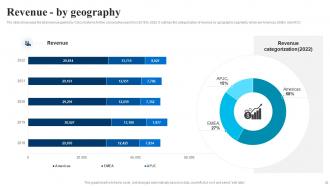
Slide 12: This slide presents the Cisco System’s presence in international regions across all continents. It depicts regions such as the Americas, EMEA (Europe, Middle East and Africa) etc.
Slide 13: This slide outlines executive members of the leadership team of cisco systems, which consists of chair & chief executive officer, EVP & chief legal officer etc.
Slide 14: This slide showcases Cisco Systems organizational structure, which consists of key personnel of various divisions such as chairman & CEO, EVP & CFO etc.
Slide 15: This slide showcases the ownership pattern of Cisco Systems which consists of types of investors i.e. institutional, retailers and business insiders.
Slide 16: This slide outlines number of employees of Cisco Systems for five consecutive financial years i.e. 2018 to 2022.
Slide 17: This slide outlines key facts of diversity, equity and inclusion at the Cisco Systems workplace. It outlines elements such as gender diversity, sexual orientation diversity etc.
Slide 18: This slide showcases competitive analysis of Cisco Systems with competitors like Huawei, Juniper Networks and Arista Networks.
Slide 19: This slide also showcases competitive analysis of Cisco Systems with competitors like Huawei, Juniper Networks and Arista Networks.
Slide 20: The slide presents the total revenue gained by Cisco Systems for five consecutive years from 2018 to 2022.
Slide 21: The slide also presents the total revenue gained by Cisco Systems for five consecutive years from 2018 to 2022.
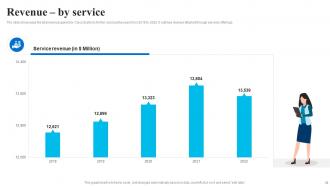
Slide 22: The slide showcases the total revenue gained by Cisco Systems for five consecutive years from 2018 to 2022. It outlines revenue attained through services offerings.
Slide 23: The slide displays the total revenue gained by Cisco Systems for five consecutive years from 2018 to 2022.
Slide 24: The slide showcases the total cost of goods sold by Cisco Systems for five consecutive years from 2018 to 2022.
Slide 25: This slide shows gross profit of Siemens company for five consecutive financial years i.e. from 2018 to 2022.
Slide 26: The slide displays the operating profit of Cisco Systems for five consecutive years from 2018 to 2022, recognized as income derived from business core operational activities.
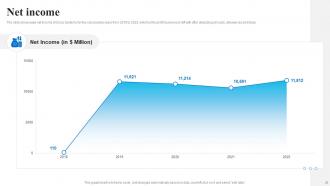
Slide 27: The slide showcases net income of Cisco Systems for five consecutive years from 2018 to 2022, which is the profit business is left with after deducting all costs.
Slide 28: This slide outlines the earnings per share of Cisco Systems, which assists investors in determining whether investing in business will yield maximized profits or not.
Slide 29: This slide shows position of total current and non-current assets for five consecutive financial years i.e. from 2018 to 2022 of Cisco Systems.
Slide 30: This slide displays position of capital structure for five consecutive financial years i.e. from 2018 to 2022 of Cisco Systems.
Slide 31: This slide presents cash inflows and outflows of Cisco Systems for five consecutive financial years i.e. from 2018 to 2022.
Slide 32: This slide showcases the strengths of Cisco Systems that showcases factors that are strong factors of company’s business model.
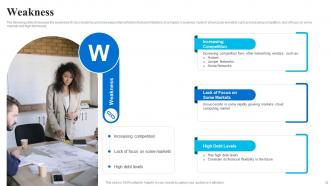
Slide 33: This slide displays the weakness of Cisco Systems and showcases internal factors that are limitations of company’s business model.
Slide 34: This slide showcases the opportunities of Cisco Systems and showcases external factors that can lead to business growth and development.
Slide 35: This slide displays the threats to Cisco Systems and showcases external factors that can be a hurdle in business growth and development.
Slide 36: This slide showcases key highlights of sustainability initiatives taken by Cisco Systems to promote diversity and inclusion.
Slide 37: This slide presents key highlights of sustainability initiatives taken by Cisco Systems to create a positive impact on the global community.
Slide 38: This slide showcases key highlights of sustainability initiatives taken by Cisco Systems to reduce its environmental impact by optimizing business operations.
Slide 39: This slide displays ratings and rankings received by Cisco Systems from external raters and rankers for initiatives taken by company for ESG compliance.
Slide 40: The slide highlights the impact of initiatives taken by Cisco Systems on environment to reduce its impact on natural resources.
Slide 41: This slide outlines various future objectives of Cisco Systems to reduce its impact on the environment by optimizing its operational activities.
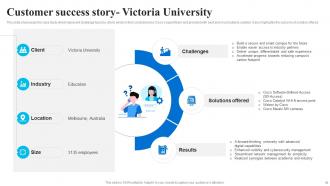
Slide 42: This slide showcases the case study which represent challenge faced by client, which is then considered by Cisco’s expert team.
Slide 43: This slide displays the case study which represent challenge faced by client, which is then considered by Cisco’s expert team.
Slide 44: This slide highlights the various platforms to follow and contact Cisco Systems. It includes links for social media profile pages on Instagram, Twitter etc.
Slide 45: This slide shows all the icons included in the presentation.
Slide 46: This slide is titled as Additional Slides for moving forward.
Slide 47: This is Our Vision, Mission & Goal slide. Post your Visions, Missions, and Goals here.
Slide 48: This slide depicts Venn diagram with text boxes.
Slide 49: This is an Idea Generation slide to state a new idea or highlight information, specifications etc.
Slide 50: This is a financial slide. Show your finance related stuff here.
Slide 51: This slide shows Post It Notes for reminders and deadlines. Post your important notes here.
Slide 52: This is a Thank You slide with address, contact numbers and email address.
Cisco Company Profile Powerpoint Presentation Slides CP CD with all 60 slides:
Use our Cisco Company Profile Powerpoint Presentation Slides CP CD to effectively help you save your valuable time. They are readymade to fit into any presentation structure.
-

Cisco Company Profile
-
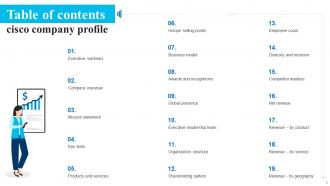
Table of contents cisco company profile
-

Table of contents cisco company profile contd
-

Executive summary
-

Company overview
-

Mission statement
-

Key stats
-

Products and services
-
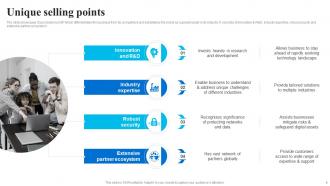
Unique selling points
-
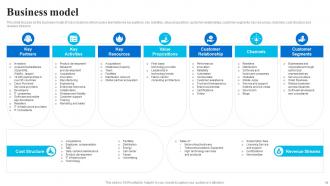
Business model
-
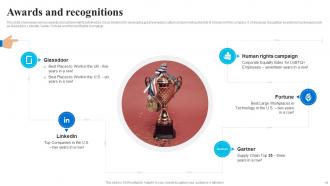
Awards and recognitions
-
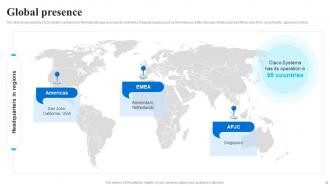
Global presence
-
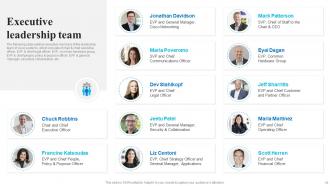
Executive leadership team
-

Organization structure
-

Shareholding structure
-

Employee count
-

Diversity and inclusion
-
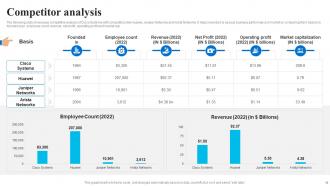
Competitor analysis
-

Competitor analysis contd
-

Net revenue
-
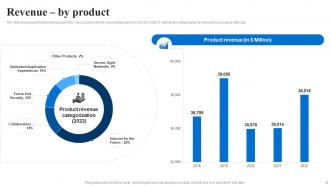
Revenue by product
-
Revenue by service
-
Revenue by geography
-

Cost of sales
-

Gross profit
-

Operating income
-
Net income
-

Income per share
-

Total assets
-

Equity and liabilities
-

Cash flows
-

Strengths
-
Weakness
-

Opportunities
-

Threats
-

Sustainability highlights people
-
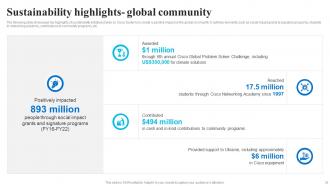
Sustainability highlights global community
-

Sustainability highlights environment
-
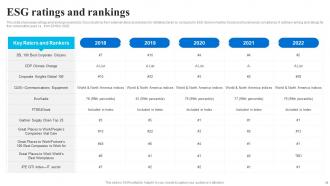
ESG ratings and rankings
-
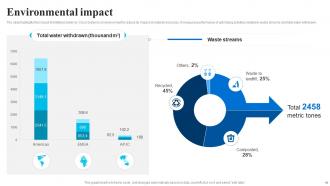
Environmental impact
-

Future sustainability goals
-
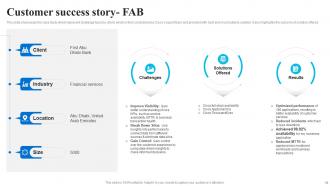
Customer success story FAB
-
Customer success story Victoria University
-

Contact us
-

Icons slide Cisco company profile
-

Additional slides
-
Our vision mission goal
-
Venn diagram
-

Idea generation
-

Financial
-
Post it notes
-
Thanks for watching
-

-

-

-

-

-

-

-

FAQs for Cisco Company Profile Powerpoint Presentation
Honestly, Cisco's worth it if you can swing the budget. Their stuff just doesn't break - I've seen networks run for years without issues. Security is top-notch too, which matters more these days. Everything in their ecosystem talks to each other nicely, so you won't have those weird compatibility headaches. Support actually knows what they're talking about when you call (shocking, I know). You can start with basic gear and expand later without rebuilding everything. Yeah, it's expensive, but downtime costs way more than the extra upfront cash. Perfect for businesses that can't afford outages.
So Cisco's SDN stuff centralizes everything - you manage your whole network from one place instead of touching each device individually. Real-time traffic visibility is clutch, and you can shift bandwidth around based on what's actually happening. Troubleshooting becomes way less painful, trust me on that one. The automation side is solid too - set your policies once and they roll out everywhere automatically. Cuts down on stupid mistakes we all make when doing things manually. Performance gets better since paths optimize themselves. Oh, and if you're gonna start somewhere, their ACI platform is probably your best bet.
Yeah so Cisco's huge in cybersecurity - they do everything from firewalls to endpoint protection. Their SecureX platform connects all their tools together which is pretty slick honestly. You'll find them protecting networks and cloud stuff for big companies everywhere. They've got solid email security too, plus their AMP endpoint tech is decent. Oh and their Talos research team constantly updates everything against new threats (those guys are legit). If you're shopping around for security vendors, definitely check them out. The way everything integrates with existing infrastructure is probably their biggest selling point.
Oh man, Cisco's actually perfect for this stuff. Their SD-WAN gives remote workers rock-solid connections that don't suck like most home internet. Webex handles all your video calls and messaging - honestly way better than it used to be, they really stepped up during COVID. For security, you'll want AnyConnect VPN and Umbrella to keep everything locked down. I'd start by figuring out what bandwidth you're actually working with and where your security's weakest. Then just build out from there, piece by piece.
Yeah so Cisco's gone all-in on IoT stuff lately. They've got this IoT Control Center that handles huge device rollouts, plus their edge computing thing processes data right there instead of bouncing everything to the cloud. Their Kinetic platform works great for industrial equipment too. Security's where they really shine though - most IoT devices are sitting ducks without proper protection. Oh, and DNA Center automates a ton of network stuff across IoT setups. Honestly their edge-to-cloud setup is worth looking at since most people totally underestimate the scale they'll actually need.
So Cisco's got this Intent-Based Networking thing that's actually pretty cool - your network can spot problems and fix them before you even know they exist. DNA Center is where the magic happens, using machine learning to watch traffic patterns and automatically tweak policies when needed. Honestly, beats the old days of playing guessing games when something breaks. The AI handles network assurance too, so troubleshooting gets way faster since you can see what's really going on. DNA Analytics is worth looking into if you're dealing with anything complex - might save you some headaches.
Dude, Cisco's stuff is actually pretty solid for remote teams. Webex handles video calls really well - like, you can actually see people's faces clearly which helps when you're dealing with different time zones. The messaging and file sharing works smoothly too. Everything connects together nicely, so you're not constantly switching between apps (which drives me crazy). Your IT people will probably love the security side of things. Oh, and if you're just testing the waters, I'd start with Webex Meetings and Teams first. Way easier than trying to roll out everything at once.
Look, Cisco certs are basically your ticket to the good networking jobs - we're talking network engineer, architect, security roles that actually pay well. Most of the internet runs on Cisco gear, which is kinda crazy when you think about it, so companies eat this stuff up. Each level (CCNA, CCNP, CCIE) bumps your salary potential pretty significantly. These aren't just paper certs either - you need real technical skills, not memorization BS. Start with CCNA if you're getting into networking. Everything builds from there and honestly, it'll make you stand out since most people won't put in the work.
Cisco's actually really solid on this stuff. They bake privacy right into their products from the start, plus they've got all the major certifications - ISO 27001, SOC 2, the works. Their teams handle GDPR, CCPA, you name it. The auditing is pretty much non-stop (borderline excessive tbh, but whatever works). Check out their Trust Center first - it's got compliance frameworks and transparency reports laid out clearly. Will definitely save you headaches with procurement later. Oh, and if you're dealing with weird regional requirements, their documentation is surprisingly thorough.
So Cisco's whole cloud thing is pretty smart actually - they give you one platform to run everything whether it's in your office, hybrid, or totally in the cloud. No more integration headaches (which honestly are the worst). You can move apps around based on what works best, and their security stays consistent everywhere. Plus you're not stuck with just one cloud provider, so you've got bargaining power. Oh and Cisco Cloud Center makes managing it all way less painful. I'd start by just looking at what you're running now and see where this could actually save you hassle and cash.
So basically ACI gives each app its own network lane with the exact bandwidth and priority it needs. No more apps fighting over shared resources. The software-defined piece is pretty slick - you can make changes instantly without touching any manual configs. Plus you get real-time visibility into performance across your whole data center fabric, which honestly saves so much troubleshooting time. If you're hitting performance walls, I'd start by mapping out your app dependencies in the ACI dashboard first. Makes it way easier to spot what's actually causing the bottleneck.
So switches and routers do completely different jobs. Your switch works at Layer 2 - connects stuff on the same network using MAC addresses, like your laptop talking to the printer. Routers handle Layer 3, moving data between different networks with IP addresses. It's kinda like switches manage traffic inside one building while routers are the highways between cities. You'll need both honestly - switches for local connections and routers to actually get online. Most home setups have this built into one device, but in bigger networks they're separate. Makes way more sense that way.
So Cisco's really into this intent-based networking thing where you just tell it what you want and it handles the rest. DNA Center is their main tool for enterprise stuff - does provisioning, monitoring, all that policy management. NSO is more for service providers. Honestly the DNA Center interface is pretty nice if your team isn't super into coding. They've got APIs everywhere too if you want to build your own scripts. I'd probably start with DNA Center for campus networks, but definitely mess around in their DevNet sandbox first. Way better than jumping into something expensive blind.
Yeah, Cisco's been crushing it in the 5G space, mostly on the backend infrastructure stuff. They build the core network solutions and security frameworks that carriers actually use to deploy their networks. The cool part is how they've made everything way more software-based and virtualized - sounds boring but it's actually pretty slick when you see it in action. They work with all the big names like Verizon and AT&T. Oh, and if your company's looking into this stuff, definitely scope out their private 5G options. That's where they're really pushing hard right now.
Look, Cisco's actually pretty smart about this - you can start small and build up instead of dropping a fortune upfront. Grab some basic gear first, maybe a router and couple access points. Their Meraki stuff is cloud-managed which is nice because you don't need to be super technical. As your business grows, just add more switches, security devices, whatever. Oh and Webex scales with however many people you hire. The whole thing's modular so you're not stuck buying these huge packages. I mean, who has that kind of cash when you're starting out? Just expand your setup as the money comes in.
-
The customer care of SlideTeam is very responsive. I was having a payment issue and they fixed it for me in no time.
-
Very unique and reliable designs.