


Sprint development timeline




Try Before you Buy Download Free Sample Product
 Impress Your
 Audience
 100%
100% Editable
 Save Hours
 of Time


Sprints are timed iterations in a continuous project development cycle—short, repeated periods lasting one to four weeks. Sprints are at the heart of the Agile and Scrum techniques, which divide big, complicated product development projects into smaller, more manageable portions. Developers sometimes resort to adding extra bells and whistles to their apps in order to make them more attractive and competitive. These additions raise the complexity of the final product, making the development process more difficult to execute. lideTeam’s agile technology PowerPoint templates can help you visualize your project timeline and keep everyone on track. Our templates are easy to use and customizable, so you can create a presentation that fits your specific needs. Plus, our team is always updating our templates with the latest features and trends, so you can be confident that you’re using the most up-to-date tools available. Download our Agile technology ppt templates now.
People who downloaded this PowerPoint presentation also viewed the following :
Content of this Powerpoint Presentation
Description:
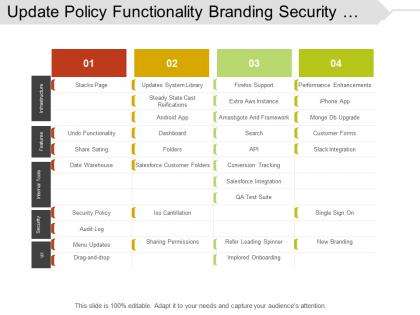
The image exhibits a presentation slide titled "Update Policy Functionality Branding Security ..." with four columns categorized by themes or functions, each consisting of a list of items that appears to represent updates or features for a product or service. Each column represents a distinct area of focus: Infrastructure, Features, Internal Tools, and Security & UX.
1. Column 01 [Infrastructure] includes "Stacks Page," "Updates System Library," "Steady State Cast Refications," and "Android App," indicating platform or foundational updates.
2. Column 02 [Features] lists "Undo Functionality," "Dashboard," "Share Sating," and "Salesforce Customer Folders," which suggests enhancements to user-facing elements of the service.
3. Column 03 [Internal Tools] has "Firefox Support," "Extra AWS Instance," "Amastigote And Framework," and "API," indicating improvements to internal tools and support for services.
4. Lastly, Column 04 [Security & UX] includes "Performance Enhancements," "iPhone App," "Mongo DB Upgrade," and "Slack Integration" among others, focusing on improving user experience and security aspects. Items are highlighted with a green check to denote completion or priority.
Use Cases:
These slides can be applied in the following seven industries:
1. Software Development:
Use: Tracking updates and new release features.
Presenter: Product Manager.
Audience: Development Team.
2. Cyber Security:
Use: Presenting updates on security policies and UI enhancements.
Presenter: Chief Information Security Officer.
Audience: Security Personnel and Stakeholders.
3. Information Technology Services:
Use: Outlining infrastructure improvements and support tools.
Presenter: IT Services Manager.
Audience: IT Department.
4. Cloud Computing:
Use: Showcasing cloud infrastructure updates and integration capabilities.
Presenter: Cloud Architect.
Audience: Cloud Services Clients.
5. Marketing Technology:
Use: Discussing new marketing tools and dashboard analytics features.
Presenter: Marketing Technology Leader.
Audience: Marketing Team.
6. Telecommunications:
Use: Reviewing performance enhancements and user experience improvements.
Presenter: Operations Director.
Audience: Network Engineers & Product Specialists.
7. Enterprise SaaS:
Use: Communicating new functionalities in a SaaS platform to stakeholders.
Presenter: Product Development Lead.
Audience: Customers and Client Success Teams.
Sprint development timeline with all 5 slides:
Use our Sprint Development Timeline to effectively help you save your valuable time. They are readymade to fit into any presentation structure.
FAQs for
A typical sprint timeline includes sprint planning, daily standups, development work, sprint review, and sprint retrospective phases. These structured phases streamline project delivery by establishing clear objectives, maintaining daily alignment, and enabling continuous improvement, with many development teams finding that this approach accelerates product releases while enhancing team collaboration and stakeholder satisfaction.
Sprint phase duration significantly impacts project delivery by affecting development velocity, quality assurance thoroughness, and stakeholder feedback integration. Shorter phases accelerate delivery cycles but may compromise testing depth, while longer phases enhance quality control and feature refinement, with many agile teams finding that balanced sprint timing ultimately delivers better products and maintains sustainable development pace.
Effective sprint tracking tools include Jira, Azure DevOps, Trello, Asana, and Monday.com, each offering unique capabilities for agile project management. These platforms streamline progress monitoring by providing real-time dashboards, automated reporting, and collaborative workspaces, with many development teams finding that integrated tools ultimately enhance transparency and deliver faster project completion.
A well-defined sprint timeline enhances team accountability by establishing clear deadlines, progress checkpoints, and deliverable expectations that prevent scope creep and ensure focused execution. Through structured timeboxing, teams streamline workflows, prioritize high-impact tasks, and maintain consistent velocity, with many development organizations finding that defined sprints reduce project delays by 30-40% while improving collaboration.
Stakeholder feedback provides crucial validation and direction within sprint timelines through sprint reviews, daily touchpoints, and iterative input sessions. This continuous dialogue enables teams to adjust priorities, refine deliverables, and ensure alignment with business objectives, with many organizations finding that regular stakeholder engagement reduces costly revisions and accelerates project success.
Teams effectively plan and prioritize tasks during sprint planning by establishing clear sprint goals, breaking user stories into manageable tasks, estimating effort using story points or hours, and considering team capacity and dependencies. Through collaborative discussion and backlog refinement, teams can sequence work based on business value and technical complexity, while identifying potential blockers early, ultimately delivering focused sprint outcomes and maintaining sustainable development velocity.
Common pitfalls include overcommitting to unrealistic deliverables, underestimating task complexity, failing to account for dependencies between team members, and neglecting buffer time for unexpected challenges. These planning oversights create cascading delays and team burnout, with many agile organizations finding that conservative estimation and clear dependency mapping ultimately deliver more predictable outcomes and sustainable development cycles.
Larger teams require more structured sprint timelines with extended planning sessions, detailed task breakdown, and additional coordination checkpoints, while smaller teams can operate with streamlined processes and faster decision-making cycles. Organizations in software development, financial services, and manufacturing find that scaling sprint structures appropriately enhances team productivity, reduces communication overhead, and ultimately delivers faster project completion with better resource allocation across development phases.
Strategies include implementing buffer time, conducting daily standups for early issue identification, maintaining flexible scope adjustments, establishing clear escalation protocols, and fostering cross-functional team collaboration. These approaches streamline sprint management by enabling rapid response to roadblocks, maintaining team alignment, and preserving delivery momentum, with many agile organizations finding that proactive challenge management ultimately delivers higher sprint success rates and enhanced team resilience.
Sprint retrospectives integrate into timelines by scheduling them immediately after sprint reviews, typically lasting 1-2 hours with dedicated time for reflection, feedback analysis, and action planning. This strategic placement enables teams to capture insights while sprint experiences remain fresh, identify process improvements, and implement changes in subsequent sprints, ultimately delivering enhanced team performance and project outcomes through systematic iteration refinement.
Sprint timelines vary significantly across methodologies, with Scrum utilizing fixed 1-4 week sprints featuring defined ceremonies and deliverables, while Kanban operates on continuous flow without predetermined timeboxes. This fundamental difference enables Scrum teams to establish predictable planning cycles and stakeholder expectations, whereas Kanban provides greater flexibility for dynamic priorities, with many organizations finding that hybrid approaches deliver both structure and adaptability.
Visualizing sprint timelines through Gantt charts delivers enhanced project transparency, improved resource allocation, better deadline tracking, clearer task dependencies, and streamlined team coordination. These visualization tools enable development teams to identify bottlenecks quickly, communicate progress effectively to stakeholders, and maintain sprint momentum, with many organizations finding that visual timeline management significantly reduces project delays and enhances overall delivery predictability.
Teams ensure effective sprint reviews by establishing clear success criteria upfront, tracking deliverable completion rates, and comparing actual versus planned velocity throughout the sprint. These reviews should focus on demonstrable outcomes rather than activities, with stakeholders evaluating working software against timeline commitments, while teams identify bottlenecks and adjust future sprint planning accordingly.
Key sprint timeline metrics include velocity, sprint burndown rate, story point completion percentage, cycle time, and adherence to planned deliverables. These measurements enhance project predictability by identifying bottlenecks, optimizing resource allocation, and improving estimation accuracy, with many development teams finding that consistent tracking ultimately delivers faster delivery cycles and better stakeholder alignment.
Cross-functional teams synchronize efforts through daily standups, shared sprint boards, and aligned sprint goals that connect individual tasks to collective outcomes. These coordination mechanisms streamline communication, minimize dependencies, and enhance transparency across development, design, and testing functions, with many organizations finding that synchronized sprints deliver faster product iterations and improved team accountability.
-
Unique design & color.
-
Design layout is very impressive.
-
Use of icon with content is very relateable, informative and appealing.