


Staff Assessment And Review Powerpoint Presentation Slides




Try Before you Buy Download Free Sample Product
 Impress Your
 Audience
 100%
100% Editable
 Save Hours
 of Time


Employee evaluations are a challenging but essential practice to set plans for future improvements. Download our Staff Assessment and Review PowerPoint Presentation Slides to conduct effective employee evaluation. The staff performance evaluation PPT presentation comprises of content ready slides including employee assessment criteria table, employee assessment form, review card, scorecard, evaluation form, self-assessment form, employee performance analysis template, performance review table, cross-training analysis chart, employee competency analysis table to name a few. Furthermore, to cover all the important concepts our designers have included additional slides like meet our team, mission and vision, mind map, financial, sticky notes, puzzle, timeline, target thank you, etc. Our all slides are fully editable and can be edited as per your need. Showcase the effectiveness of performance appraisal system and its effect on employee motivation. Get access to this tailor-made employee evaluation and performance review PowerPoint Slides to bring up areas of improvement for your employees.
People who downloaded this PowerPoint presentation also viewed the following :
Content of this Powerpoint Presentation
Slide 1: This slide introduces Staff Assessment and Review. State Your Company Name and begin.
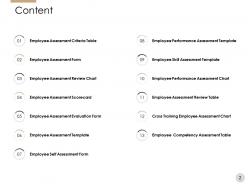
Slide 2: This slide shows Content of the presentation.
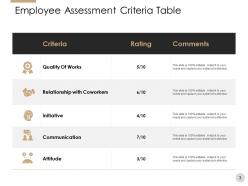
Slide 3: This slide presents Employee Assessment Criteria Table describing quality of works, relationship with coworkers, initiative, communication and attitude.
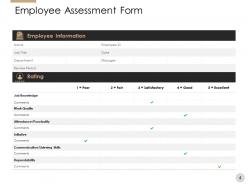
Slide 4: This slide displays Employee Assessment Form with employee information and ratings.
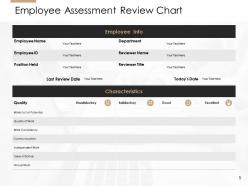
Slide 5: This slide represents Employee Assessment Review Chart with employee information and characteristics.
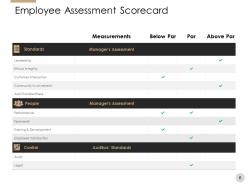
Slide 6: This slide showcases Employee Assessment Scorecard in a tabular form with categories as measurements, below par, par and above par.
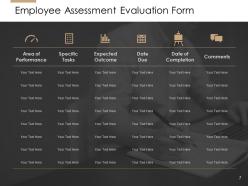
Slide 7: This slide shows Employee Assessment Evaluation Form with categories as- area of performance, specific tasks, expected outcome, date due, date of completion and comments.
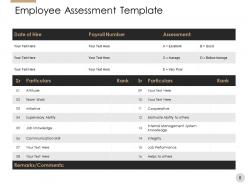
Slide 8: This slide presents Employee Assessment Template with date of hire, payroll number and assessment.
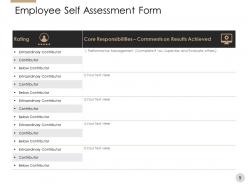
Slide 9: This slide displays Employee Self Assessment Form describing ratings.
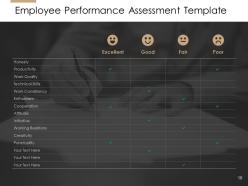
Slide 10: This slide represents Employee Performance Assessment Template.
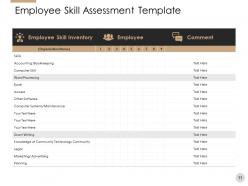
Slide 11: This slide showcases Employee Skill Assessment Template with categories as employee skill inventory, employee and comments.
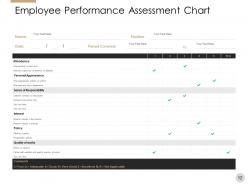
Slide 12: This slide shows Employee Performance Assessment Chart with attendance, personal appearance, sense of responsibility, interest, policy, quality of works and comments.
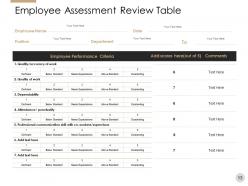
Slide 13: This slide presents Employee Assessment Review Table. You can add or edit data as per requirements.
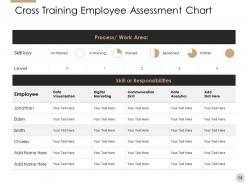
Slide 14: This slide displays Cross Training Employee Assessment Chart with process/work area and skills/responsibilities.
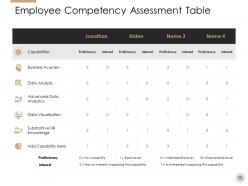
Slide 15: This slide represents Employee Competency Assessment Table with categories as- capabilities, business acumen, data analysis, advanced data analysis, data visualization and substantive Hr knowledge.
Slide 16: This slide showcases Staff Assessment and Review icons.
Slide 17: This slide is titled as Additional Slides for moving forward.
Slide 18: This is Our Mission slide with related imagery and text boxes.
Slide 19: This is About Us slide to show company specifications etc.
Slide 20: This is Meet Our Team slide with names and designation.
Slide 21: This slide shows Mind Map for representing entities.
Slide 22: This is a Quotes slide to convey message, beliefs etc.
Slide 23: This is a Financial slide. Show your finance related stuff here.
Slide 24: This is a Puzzle slide with additional text boxes.
Slide 25: This is Our Target slide. State your targets here.
Slide 26: This is a Timeline slide. Show information related with time period here.
Slide 27: This slide displays Magnifying glass with text boxes.
Slide 28: This is a Thank You slide with address, contact number and email address.
Staff Assessment And Review Powerpoint Presentation Slides with all 28 slides:
Find a formula that fits with our Staff Assessment And Review Powerpoint Presentation Slides. Come up with extremely convincing answers.

FAQs for Staff Assessment And Review
Honestly, I'd break it into five main chunks: performance highlights, goal achievements (with actual numbers), development areas, and next period's objectives. Skills matrices are clutch too - people eat up that visual progress stuff. Don't forget a feedback section where they can talk about career goals and share their thoughts. Action items with deadlines should wrap it up. Oh, and keep slides minimal! Focus more on having real conversations instead of reading off bullet points like a robot. The dialogue part is where the magic happens anyway.
Honestly, good staff reviews are like giving people a GPS for their career - they actually know where they're going instead of wandering around confused. Regular feedback keeps everyone way more engaged since nobody's sitting there wondering if they're screwing up. You can catch skill gaps before they become disasters too. I've actually watched teams get happier after better review systems (weird, right?). The trick is being constructive about it. Don't just tell someone they suck - give them real ways to improve or you're wasting everyone's time.
Honestly, I'd stick to three main things: how well they hit their actual goals, whether they're good to work with, and if they're actually growing. Too many companies get caught up tracking stuff that sounds impressive but doesn't really matter. Like, who cares about activity metrics if the work quality sucks? Focus on measuring real output, teamwork skills, and whether someone's picking up new abilities or handling tougher projects. The trick is making sure what you're tracking actually connects to business results. Oh, and definitely nail down clear goals for each role first - otherwise you're just shooting in the dark.
Tech has honestly been a game changer for staff reviews. You can automate all that tedious data collection and get real-time performance metrics without drowning in spreadsheets. Digital platforms let you collect 360-degree feedback way easier, plus they'll bug people with automated reminders so you're not constantly chasing deadlines. AI tools are pretty good at spotting performance patterns you'd probably miss. Your team can access their reviews and development plans whenever they want too, which is nice. Oh, and don't try to digitize everything at once - that's a nightmare. Pick one thing first, like feedback collection.
Look, feedback is what actually makes staff assessments worth doing. Otherwise you're just collecting random data that sits there doing nothing. Monthly check-ins work way better than those brutal annual reviews where people get hit with surprises they could've fixed months ago. Train your managers to have real conversations – not just "good job" but actual specific stuff people can act on. Two-way conversations are key too, so employees can push back or ask questions. Honestly, most places mess this up by making it too formal and weird. Keep it regular and casual, and people will actually improve instead of just surviving review season.
Make standardized rubrics that focus on actual behaviors, not personality stuff. Don't let one crappy week mess up the whole review - I've watched managers do this constantly and it's so unfair. Gather feedback all year long instead of relying on your memory (which sucks anyway). Document examples as they happen. Get input from coworkers who actually work with that person. Quarterly check-ins help you track things consistently. Honestly, the biggest thing is sticking to performance data you can actually observe rather than letting your personal feelings take over.
Ugh, don't be vague with feedback - that's the worst. Instead of "communicate better," tell them exactly what they did wrong. I learned this the hard way! Also, document stuff as it happens, not right before review season when you're panicking trying to remember everything. Never blindside someone with problems they haven't heard about before. Oh, and don't compare them to other people - creates so much drama. Skip the sugarcoating too if there's a real issue. Keep running notes throughout the year so you're not scrambling later.
Honestly, quarterly is the way to go. I learned this the hard way after trying monthly check-ins - felt like I was constantly breathing down everyone's necks. Annual reviews? Forget it. Too much happens in a year to wait that long. Four times a year hits that sweet spot where you can actually see patterns developing and keep those growth conversations meaningful. Plus your team won't dread them once it becomes normal routine. Oh, and schedule next quarter's sessions now while you're thinking about it - otherwise you'll forget and scramble later.
Honestly, just tailor everything to what each role actually does day-to-day. Sales people? Hit them on revenue numbers and how they handle clients. IT folks need to show they can solve problems and know their tech stuff. Marketing's totally different - creativity matters way more there, plus campaign results. Mix up how you test people too. Mystery shoppers work great for customer service (tried that once, pretty eye-opening), but finance teams respond better to straight accuracy checks and compliance stuff. Start simple: write down the 3-4 biggest skills each department needs, then build from there. Don't overthink it.
Honestly? Just work backwards from what you actually care about this year. Customer satisfaction matters most? Then measure your people on how they treat customers, not some random generic stuff. Figure out your main business goals first. Then ask yourself - what do my employees need to DO to make that happen? That's what you evaluate them on. Most companies overthink this so much when it's pretty straightforward. The trick is helping everyone see how their specific job connects to the bigger goals. Otherwise they're just checking boxes on some boring review form that doesn't mean anything.
Honestly, self-evaluations work really well - have them rate themselves and list their wins before you meet. 360-degree feedback is clutch too, getting input from coworkers and other departments. Let them help set their own goals and metrics for next quarter. Peer reviews can be surprisingly honest (sometimes brutally so, but that's good). Also try having them create their own development plans - they'll spot skill gaps and suggest training ideas. The key is making them part of the process instead of just sitting there getting judged.
So three main things to work on with your managers. Get them giving actual specific feedback - not just "good job" stuff that doesn't help anyone. Role-playing is awkward but honestly works great once they get over feeling weird about it. Active listening is huge too, plus making sure people feel safe to be honest during reviews (otherwise what's the point?). Oh and calibration - you don't want one manager being super harsh while another's giving everyone 5s. Mock assessments help with this. Have them all rate the same fake employee scenario, then compare results. Sounds boring but it actually prevents a lot of headaches later.
Definitely do one-on-ones instead of group emails - nobody wants their weaknesses aired out to the whole team, you know? I always jot down a few talking points beforehand so I don't blank out mid-conversation. Be specific with examples from their actual work, both good stuff and areas to grow. Give them space to ask questions too. Honestly, some of my best feedback sessions turned into real conversations where they opened up about challenges I didn't even know about. Wrap up by picking 2-3 concrete things they can focus on going forward.
Okay so basically you want to be super consistent with everyone - same criteria, same standards. Document literally everything because people will definitely challenge their reviews later and you'll need proof of what you said and why. The legal stuff isn't too crazy, just common sense really. Don't bring up anything about age, race, gender, that whole protected class thing. Keep your feedback tied to actual job performance. Oh and avoid playing favorites obviously - that's where managers usually mess up. Be specific about what they did well or poorly. Fair + consistent + documented = you're covered.
Look at your best people first - what do their assessment scores have in common? Like if your top salespeople all crush the resilience part, make that a bigger deal in interviews. Then flip it around and see where everyone's struggling. Way better than those random training sessions nobody asked for (we've all sat through those, right?). The real trick is matching assessment results with who's actually killing it at work - not just who looks good on paper. Honestly, just grab your top 20% performers and work backwards from there. You'll probably find some patterns you didn't expect.
No Reviews