


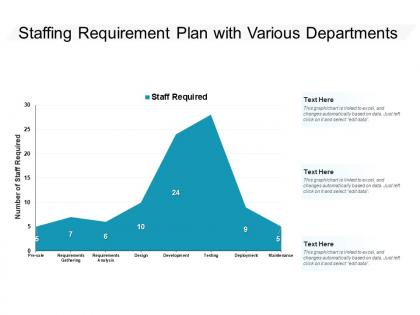
Staffing requirement plan with various departments




Try Before you Buy Download Free Sample Product
 Impress Your
 Audience
 100%
100% Editable
 Save Hours
 of Time


Ride the beam with our Staffing Requirement Plan With Various Departments. Your thoughts will fly accurately to their target.
People who downloaded this PowerPoint presentation also viewed the following :
Staffing requirement plan with various departments with all 2 slides:
Put your best foot forward with our Staffing Requirement Plan With Various Departments. Your thoughts will march on in line.
FAQs for Staffing requirement plan
Effective staffing plans include workforce analysis, role definitions, recruitment strategies, succession planning, and budget allocation. These components work together by identifying current gaps, establishing clear job requirements, and creating scalable hiring processes, with many organizations finding that strategic workforce planning ultimately delivers improved operational efficiency and competitive advantage in talent acquisition.
Businesses align staffing plans with strategic goals by conducting workforce gap analyses, mapping required skills to objectives, implementing targeted recruitment strategies, and establishing performance metrics tied to strategic outcomes. Through strategic workforce planning, organizations streamline resource allocation, enhance operational efficiency, and accelerate goal achievement, with many companies finding that aligned staffing delivers competitive advantage and sustainable growth.
Workforce analysis serves as the foundation for effective staffing plans by evaluating current employee skills, identifying capability gaps, forecasting future talent needs, and assessing organizational capacity against strategic objectives. Through comprehensive workforce analysis, organizations can optimize resource allocation, reduce recruitment costs, and ensure proper skill alignment across departments, ultimately delivering improved operational efficiency and competitive advantage in an increasingly dynamic business environment.
Technology streamlines staffing plans through applicant tracking systems, AI-powered candidate screening, video interviewing platforms, automated scheduling tools, and predictive analytics for workforce planning. These solutions enhance recruitment efficiency by reducing manual tasks, accelerating candidate evaluation, and improving hiring accuracy, with many organizations finding significantly faster time-to-hire and better candidate experiences.
Key staffing plan metrics include employee retention rates, time-to-fill positions, cost-per-hire, productivity levels, and employee satisfaction scores. These measurements enable organizations to assess recruitment effectiveness, workforce stability, and operational efficiency, with many companies finding that tracking these metrics simultaneously delivers improved resource allocation, reduced turnover costs, and enhanced competitive advantage.
A staffing plan addresses workforce diversity and inclusion by establishing targeted recruitment strategies, implementing bias-free selection processes, creating inclusive job descriptions, and setting measurable diversity goals across all organizational levels. Through strategic partnerships with diverse talent networks, organizations enhance cultural competency, improve decision-making, and access broader talent pools, ultimately delivering better innovation and competitive advantage in increasingly diverse markets.
Organizations face challenges including budget constraints, skill shortages, unclear role definitions, resistance to change, and inaccurate demand forecasting when implementing staffing plans. These obstacles can significantly impact workforce optimization, with many companies finding that inadequate planning leads to misallocated resources, operational inefficiencies, and competitive disadvantages, ultimately requiring strategic adjustments and enhanced forecasting capabilities.
Staffing plans can be adapted for remote and hybrid environments through flexible scheduling models, digital collaboration tools, performance-based metrics, virtual onboarding processes, and enhanced communication protocols. These adaptations enable organizations to maintain productivity across distributed teams while reducing overhead costs, with many companies finding that strategic workforce flexibility delivers improved employee satisfaction and access to broader talent pools.
A staffing plan should evolve through regular workforce assessments, flexible role definitions, and scalable hiring strategies that align with business objectives and market demands. Organizations experiencing growth or market shifts can adapt by implementing cross-training programs, establishing talent pipelines, and leveraging workforce analytics, ultimately enabling rapid response to opportunities while maintaining operational efficiency and competitive advantage.
Best practices for forecasting staffing needs include analyzing historical data and turnover patterns, evaluating business growth projections, conducting skills gap assessments, monitoring industry trends, and incorporating seasonal fluctuations. These strategic approaches enable organizations to anticipate workforce requirements by aligning talent acquisition with business objectives, identifying critical skill shortages before they impact operations, and ultimately delivering improved resource allocation and competitive advantage in an increasingly dynamic market.
Employee feedback contributes to staffing plan refinement by revealing skill gaps, workload imbalances, and operational bottlenecks that management might overlook. Through surveys, one-on-ones, and team assessments, organizations identify training needs, optimize resource allocation, and enhance team structures, ultimately delivering improved productivity and employee satisfaction while reducing turnover costs.
Legal considerations for staffing plans include employment law compliance, anti-discrimination regulations, wage and hour requirements, worker classification rules, and safety standards. These frameworks ensure organizations maintain proper hiring practices, fair compensation structures, and workplace protections while minimizing legal risks, with many companies finding that proactive compliance ultimately delivers stronger employee relations and operational stability.
Seasonal and project-based staffing needs require flexible workforce planning strategies that include temporary hires, contractor partnerships, cross-training programs, and scalable recruitment processes. These approaches enable organizations to maintain operational efficiency during peak periods while minimizing fixed costs, with many retail and construction companies finding that strategic workforce flexibility delivers competitive advantage and optimized resource allocation.
Employee retention significantly impacts staffing plan effectiveness by reducing recruitment costs, maintaining institutional knowledge, and ensuring consistent service delivery. High retention enables organizations to focus resources on strategic growth rather than constant replacement hiring, while retained employees develop deeper expertise and stronger client relationships, ultimately delivering enhanced productivity and competitive advantage in increasingly talent-competitive markets.
Organizations ensure staffing plan compliance through regular regulatory audits, standardized documentation processes, and alignment with industry-specific requirements like healthcare accreditation or financial services guidelines. By implementing compliance tracking systems, conducting training programs, and partnering with legal experts, companies streamline regulatory adherence while maintaining operational efficiency and minimizing compliance risks.
No Reviews