


Stages Of Big Data Analytics Life Cycle




Try Before you Buy Download Free Sample Product
 Impress Your
 Audience
 100%
100% Editable
 Save Hours
 of Time


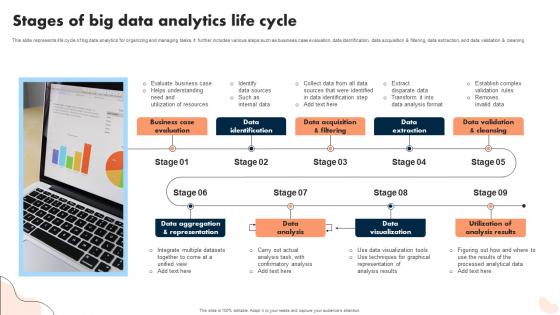
This slide represents life cycle of big data analytics for organizing and managing tasks. It further includes various steps such as business case evaluation, data identification, data acquisition and filtering, data extraction, and data validation and cleaning.
People who downloaded this PowerPoint presentation also viewed the following :
Stages Of Big Data Analytics Life Cycle with all 9 slides:
Use our Stages Of Big Data Analytics Life Cycle to effectively help you save your valuable time. They are readymade to fit into any presentation structure.








FAQs for Stages Of Big Data
The Big Data Analytics life cycle includes data discovery, data preparation, model planning, model building, operationalization, and monitoring. These stages enable organizations to systematically transform raw data into actionable insights through comprehensive collection, cleansing, analysis, and deployment processes, ultimately delivering enhanced decision-making capabilities and competitive advantage across industries.
Structured data collection involves extracting information from organized sources like databases, spreadsheets, and CRM systems with predefined formats, while unstructured data collection requires advanced tools to capture text, images, videos, and social media content. Financial institutions increasingly leverage both approaches, with structured data streamlining transaction analysis and unstructured data enhancing customer sentiment insights, ultimately delivering comprehensive business intelligence.
Data cleaning ensures accuracy by removing duplicates, correcting errors, handling missing values, standardizing formats, and validating data integrity throughout collection processes. This critical preprocessing step enables organizations across healthcare, finance, and retail to generate reliable insights, reduce analytical errors, and make confident strategic decisions, ultimately delivering trustworthy business intelligence and competitive advantage.
Organizations ensure data integrity through comprehensive validation protocols, automated quality checks, standardized governance frameworks, encryption methods, and continuous monitoring systems throughout each analytics phase. These approaches streamline operations by detecting anomalies early, maintaining consistent data standards, and implementing role-based access controls, with many financial services and healthcare institutions finding that robust integrity measures ultimately deliver enhanced decision-making accuracy and regulatory compliance.
Common Big Data analytics tools include Apache Hadoop, Spark, Kafka, Tableau, Python, R, SQL databases, and cloud platforms like AWS and Azure. These technologies streamline data processing, visualization, and analysis by enabling faster computations, real-time streaming, and scalable storage, with many organizations finding that strategic combinations ultimately deliver enhanced decision-making capabilities and competitive advantage.
Data storage significantly impacts analytics performance by influencing processing speed, scalability, and data accessibility across different storage architectures and configurations. Optimized storage solutions, including distributed systems, in-memory databases, and cloud infrastructures, enable faster query responses, seamless data integration, and enhanced computational efficiency, with many organizations finding that strategic storage investments ultimately deliver reduced processing times and improved analytical capabilities.
Data exploration and discovery techniques include data profiling, statistical analysis, visualization tools, pattern recognition algorithms, and clustering methods. These approaches enable organizations to uncover hidden patterns, identify anomalies, and extract meaningful insights from massive datasets, with many financial institutions and healthcare providers finding that systematic exploration significantly enhances decision-making capabilities and competitive advantage.
Data visualization transforms complex analytical findings into accessible, actionable insights that stakeholders can quickly understand and act upon, enabling faster decision-making and broader organizational adoption of data-driven strategies. Through interactive dashboards and visual storytelling, organizations streamline communication across departments, enhance strategic planning, and ultimately deliver competitive advantages, with many companies finding that effective visualization significantly accelerates their business intelligence outcomes.
Machine learning integrates into Big Data analytics through automated data preprocessing, pattern recognition during exploration, predictive modeling development, and continuous model refinement. These capabilities streamline traditional analytics workflows by reducing manual analysis time, identifying complex data relationships, and enabling real-time insights, with organizations across retail, healthcare, and finance finding significantly enhanced decision-making speed and accuracy.
Organizations face challenges including infrastructure limitations, data quality inconsistencies, skills shortages, integration complexities, and governance gaps when scaling analytics efforts. These obstacles can significantly impact operational efficiency, with many enterprises finding that strategic investment in cloud platforms, automated data management, and cross-functional training ultimately delivers sustainable growth and competitive advantage.
Big Data analytics life cycles adapt to industry-specific requirements, with healthcare focusing on patient outcomes and regulatory compliance, finance emphasizing risk assessment and fraud detection, and retail prioritizing customer behavior and inventory optimization. While core stages remain consistent across sectors, healthcare organizations integrate clinical workflows and HIPAA protocols, financial institutions emphasize real-time transaction monitoring, and retailers concentrate on seasonal patterns and personalization, ultimately delivering tailored insights that enhance operational efficiency and competitive advantage.
Ethical considerations include data privacy protection, informed consent acquisition, algorithmic bias prevention, transparency maintenance, and responsible data usage throughout collection and analysis phases. These principles help organizations navigate complex regulatory landscapes while building customer trust, with many financial institutions and healthcare providers finding that ethical frameworks ultimately deliver stronger stakeholder relationships and sustainable competitive advantage.
Organizations measure Big Data analytics success through key performance indicators like ROI improvement, operational efficiency gains, customer satisfaction scores, and decision-making speed enhancements. By tracking metrics such as cost reduction percentages, revenue growth from data-driven insights, and process automation achievements, companies can quantify their analytics investments' strategic value and competitive advantage.
Feedback loops enhance analytics by enabling continuous model refinement, improving prediction accuracy, and identifying data quality issues through real-world performance monitoring. These iterative processes help organizations in healthcare, finance, and retail optimize their algorithms based on actual outcomes, ultimately delivering more reliable insights, reduced operational costs, and competitive advantages in increasingly data-driven markets.
AI and IoT significantly transform the Big Data analytics life cycle by automating data collection, enhancing processing speeds, and enabling real-time insights generation. These technologies streamline traditional workflows through intelligent data ingestion, predictive modeling, and automated pattern recognition, with sectors like manufacturing and healthcare finding that IoT sensors deliver continuous data streams while AI accelerates analysis, ultimately providing faster decision-making capabilities.
-
Thanks to SlideTeam, we have an ideal template to present all the info we need to cover. Their slides give our numbers and projections a more clear and enchanting look.
-
“One of the best experiences with SlideTeam for my presentation.Everything on time, communication is efficient and price is reasonable. All good in one place.”