

Stakeholder assessment and mapping powerpoint presentation slides




Try Before you Buy Download Free Sample Product
 Impress Your
 Audience
 100%
100% Editable
 Save Hours
 of Time


Our Stakeholder Assessment And Mapping Powerpoint Presentation Slides are topically designed to provide an attractive backdrop to any subject. Use them to look like a presentation pro.
People who downloaded this PowerPoint presentation also viewed the following :
Content of this Powerpoint Presentation
Slide 1: This is a slide that illustrates the topic of Stakeholder Assessment and Mapping.
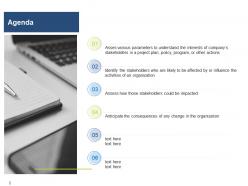
Slide 2: This is an Agenda slide that illustrates all the topics included in the presentation.
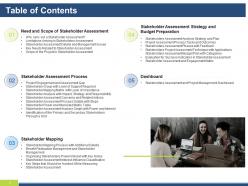
Slide 3: This is a Table of Contents slide that illustrates the Stakeholder Assessment Process, Stakeholder Mapping, and Stakeholders Assessment & Project Management Dashboard.
Slide 4: This is a Table of Contents slide that illustrates the Need and Scope of Stakeholder Assessment.
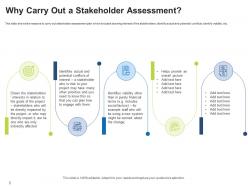
Slide 5: This slide shows the reasons to carry out a stakeholder assessment plan covering drawing interest of the stakeholders, identifying actual and potential conflicts, identifying viability, etc.
Slide 6: This slide covers the problems with stakeholders' assessment plan due to which project might fail.
Slide 7: This slide shows the table related to stakeholder assessment details and how to manage the stakeholder assessment, including advocates, followers, blockers, etc.
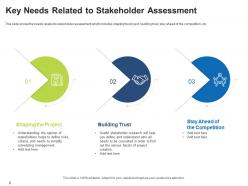
Slide 8: This slide shows the needs related to stakeholder assessment, including shaping the project, building trust, staying ahead of the competition, etc.
Slide 9: This slide shows the scope of the project in stakeholder management, including scope description, project deliverables, acceptance criteria, etc.
Slide 10: This is a Table of Contents slide illustrating the Stakeholder Assessment Process.
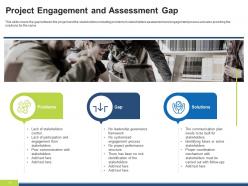
Slide 11: This slide covers the gap between the project and the stakeholders including problems in stakeholders assessment, engagement process, and solutions for the same.
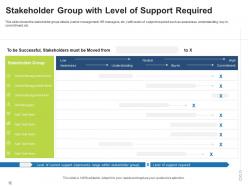
Slide 12: This slide shows the stakeholder group details, including the senior management, HR managers, etc.
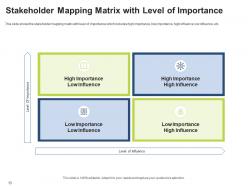
Slide 13: This slide shows the stakeholder mapping matrix with a level of importance which includes high importance, low importance, high influence, low influence, etc.
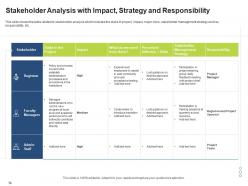
Slide 14: This slide shows the table related to stakeholder analysis which includes the stake in the project, impact, major risks, stakeholder management strategy, and key responsibility.
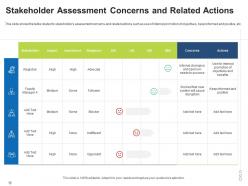
Slide 15: This slide shows the table related to stakeholders' assessment concerns and related actions, such as the use of internal promotion of objectives, keeping informed and positive, etc.
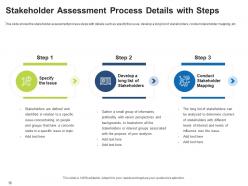
Slide 16: This slide shows the stakeholder assessment process steps with details, such as specifying the issue, developing a long list of stakeholders, conducting stakeholder mapping, etc.
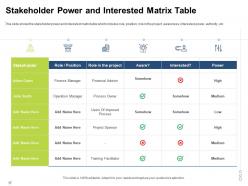
Slide 17: This slide shows the stakeholder power and interesting matrix table, which includes role, position, role in the project, awareness, interest, power, authority, etc.
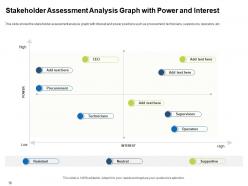
Slide 18: This slide shows the stakeholder assessment analysis graph with interesting and powerful positions, such as procurement, technicians, supervisors, operators, etc.
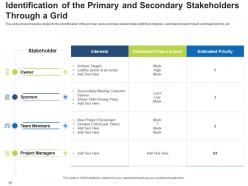
Slide 19: This slide shows the table related to the identification of the primary and secondary stakeholders with their interests, estimated project impact, estimated priority, etc.
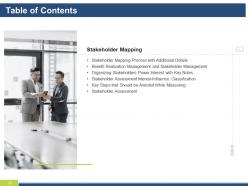
Slide 20: This is a Table of Contents slide illustrating the topic of Stakeholder Mapping.
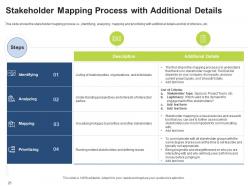
Slide 21: This slide shows the stakeholder mapping process, i.e. identifying, analyzing, mapping, additional details, and a list of criteria.
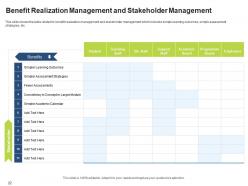
Slide 22: This slide shows the table related to benefit realization management, stakeholder management, learning outcomes, simple assessment strategies, etc.
Slide 23: This slide shows the organization of stakeholder's power, interest with keynotes, such as keeping satisfied, engaging closely, influencing actively, monitoring, etc.
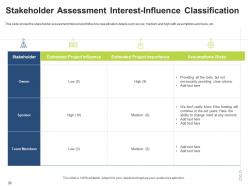
Slide 24: This slide shows the stakeholder Assessment Interest and Influence classification details, such as low, medium, and high with assumptions and risks, etc.
Slide 25: This slide shows the various steps which should be avoided while measuring stakeholder assessment, including a one-way mechanism, trading one party’s interest, etc.
Slide 26: This is a Table of Contents slide that illustrates the Stakeholder Assessment Strategy and Budget Preparation.
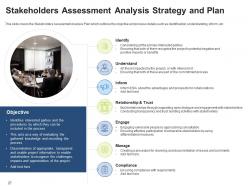
Slide 27: This slide covers the Stakeholders Assessment Analysis Plan, which outlines the objective and process details, such as identification, understanding, inform, etc.
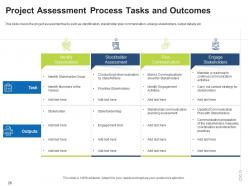
Slide 28: This slide covers the project assessment tasks such as identification, stakeholder plan communication, enlarged stakeholders, output details, etc.
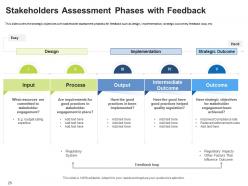
Slide 29: This slide covers the strategic objectives with stakeholder assessment phases with feedback, such as design, implementation, strategic outcomes, feedback loop, etc.
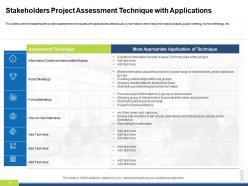
Slide 30: This slide covers the stakeholder project assessment techniques with application details, such as information centers, boards, public meetings, formal meetings, etc.
Slide 31: This slide covers the stakeholder's assessment budget category, including promotional items, stakeholders engagement meetings, engagement roadshows, and stakeholders involvement workshops.
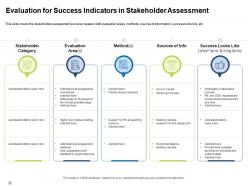
Slide 32: This slide covers the stakeholder's assessment success measure with evaluation areas, methods, sources of information, success looks like, etc.
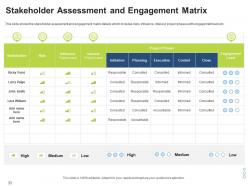
Slide 33: This slide shows the stakeholder assessment and engagement matrix details, including risks, project phases with engagement level, etc.
Slide 34: This is a Table of Contents slide that illustrates the Stakeholders Assessment and Project Management Dashboard.
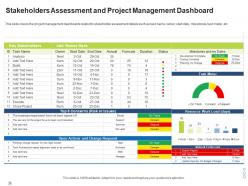
Slide 35: This slide covers the project management dashboards related to stakeholder assessment details, such as task name, owner, start date, milestones, task meter, etc.
Slide 36: This is an icon slide illustrating the topic Stakeholder Assessment and Mapping.
Slide 37: This is a template that illustrates the introduction of Additional Slides.
Slide 38: This is an About Us slide that illustrates the company’s creative and professional information.
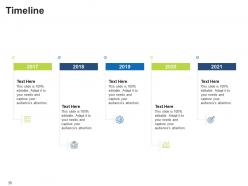
Slide 39: This is a Timeline slide that is 100% editable and can capture your audience's attention.
Slide 40: This is a slide that can be used to share motivational Quotes.
Slide 41: This is a Post-it Notes slide that can be used to display the critical pointers.
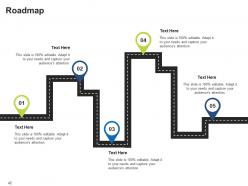
Slide 42: This is a Roadmap slide that can be used to represent your process or plan strategically.
Slide 43: This is a Thank You slide that can be used to display the company Address, Contact Details, Email, and other information.
Stakeholder assessment and mapping powerpoint presentation slides with all 43 slides:
Use our Stakeholder Assessment And Mapping Powerpoint Presentation Slides to effectively help you save your valuable time. They are readymade to fit into any presentation structure.









FAQs for Stakeholder assessment and mapping
Look, spend 30 minutes mapping out who matters before diving into your next project. Trust me on this. You'll figure out who has real influence vs who just makes noise, plus you won't get blindsided by some random VP who suddenly has opinions. The relationships matter too - like knowing the CFO whispers in the CEO's ear can save your butt later. Without this, you end up wasting time updating people who don't matter while accidentally ignoring the actual decision makers. It's honestly one of those boring prep things that prevents way bigger headaches down the line.
Honestly, stakeholder mapping is a game changer for project success. Figure out who has real influence and what they actually want before you dive in. This lets you communicate the right way and get people on board early - way better than dealing with drama later. I've watched projects completely tank because someone missed a key person who could kill the whole thing. Such a waste! Map out everyone who might impact your project or get impacted by it, then figure out their influence level. Oh, and whether they're supporting you or not - that part's crucial too.
Honestly, just go with whatever your team's already using - that'll save you so much headache later. Miro and Mural are pretty sweet if you want everyone collaborating visually, plus they've got templates ready to go. Lucidchart's solid for the more diagram-heavy stuff. But real talk? I've seen amazing stakeholder maps done in plain old PowerPoint. Sometimes simple wins over fancy. The whole point is getting people to actually use it, not impressing them with bells and whistles. Start basic and see what sticks - you can always upgrade later if needed.
Map out everyone who touches your project first - sponsors, users, but also think weird like compliance people or random teams that might care. Honestly, I always use a whiteboard because this gets chaotic quick. Then do that power/interest grid thing: high power + high interest folks need constant updates. Low power but super interested? They're usually your biggest cheerleaders. High power people who don't really care just need to stay happy without you bugging them constantly. Oh and definitely update this as you go - people's priorities change and new players show up.
Okay so think of stakeholder mapping as your crystal ball for spotting trouble early. List everyone who could mess with your project or get affected by it. That quiet finance director? Yeah, they probably have way more power than you think. Once you've got your list, figure out who has real influence and who actually cares about the outcome. This helps you predict where pushback might come from - honestly, it's saved my butt more times than I can count. You'll see competing priorities coming and know exactly who to keep sweet to avoid major headaches down the road.
Just do quick surveys or grab people for coffee chats to check your stakeholder map. Ask who they think matters most and if you missed anyone obvious. People absolutely love dishing about office politics - honestly it's the best intel you'll get! Their input helps you fix your influence grid and spot gaps. Don't make it a one-and-done thing though. Regular check-ins keep everything current since relationships change constantly. Oh, and one-on-ones work great too if surveys feel too formal for your team culture.
Honestly, the biggest screwup I see is people rushing through it and only looking at the obvious folks - direct managers, key clients, whatever. But you're gonna miss the people who actually pull strings behind closed doors. Teams also treat it like checking a box instead of something you update regularly (and trust me, those dynamics shift constantly). Oh and another thing - everyone gets obsessed with the org chart. Don't ignore the informal networks or that random person in accounting who somehow knows everything. Start wide, actually talk to people to find the hidden influencers, then revisit every few months.
Quarterly works for most projects, but honestly? Depends how crazy things get. Monthly makes way more sense if it's fast-moving or political stuff. People are always joining, leaving, changing their minds - especially on longer projects where everything suddenly shifts. I always update mine after big milestones too, or when someone unexpected starts pushing back (that's usually a red flag you missed something). Just put a recurring reminder on your calendar or you'll definitely forget. Oh and don't treat it like some formal document - it's more like notes you keep tweaking.
Honestly, just go with a power-influence grid - it's the easiest way to figure out who actually calls the shots. You plot everyone based on how much influence they have vs how interested they are in your project. I like color-coding by department and using different shapes for internal/external people. Adding arrows between stakeholders shows relationships too, though some people think that makes it messy. The key is keeping it simple enough that you can walk anyone through it in like 30 seconds. Oh, and don't forget to update it regularly since people's priorities change all the time. Share it with your team so you're all on the same page about who matters most.
Oh man, stakeholder mapping is honestly a game-changer. It gets your whole team on the same page about who you need to keep happy and what they're expecting from you. Nothing worse than realizing halfway through that you totally forgot about some VP who needed updates. You can actually see all the players - from the big decision makers down to whoever's using your stuff daily. Makes it super easy to split up who talks to whom based on how much influence people have. I swear I've watched teams completely derail because they didn't bring the right people into the loop early enough. Just build it out together and assign ownership.
Look at three main things: can they actually say yes or no to your project? What budget/resources do they control? How connected are they across the company? I used to think the loudest person in meetings had all the power - totally wrong. Real influence is quieter than that. Check if they're respected experts in your area and how much pull they have with the big bosses. The informal influencers are honestly the hardest to figure out but super important. Maybe throw together a quick grid mapping this stuff out so you know where to spend your time.
Oh man, this bit me so hard on my last project. Different cultures have totally different power dynamics - like sometimes the person who actually calls the shots isn't even on the official org chart. Community leaders, family connections, informal networks... it's wild how much influence flows through channels you'd never expect. I learned the hard way to grab someone local right at the start. They'll spot the real decision-makers and save you from accidentally snubbing someone important. Trust me, your stakeholder map will be way more accurate.
First thing - figure out why they're dragging their feet. Maybe they're swamped, don't see the point, or got burned before. Once you know that, start tiny. Like seriously small asks that barely take any effort. Lead with what they'll get out of it, not what you want from them (honestly this took me forever to learn). If you know someone they respect, bring them along - that mutual connection thing really works. Make everything stupid easy for them. Flexible times, quick calls, whatever. You gotta prove it's worth their time fast, otherwise they'll just feel stuck.
Yeah, stakeholder maps totally change depending on your industry. Healthcare is honestly a nightmare - you've got patients, doctors, insurance companies, plus like twenty different regulatory agencies breathing down your neck. Tech is way cleaner, mostly users and investors to worry about. Manufacturing throws in suppliers, unions, environmental groups - the whole supply chain mess. But government projects? Those are the absolute worst for complexity. Multiple citizen groups all wanting different things, political parties, endless bureaucratic layers. Really comes down to figuring out who actually has power in your space first, then map everyone else around them.
Honestly, the big things you gotta watch are privacy and consent - don't map people without telling them what you're doing with their info. Power dynamics are tricky too. Like, you don't want to just listen to whoever yells loudest while ignoring quieter voices that actually matter. Be super careful if stakeholders start gossiping about others - that stuff can get messy fast. Oh, and don't be manipulative about it. I mean, that should be obvious but still. Set up some basic rules beforehand about how you'll handle data. Would you be cool with someone mapping you the same way?
-
Enough space for editing and adding your own content.
-
Great designs, Easily Editable.