


Stakeholder Power Influence And Impact Matrix




Try Before you Buy Download Free Sample Product
 Impress Your
 Audience
 100%
100% Editable
 Save Hours
 of Time


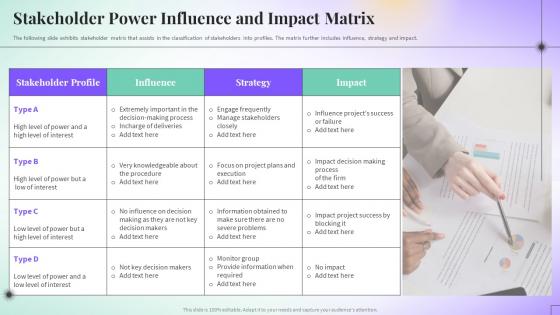
The following slide exhibits stakeholder matrix that assists in the classification of stakeholders into profiles. The matrix further includes influence, strategy and impact.
People who downloaded this PowerPoint presentation also viewed the following :
Stakeholder Power Influence And Impact Matrix with all 6 slides:
Use our Stakeholder Power Influence And Impact Matrix to effectively help you save your valuable time. They are readymade to fit into any presentation structure.





FAQs for Stakeholder Power Influence
You're basically figuring out who actually cares about your project and how to keep them happy. Map out everyone - your boss, end users, even Karen from accounting who somehow always has opinions. Once you know who matters, you can spot their needs and concerns before they blow up your timeline. Trust me, those surprise objections are the worst. Communication gets way easier when you know what everyone wants upfront. Just list anyone who affects or gets affected by your project, then rank them by how much power and interest they have. Saves so much headache later.
First thing - list everyone who touches your project or gets impacted by it. Think sponsors, users, your team, vendors, regulatory people, even internal departments whose workflows might shift. I literally always forget IT security exists until they shut something down halfway through lol. Next, rank them by how much power they have vs how interested they are. High power + high interest = your VIPs who need constant updates. Make a simple grid to visualize this mess. Oh, and ask your first few stakeholders "who else should we loop in?" They'll usually remember someone obvious you totally missed.
Oh man, stakeholder stuff can get messy fast! I'd start with a power-interest grid - basically plots who has clout vs who actually cares. Stakeholder mapping matrices work great too. Then do some interviews or surveys to figure out what's really driving people (sometimes it's not what you think). RACI charts help nail down who does what, though honestly? A basic spreadsheet works fine when you're starting out. The main thing is getting systematic about everyone's concerns and influence. Don't overthink it at first - you can always get fancier later.
Honestly, stakeholders can totally make or break your project. The high-influence ones control budgets, timelines, all the big decisions. Don't just look at who's officially in charge - find out who actually has the real power behind the scenes. Those are the people who'll either fast-track your stuff or completely shut you down. It gets pretty political, which sucks but whatever. Map out their interests from day one. Keep them in the loop constantly. Oh, and make one of those influence-interest grids if you're into that kind of thing. Focus on the heavy hitters first with your communication.
Honestly, communication is everything when it comes to managing stakeholders. You've got to figure out what each group actually cares about - your CEO wants totally different info than your end users do. I learned this the hard way once when I sent the same update to everyone and got crickets from half the people. Keep everyone in the loop with regular updates so nobody feels blindsided later. Don't wait for them to hunt you down asking what's happening. Set up your rhythm early - maybe weekly emails or monthly check-ins - and actually stick to it.
Honestly, just grab a piece of paper and draw a 2x2 grid. Put "influence" on one axis and "interest" on the other - basically how much power someone has vs how much they actually care about your project. High influence + high interest? Those are your VIPs who need constant attention. The high influence but low interest people (like super busy execs) just need the highlights so they stay happy. Then you've got your cheerleaders - low influence but high interest - keep them in the loop since they're rooting for you. Bottom left quadrant is whatever, just check in occasionally. I swear this saves so much headache because you can actually see where to spend your energy.
Figure out who has the most power and who actually cares about your project first. Those VIP stakeholders? Give them the royal treatment - regular check-ins, detailed updates, the works. Everyone else can get by with newsletters or group updates. The biggest mistake I see people make is just... disappearing for months at a time. Don't be that person. Also, match your message to your audience - execs want big picture stuff while your tech team needs all the messy details. Throw together a basic calendar so you don't accidentally ghost everyone.
Honestly, just talk to people directly first. Interviews or surveys work great - ask what they actually need and what winning looks like to them. I made this mistake once where I totally assumed I knew what everyone wanted... spoiler alert, I didn't! Find out their pain points and any weird constraints they're dealing with. Write it all down because people change their minds constantly. Also figure out who has the most pull - those voices matter way more unfortunately. Way better than just guessing your way through the whole thing.
Honestly, the worst part is missing key stakeholders upfront - you'll be kicking yourself later. Conflicting interests are brutal too, plus some people just ghost you completely. What I've found helpful: do brainstorming sessions early to cast a wide net, then double-check with your sponsors. When interests clash, find the common ground first and build from there. Non-responsive folks? Try calling instead of email, or catch them at different times. Oh, and treat your stakeholder analysis like it's alive - I'm constantly updating mine as things shift. People change their minds constantly anyway.
I'd say check it at every big milestone - monthly for short projects, maybe quarterly for longer ones. Seriously, I've watched projects completely implode because nobody noticed the CFO switched priorities midway through (that was a fun meeting). Update it whenever people leave, join, or when the scope changes too. Stakeholder influence shifts way more than you'd think. Also organizational shakeups - those mess everything up. Quick test: if you haven't glanced at it in 6 weeks, you're definitely behind. Trust me on this one.
Dude, stakeholder analysis is a total game-changer for managing any big project. Map out who's got influence vs. who actually cares about your initiative. You'll spot your champions, the people who might push back, and those with real decision-making power. Then you can customize how you talk to each group - execs want the big picture benefits while team leads need the nitty-gritty details. I swear it's prevented so many nasty surprises during launches! Oh, and you'll probably find allies you didn't even know existed. Timing announcements becomes way easier too.
So for measuring stakeholder engagement - yeah, track the obvious stuff like meeting attendance and how fast people respond to emails. But honestly? The real magic happens when you look at the softer metrics. Survey people about whether they actually feel heard. Are conflicts dying down? Do they share info without you having to drag it out of them? My favorite sign is when stakeholders start problem-solving together without me having to play referee every time. Just pick 3-4 things to watch monthly - don't overcomplicate it with some crazy spreadsheet.
Honestly, the key is being transparent and fair with everyone involved. Map out who's actually affected by your decisions first. Then - and this is crucial - actively hunt down perspectives from groups that usually get ignored. They're often the hardest to reach but have the best insights. Don't just go for the easy voices. Be upfront about data privacy stuff when you're collecting info. Oh, and never promise you'll incorporate everyone's feedback if you can't actually deliver on that. People hate being misled about their input mattering.
Honestly, tech makes stakeholder analysis so much less painful. CRM systems automatically track who you've talked to and what they care about. Project management tools are great for mapping out who has influence vs. who actually cares (sometimes very different people!). Skip the endless email chains - survey platforms get you feedback way faster. Social listening tools show what people are really saying about your project online, which can be... enlightening. Real-time stakeholder mapping software is clutch since relationships change constantly. My advice? Pick one tool that fixes your biggest headache first. Don't go crazy trying to implement everything at once.
So basically, internal stakeholders are anyone inside your company - employees, managers, the C-suite, different departments. External ones are outside but still care about what you're doing - customers, suppliers, government regulators, investors, even community groups sometimes. The big difference? You actually have some control with internal people. You can grab coffee with them, they're (theoretically) working toward the same company goals. External stakeholders though... good luck getting them on the phone when you need them. Oh and map out both types early on because honestly, your approach has to be completely different for each group or you'll waste so much time.
-
“As you have innovative ideas and they are all customizable, this saves a huge chunk of your time to prepare well-read presentations.”
-
Presentation Design is very nice, good work with the content as well.