


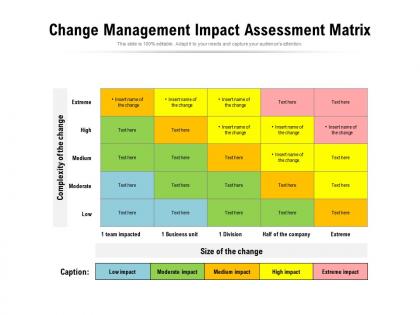
Change management impact assessment matrix





Try Before you Buy Download Free Sample Product
 Impress Your
 Audience
 100%
100% Editable
 Save Hours
 of Time


Our Change Management Impact Assessment Matrix are topically designed to provide an attractive backdrop to any subject. Use them to look like a presentation pro.
People who downloaded this PowerPoint presentation also viewed the following :
Change management impact assessment matrix with all 2 slides:
Use our Change Management Impact Assessment Matrix to effectively help you save your valuable time. They are readymade to fit into any presentation structure.
FAQs for Change management
Communication is huge - people freak out when they don't know what's happening to their jobs. Get your leaders actually participating, not just sending those generic company emails (you know the ones). Honestly, resistance is gonna happen no matter what, so listen to people's concerns instead of steamrolling through. Give them proper training and time to adjust. Being transparent about the "why" makes a massive difference. Start with small pilot programs if you can - builds momentum without overwhelming everyone. Oh, and involve people in the process rather than just dropping changes on them.
Here's the thing - people hate change when they don't get why it's happening. So explain the actual problem you're solving and how it hits them personally. I can't tell you how many managers just announce changes without context, then act shocked when everyone freaks out! Give them real examples and data if you have it. Don't sugarcoat it either - admit this stuff is genuinely hard. Stay positive about where you're headed, but be real about the bumps ahead. Oh, and make time for their questions instead of just talking at them.
Dude, employee engagement makes or breaks change projects - I've seen this so many times. Your people either become cheerleaders pushing things forward or they turn into roadblocks. Honestly, the difference is night and day. Engaged folks actually embrace new stuff, give you useful feedback, and help others get on board too. There's research showing 70% higher success rates when engagement is high, which is pretty crazy if you think about it. Get them involved early though - like actually include them in planning and be transparent about what's happening. Don't just dump changes on them.
Honestly, communication is everything here. You've gotta explain WHY you're making changes, not just what's happening. People hate being blindsided - trust me on this one. Get them involved in the planning if you can. Listen to their concerns instead of brushing them off (even when they're being dramatic about it). Training helps too, obviously. Find the people who are already on board and let them do some of the convincing for you. Oh, and celebrate small wins along the way. That stuff actually works better than trying to do everything at once.
Honestly, start by measuring the obvious stuff - adoption rates, productivity numbers, customer satisfaction. Timeline and budget tracking too. But here's the thing - soft metrics are where you really see what's working. Employee engagement surveys tell you way more than spreadsheets sometimes. Retention rates matter. How people actually feel about the transition matters. Are they using new processes without constant reminders? That's your real win right there. Just make sure you've got baseline measurements from before you started, or you'll have no clue if anything actually improved.
Honestly, I'd start with either Kotter's 8-Step Process or ADKAR - they're both solid. Kotter works really well for big company-wide changes because it walks you through creating urgency, building coalitions, all that stuff. ADKAR focuses more on individuals (Awareness, Desire, Knowledge, Ability, Reinforcement) which I actually prefer since you can see who's stuck where. There's also Lean Change Management if your company's into the agile thing - though that might be overkill depending on what you're dealing with. Pick whichever fits your culture best and don't stress too much about getting it perfect from day one.
Honestly, culture is everything when it comes to change at work. I've watched the exact same strategy totally bomb at one company but crush it at another - the only difference was how people felt about trying new things. Some places actually celebrate when experiments don't work out because hey, you learned something. Others? Good luck even suggesting a different way to file reports without getting side-eyes. My old boss used to say you can't just drop changes on people if they're already scared of messing up. Figure out what your workplace is like first, then maybe work on getting everyone more comfortable with change before you actually change anything big.
Honestly, most people just rush everything and skip the communication part completely. Don't announce changes without explaining why - that's like the fastest way to piss everyone off. Resistance is gonna happen no matter what, but listen to it because sometimes they have a point. Map out who's getting affected first, then actually involve those people from day one instead of deciding everything behind closed doors. Oh and create some kind of communication plan before you do anything else - sounds boring but trust me on this one. The human side always takes longer than you think it will.
Honestly, remote change management is like regular change management but on steroids - you've gotta overcommunicate EVERYTHING. Can't just bump into people by the coffee machine anymore, so set up those formal check-ins and pulse surveys to actually know what's going on. Visual stuff works really well, like roadmaps that keep the "why" front and center. Find champions in each location - they're basically your remote spies who'll tell you the real deal. Oh, and create tons of ways for people to ask questions since those casual hallway chats just don't exist anymore. The disconnect is real without face-to-face time.
Look, stakeholder analysis saved my butt more times than I can count. You gotta map out everyone who'll be touched by your change - from the big shots to regular users. Figure out who has real influence and who might fight you on it. I totally bombed a project once because we completely overlooked this one department (still cringe thinking about it). The trick is listing everyone first, then sorting them by how much power they have and how much your change affects them. That way you can actually talk to them in a way that makes sense for each group.
Honestly, these two are joined at the hip - can't nail one without the other. Project management tackles all the technical stuff (timelines, budgets, deliverables). Change management? That's about getting people to actually USE what you built. I've watched so many "successful" projects crash and burn because teams forgot about the human element. You gotta weave change management into your project from the start - not slap it on later like an afterthought. Find your change champions early and get them in those planning meetings. Trust me on this one.
Honestly, communication is everything - you gotta be able to sell people on the "why" behind changes. Project management skills are huge too for keeping things moving. But here's the thing that surprised me: emotional intelligence matters way more than most people realize. Reading the room, knowing when to push vs. when to back off. Data analysis helps since you'll constantly be measuring what's working. Oh, and get good at running meetings! Sounds boring but being able to facilitate productive workshops will make you stand out. Half the job is just making people feel heard during all the chaos.
Don't wait until the end to ask for feedback - that's like checking if dinner tastes good after everyone's already eaten. Weekly check-ins work great during the messy phases. Mix it up: anonymous surveys, focus groups, casual one-on-ones. Here's what kills me though - so many leaders only talk to other leaders! Big mistake. You'll get way better intel from people actually living through the changes. And honestly? If you don't respond to what people tell you, they'll just stop talking. Close that loop or you're toast.
Dude, you absolutely need to train people when rolling out changes. Can't just drop new processes on them and hope for the best - I've watched so many companies crash and burn doing exactly that. People need time to learn new skills and build confidence with whatever you're throwing at them. Plus it shows you actually care about helping them succeed instead of just making their lives harder. Oh, and don't forget the soft skills stuff too. Sometimes learning how to deal with change itself is just as important as the technical training.
Honestly, tech makes change management so much easier. Tools like Slack keep everyone in the loop during messy transitions. Project management platforms are clutch for tracking where things actually stand. Quick pulse surveys beat the hell out of waiting forever for formal feedback - I swear some companies still think quarterly surveys are enough. You can automate training rollouts and communications too, which saves tons of time. Analytics show you exactly where people are getting stuck. Don't go crazy though. Pick whatever fixes your biggest headache first, then add more tools later.
No Reviews