


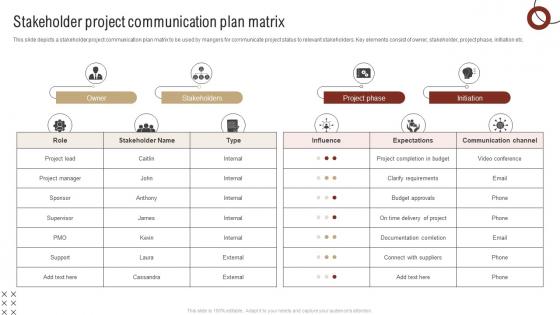
Stakeholder Project Communication Plan Matrix




Try Before you Buy Download Free Sample Product
 Impress Your
 Audience
 100%
100% Editable
 Save Hours
 of Time


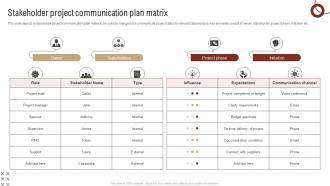
This slide depicts a stakeholder project communication plan matrix to be used by mangers for communicate project status to relevant stakeholders. Key elements consist of owner, stakeholder, project phase, initiation etc.
People who downloaded this PowerPoint presentation also viewed the following :
Stakeholder Project Communication Plan Matrix with all 6 slides:
Use our Stakeholder Project Communication Plan Matrix to effectively help you save your valuable time. They are readymade to fit into any presentation structure.





FAQs for Stakeholder Project
A Stakeholder Communication Matrix is a strategic framework that maps stakeholders, their information needs, preferred communication channels, frequency requirements, and responsible team members for each interaction. It streamlines project coordination by ensuring consistent messaging, reducing miscommunication risks, and maintaining stakeholder engagement throughout project lifecycles, with many organizations finding that structured communication approaches ultimately deliver faster project completion and stronger stakeholder buy-in.
Identifying stakeholders involves mapping internal teams, external partners, customers, regulatory bodies, and community groups affected by your project or organization. This systematic approach includes analyzing influence levels, communication preferences, and decision-making authority across departments like finance, operations, and marketing, ultimately ensuring comprehensive engagement and strategic alignment throughout your initiative.
Key components include stakeholder identification, communication frequency, preferred channels, message content, and responsibility assignments. This strategic framework enhances project transparency by defining who receives what information, when, and through which medium, with many organizations finding that structured matrices significantly streamline stakeholder engagement and minimize communication gaps.
The Stakeholder Communication Matrix enhances project transparency by clearly defining communication channels, frequency, and content requirements for each stakeholder group, while establishing accountability through documented responsibilities and feedback mechanisms. Through structured reporting protocols, project teams streamline information flow, minimize miscommunication, and ensure consistent updates across departments, with many organizations finding that systematic stakeholder engagement ultimately delivers improved project outcomes and stronger stakeholder relationships.
Effective assessment methods include surveys, one-on-one interviews, communication audits, preference mapping tools, and feedback analysis. These approaches enable organizations to identify preferred channels, frequency expectations, and content formats across different stakeholder groups, with many companies finding that tailored communication strategies significantly enhance engagement and reduce miscommunication risks.
A Stakeholder Communication Matrix should be reviewed monthly and updated whenever project scope, stakeholder roles, or communication needs change significantly. Dynamic projects often require more frequent reviews, especially during critical phases like planning transitions or milestone deliveries, with many project managers finding that proactive updates prevent communication gaps, enhance stakeholder satisfaction, and ultimately deliver smoother project execution across complex organizational environments.
Cultural differences significantly impact communication strategies by influencing preferred communication styles, decision-making processes, hierarchy expectations, and information-sharing approaches within the matrix. Organizations must adapt their stakeholder engagement methods to accommodate varying cultural norms, with many multinational companies finding that localized communication approaches, culturally sensitive messaging, and region-specific channels ultimately enhance stakeholder relationships and project success across diverse markets.
Common implementation challenges include unclear stakeholder identification, inconsistent communication frequency, inadequate channel selection, resistance to structured processes, and lack of executive buy-in. Many organizations find that initial setup requires significant time investment and cross-departmental coordination, but ultimately streamlines communication flows, reduces information gaps, and enhances project transparency, delivering improved stakeholder satisfaction and operational efficiency.
Digital tools streamline Stakeholder Communication Matrix creation through automated contact management, real-time collaboration features, customizable templates, and integrated scheduling systems. These platforms enable teams to centrally store stakeholder information, track communication history, set automated reminders, and generate reports, with many project management organizations finding that cloud-based solutions deliver enhanced accuracy and significantly faster matrix updates.
Effectiveness can be measured through stakeholder satisfaction surveys, communication response rates, feedback quality, project milestone adherence, and reduced misunderstandings or conflicts. Organizations track engagement metrics like meeting attendance, email open rates, and decision-making speed, with many finding that regular assessment cycles enable continuous improvement in communication strategies, ultimately delivering stronger stakeholder relationships and smoother project outcomes.
Feedback plays a crucial role in refining the Stakeholder Communication Matrix by identifying communication gaps, revealing stakeholder preference changes, and highlighting ineffective messaging approaches or frequency issues. Through regular feedback collection, organizations can adjust communication channels, timing, and content strategies, with many finding that iterative refinements based on stakeholder input significantly enhance engagement effectiveness and project outcomes.
A Stakeholder Communication Matrix supports conflict resolution by establishing clear communication protocols, identifying preferred channels for each stakeholder, and defining escalation pathways for addressing disputes. This structured approach enables project managers to facilitate transparent dialogue, ensure all parties receive consistent information, and create documented resolution processes, ultimately reducing misunderstandings and building stronger stakeholder relationships through systematic engagement.
Without a well-defined Stakeholder Communication Matrix, organizations face significant risks including misaligned expectations, delayed decision-making, information silos, inconsistent messaging, and stakeholder disengagement. These communication gaps often result in project failures, budget overruns, and damaged relationships, with many companies finding that poor stakeholder management ultimately leads to reduced trust, missed opportunities, and competitive disadvantage in increasingly complex business environments.
Prioritizing stakeholder needs involves assessing their influence, interest levels, project impact, and decision-making authority through stakeholder mapping and analysis frameworks. Organizations typically categorize stakeholders by engagement requirements, communication frequency, and strategic importance, with key decision-makers and high-influence groups receiving tailored messaging approaches, ultimately ensuring critical concerns are addressed while maintaining project momentum and stakeholder satisfaction.
Yes, a Stakeholder Communication Matrix can be easily adapted for different project sizes and complexities by adjusting communication frequency, detail levels, stakeholder categories, and reporting mechanisms. Small projects might use simplified weekly updates and fewer stakeholder tiers, while complex enterprise initiatives require detailed multi-tiered matrices with daily touchpoints, specialized reporting channels, and comprehensive escalation paths, ultimately ensuring scalable communication strategies that match project requirements.
-
“Superb. What a great finding. Thankful for SlideTeam. We were paying people to make slides which went all in vain. We are so happy to have found you.”
-
The best collection of PPT templates!! Totally worth the money.