


Main Working Components Of Industrial Robotic Integration In Industries IT




Try Before you Buy Download Free Sample Product
 Impress Your
 Audience
 100%
100% Editable
 Save Hours
 of Time


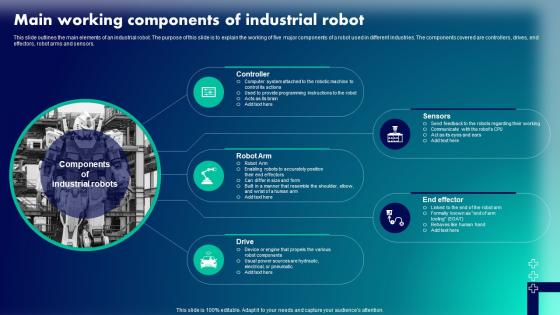
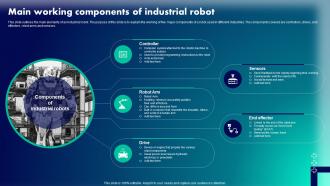
This slide outlines the main elements of an industrial robot. The purpose of this slide is to explain the working of five major components of a robot used in different industries. The components covered are controllers, drives, end effectors, robot arms and sensors.
People who downloaded this PowerPoint presentation also viewed the following :
Main Working Components Of Industrial Robotic Integration In Industries IT with all 6 slides:
Use our Main Working Components Of Industrial Robotic Integration In Industries IT to effectively help you save your valuable time. They are readymade to fit into any presentation structure.





FAQs for Main Working Components Of Industrial Robotic Integration
Industrial robotics integration delivers enhanced productivity, improved precision, reduced labor costs, consistent quality control, and increased operational safety in manufacturing environments. Through automated assembly lines, welding systems, and material handling, manufacturers like automotive plants and electronics facilities achieve faster production cycles, minimize human error, and maintain competitive advantage in increasingly demanding markets.
Companies can assess their readiness for industrial robotics integration by evaluating current infrastructure, workforce capabilities, financial resources, operational processes, and strategic objectives. Manufacturing facilities, logistics centers, and assembly operations typically conduct comprehensive audits of production workflows, employee skill levels, and technological compatibility, ultimately determining integration timelines and investment priorities for competitive advantage.
Common integration challenges include inadequate infrastructure assessment, workforce resistance and training gaps, complex system compatibility issues, safety protocol development, and budget overruns. Manufacturing and automotive companies often find that addressing these through phased implementation, comprehensive staff education, and strategic partnerships with robotics specialists ultimately delivers smoother transitions and faster ROI realization.
Industrial robotics enhances workplace safety by automating hazardous tasks, implementing precision controls, and maintaining consistent quality standards while reducing human exposure to dangerous environments. Through advanced sensors and AI integration, manufacturing facilities, chemical plants, and automotive assembly lines minimize workplace accidents, eliminate repetitive strain injuries, and achieve error rates below 0.1%, ultimately delivering safer operations and improved productivity.
Software serves as the central nervous system for industrial robotics integration, enabling programming, real-time monitoring, predictive maintenance, safety protocols, and seamless communication with existing manufacturing systems. Through advanced software platforms, manufacturers streamline production workflows, minimize downtime, and enhance operational efficiency, with automotive and electronics companies finding that integrated software solutions deliver faster changeovers and improved quality control.
Companies can measure industrial robotics ROI through metrics like labor cost reduction, production throughput increases, quality improvement rates, maintenance cost savings, and reduced workplace incidents. Manufacturing facilities typically see 15-25% efficiency gains within the first year, with automotive and electronics companies finding that faster cycle times, consistent quality, and 24/7 operational capability ultimately deliver substantial competitive advantages.
Latest trends in industrial robotics include collaborative robots (cobots), AI-powered autonomous systems, cloud-based robot management, advanced computer vision, and mobile robotic platforms. These technologies enhance manufacturing efficiency by enabling safer human-robot collaboration, predictive maintenance, and real-time optimization, with automotive, electronics, and logistics companies finding significantly improved productivity and reduced operational costs.
Automotive, electronics manufacturing, food processing, pharmaceuticals, and logistics currently lead industrial robotics adoption. These sectors leverage robotic automation to streamline production processes, enhance precision in assembly operations, and minimize labor costs, with automotive manufacturers finding that integrated robotic systems deliver faster production cycles, improved quality control, and significant competitive advantages in increasingly demanding markets.
AI integration enhances industrial robots by enabling predictive maintenance, adaptive learning, and autonomous decision-making, significantly improving precision and efficiency. Through machine learning algorithms, robots can optimize production workflows, reduce downtime, and adapt to varying operational conditions, with manufacturing facilities finding that AI-powered systems deliver faster throughput and lower operational costs.
Training for robotic integration includes safety protocols, human-robot collaboration techniques, basic programming skills, troubleshooting procedures, and adaptive workflow management. These programs enhance operational efficiency by reducing downtime, improving safety compliance, and maximizing productivity, with many manufacturing facilities finding that comprehensive training ultimately delivers smoother transitions and competitive advantage.
Small to medium-sized enterprises can leverage industrial robotics through modular automation systems, collaborative robots for specific tasks, leased equipment options, and partnerships with automation specialists. These approaches enable manufacturers, packaging companies, and assembly operations to enhance productivity, reduce labor costs, and improve quality control, while maintaining flexibility and manageable investment levels for sustainable growth.
**INPUT**: What are the ethical considerations of deploying robots in industrial settings? **OUTPUT**: Ethical considerations include workforce displacement, safety protocols, decision-making transparency, data privacy, and equitable access to retraining opportunities. While automation presents challenges, many organizations find that strategic robot deployment, combined with comprehensive employee development programs and transparent communication, ultimately delivers enhanced workplace safety, job evolution opportunities, and competitive advantage in increasingly automated manufacturing environments. [Word count: 58 words]
Robotic systems can be customized through programmable software configurations, modular hardware components, specialized end-effectors, adaptive sensors, and flexible mounting systems. Manufacturing facilities across automotive, electronics, and pharmaceutical sectors leverage these customization capabilities to optimize assembly lines, quality control processes, and material handling operations, ultimately delivering enhanced production efficiency and reduced operational costs.
Industrial robotics integration transforms labor dynamics by automating repetitive tasks, creating demand for technical roles, and requiring workforce reskilling across manufacturing sectors. While traditional assembly positions may decline, companies increasingly find that robotics generates new opportunities in programming, maintenance, and human-robot collaboration, ultimately delivering enhanced productivity and higher-skilled employment pathways.
Industrial robotics maintenance best practices include scheduled preventive maintenance, continuous performance monitoring, regular software updates, predictive analytics implementation, and comprehensive staff training programs. These approaches streamline operations by minimizing unexpected downtime, extending equipment lifespan, and maintaining optimal performance levels, with many manufacturing facilities finding that proactive maintenance strategies ultimately deliver significant cost savings and enhanced operational efficiency.
-
The content is very helpful from business point of view.
-
Illustrative design with editable content. Exceptional value for money. Highly pleased with the product.