


Stp process in marketing powerpoint presentation slides




Try Before you Buy Download Free Sample Product
 Impress Your
 Audience
 100%
100% Editable
 Save Hours
 of Time


Delivering a good PPT presentation of stp process in marketing for a successful business is a real test. That is why we have come up with a readymade Stp Process In Marketing Powerpoint Presentation Slides having 69 slides. With help of our segmentation targeting positioning ppt PowerPoint slide deck example you can give insights about market segmentation targeting and positioning for better commercial planning with the help of slides like market segmentation evaluation, business markets, geographic segmentation, demographic and psychographic segmentation, behavioral segmentation etc. Furthermore, using this presentation deck sample you can effectively put light on market research done for competitor analysis to gain edge over your business peers. Moreover, there are many other slides templates included in this marketing, segmenting, targeting and positioning presentation deck like targeting strategy, market and product positioning, different types of graphs like line chart, pie chart, clustered bar and many more. All in all, from a marketing manager to brand promoter and business strategic thinker all can take advantage from our pre-designed PowerPoint show. Stp Process In Marketing Powerpoint Presentation Slides will save your time and will put your points across. So, why not download this professional PPT example presentation to explain your stp marketing strategies like a true professional. Our Stp Process In Marketing Powerpoint Presentation Slides don't allow fantasies to distract you. They ensure you concentrate on the actuals.
People who downloaded this PowerPoint presentation also viewed the following :
Content of this Powerpoint Presentation
Slide 1: This slide introduces STP Process in Marketing. State Your Company Name and begin.
Slide 2: This slide showcases Agenda. You can add your company agenga and use it.
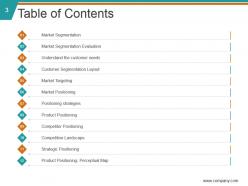
Slide 3: This slide presents Table of Contents with these points- Market Segmentation, Market Segmentation Evaluation, Understand the customer needs, Product Positioning- Perceptual Map, Strategic Positioning, Competitive Landscape, Competitor Positioning, Product Positioning, Positioning strategies, Market Targeting, Market Positioning, Customer Segmentation Layout.
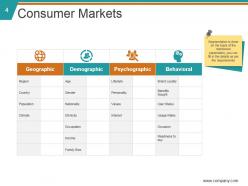
Slide 4: This slide shows Consumer Markets. Segmentation is done on the basis of the mentioned parameters, you can fill in the details as per the requirements
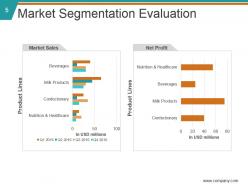
Slide 5: This slide showcases Market Segmentation Evaluation with these two parameters- Market Sales, Net Profit.
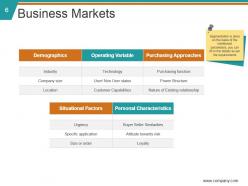
Slide 6: This slide presents Business Markets. Segmentation is done on the basis of the mentioned parameters, you can fill in the details as per the requirements
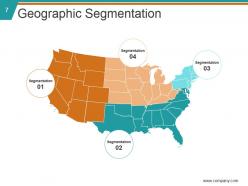
Slide 7: This slide shows Geographic Segmentation. You can add the four segmentation as per your need.
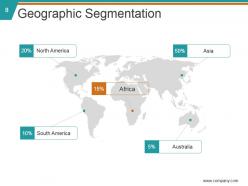
Slide 8: This slide showcases Geographic Segmentation. Add the information as per requirement.
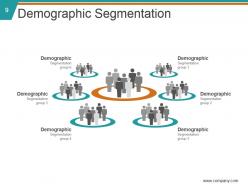
Slide 9: This slide presents Demographic Segmentation. Add the details for this
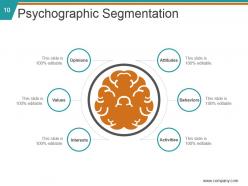
Slide 10: This slide showcases Psychographic Segmentation with these six factors- Opinions, Values, Interests, Attitudes, Behaviors, Activities.
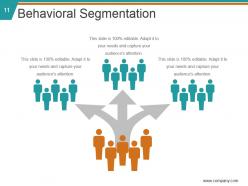
Slide 11: Behavioral Segmentation
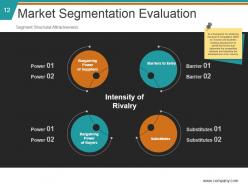
Slide 12: This slide shows Market Segmentation Evaluation with power and barrier with these four stages- Intensity of Rivalry, Bargaining Power of Suppliers, Substitutes Bargaining Power of Buyers, Barriers to Entry, Segment Structural Attractiveness, Its a framework for analyzing the level of competition within an industry and business strategy development to derive five forces that determine the competitive intensity and therefore the attractiveness of an industry.
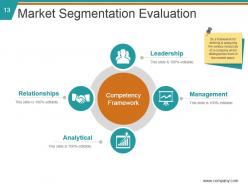
Slide 13: This slide showcases Market Segmentation Evaluation with these five steps- Competency, Framework, Leadership, Management, Analytical, Relationships, Its a framework for defining & analyzing the various resources of a company which distinguishes them in the market place.
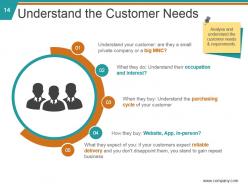
Slide 14: This slide presents Understand the Customer Needs Understand your customer: are they a small private company or a big MNC, What they do: Understand their occupation and interest, When they buy: Understand the purchasing cycle of your customer, How they buy: Website, App, in-person, What they expect of you: if your customers expect reliable delivery and you don't disappoint them, you stand to gain repeat business, Analyse and understand the customer needs & requirements.
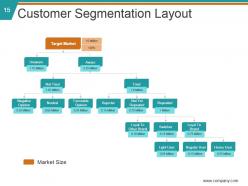
Slide 15: This slide showcases Customer Segmentation Layout. You can add the details and make the best use of it.
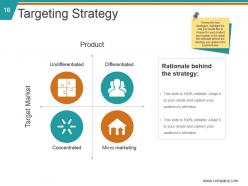
Slide 16: This slide presents Targeting Strategy Target Market, Product, Undifferentiated, Differentiated, Concentrated, Micro marketing. Among the four strategies, highlight the one you would like to choose for your product and explain in the detail the rationale behind the strategy you opted in the comment box.
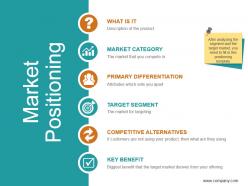
Slide 17: This slide presents market positioning with these six categories- WHAT IS IT,, MARKET CATEGORY, PRIMARY DIFFERENTIATION, TARGET SEGMENT, COMPETITIVE ALTERNATIVES, KEY BENEFIT, Market Positioning segment and the target market, you need to fill in this positioning template
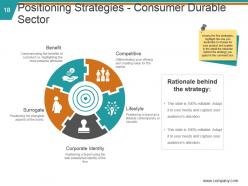
Slide 18: This slide Positioning Strategies - Consumer Durable Sector with these categories- Benefit, Corporate Identity, Lifestyle, Competitive, Surrogate, Rationale behind the strategy, Among the five strategies, highlight the one you would like to choose for your product and explain in the detail the rationale behind the strategy you opted in the comment box.
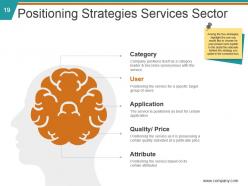
Slide 19: This slide showcases Positioning Strategies Services Sector with these factors- Category, User, Application, Attribute, Quality/ Price, Among the five strategies, highlight the one you would like to choose for your product and explain in the detail the rationale behind the strategy you opted in the comment box.
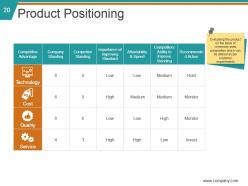
Slide 20: This slide shows Product Positioning. Evaluating the product on the basis of commonly used parameters which can be altered as per customer requirements
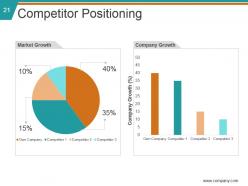
Slide 21: This slide presents Competitor Positioning with these two factors- Market Growth, Company Growth.
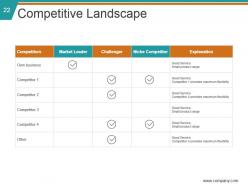
Slide 22: This slide presents Competitive Landscape table and use it for your benefits.
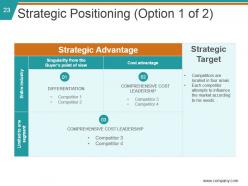
Slide 23: This slide Strategic Positioning (Option 1 of 2). You can add the data as per requirement.
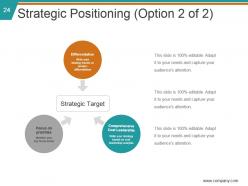
Slide 24: This slide presents Strategic Positioning (Option 2 of 2) these factors- Strategic Target, Differentiation Comprehensive Cost Leadership, Focus on priorities, Mention your key focus areas.
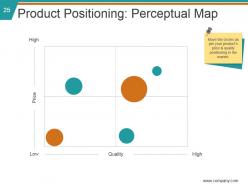
Slide 25: This slide showcases Product Positioning: Perceptual Map with these four factors- Low, High, Price, High, Quality,
Slide 26: This slide is for the coffee break.
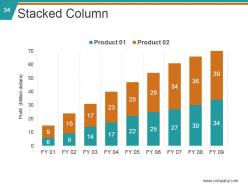
Slide 27: This is a Bar Graph image slide to show product comparison, growth etc.
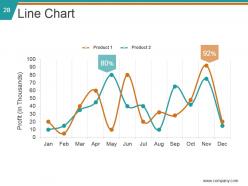
Slide 28: This slide shows a Line Chart for two product comparison.
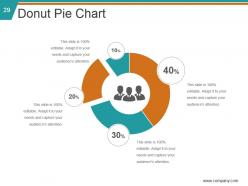
Slide 29: This slide presents Donut Pie Chart with which you can compare the product.
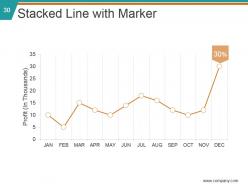
Slide 30: This slide shows Stacked Line with Marker which is being used to show the comparison.
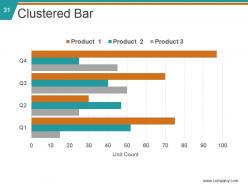
Slide 31: This slide presents Clustered Bar. Add the data and make the use of it.
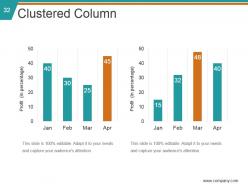
Slide 32: This slide shows Clustered Column. Add your information and use it accordingly.
Slide 33: This slide presents a Radar Chart graph/chart. Compare Product 01, Product 02 and use as per required.
Slide 34: This slide shows a Stacked Line graph in terms of percentage and years for comparison of Product 01, Product 02, Product 03 etc.
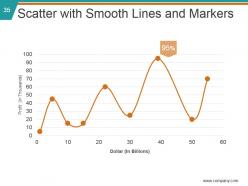
Slide 35: This slide showcases Scatter with Smooth Lines and Markers with which you can compare the products.
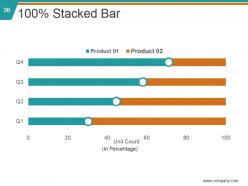
Slide 36: This slide shows Stacked Bar in which we can define the graph related problems.
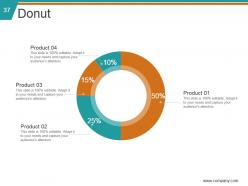
Slide 37: This slide presents Donut diagram which can be used for comparing products.
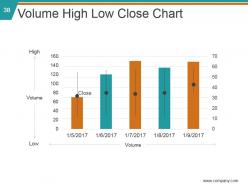
Slide 38: This slide displays a Stock Chart with volume as parameter in terms of high and low, open and close.
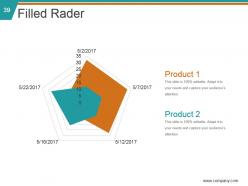
Slide 39: This slide presents Filled Rader. Add the data and use it for the comparing.
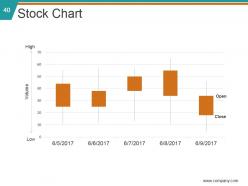
Slide 40: This slide displays a Stock Chart with volume as parameter in terms of high and low, open and close.
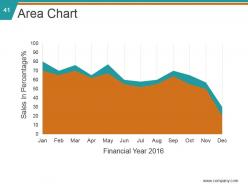
Slide 41: This slide is for area chart, you can add the comparison with this templates.
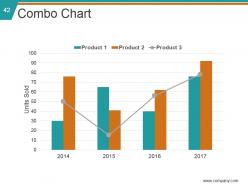
Slide 42: This slide presents Combo Chart and compare it for the product comparison.
Slide 44: This slide is titled Additional Slides.
Slide 45: This slide represents Our Mission. State your mission, goals etc.
Slide 46: This slide showcases Our Team with Name and Designation to fill.
Slide 47: This slide helps show- About Our Company. The sub headings include- Creative Design, Customer Care, Expand Company
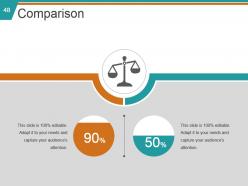
Slide 48: This slide shows Comparison of number of users and Time.
Slide 49: This slide shows Our Goals for your company.
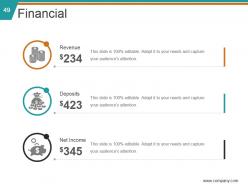
Slide 50: State your Financial score in this slide with relevant imagery and text. br/>Slide 51: This is a Quotes slide to convey message, beliefs etc.
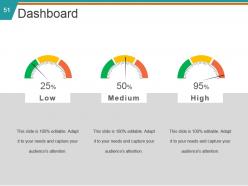
Slide 52: This is a Dashboard slide to show- Strategic System, Success, Goal Process, Sales Review, Communication Study.
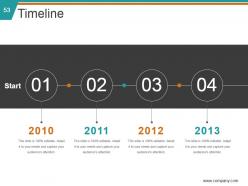
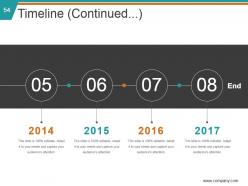
Slide 53: This is a Timelines slide to show- Plan, Budget, Schedule, Review.
Slide 54: This is a Timelines slide to show- Plan, Budget, Schedule, Review.
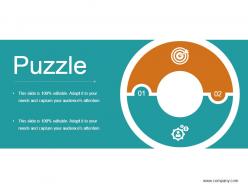
Slide 55: This is a Puzzle slide with the following subheadings- PPC Advertising, Media Marketing, Print Marketing, E-mail Campaigns
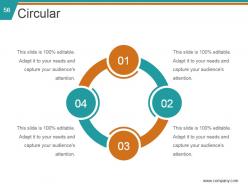
Slide 56: This is a Circular image slide to show information, specifications etc.
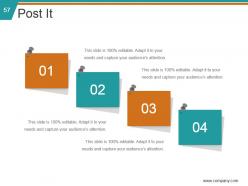
Slide 57: This is a Post It slide for reminders of Direct Marketing.
Slide 58: This is a Target slide with the following subheadings- Current Situation, Competitive Analysis, Target Segments, Vision, Positioning.
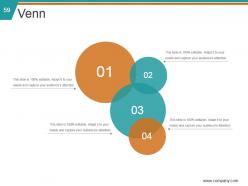
Slide 59: This is a Venn diagram image slide to show information, specifications etc.
Slide 60: This slide shows a Mind map for representing entities.
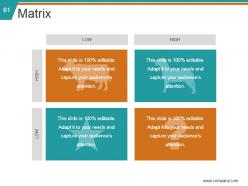
Slide 61: This slide showcases a Matrix with the following content- Development Clients, Dilemma Clients, Star Clients, High Value Clients.
Slide 62: This is a Lego Box slide with the following subheadings- Teach, Encourage, Increase, Build.
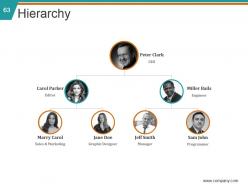
Slide 63: This is a Hierarchy slide showing- Supply Chain Manager, Supply Chain Council, Sourcing, Supplier Quality Engineer, Procurement, Logistics & Management, Supplier Management, Student, Contract Management.
Slide 64: This is a Silhouettes image slide with the subheadings- INVENTORY, PAYMENT, CASH, CREDITCARD, CHECKOUT.
Slide 65: This is a Bulb Or Idea image slide to show information, innovative aspects etc.
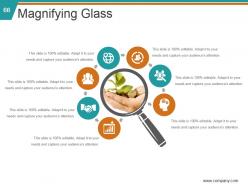
Slide 66: This is a Magnifying glass image slide to show information, scoping aspects etc.
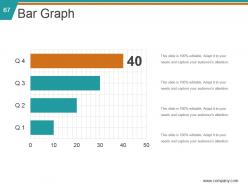
Slide 67: This is a Bar Graph image slide to show product comparison, growth etc.
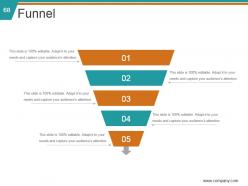
Slide 68: This is a Funnel image slide showing: Calls-to-action, Reachability, User Experience, Color Schemes, Engagement, Simplicity.
Slide 69: This is a Thank You slide for acknowledgement.
Stp process in marketing powerpoint presentation slides with all 69 slides:
Fright takes flight with our Stp Process In Marketing Powerpoint Presentation Slides. Do away with any cause for apprehension.







FAQs for Stp process in marketing
So STP breaks down into three parts - segmentation, targeting, and positioning. You start by grouping customers based on demographics, behaviors, that kind of stuff. Next step is picking which segments actually make sense for your business to go after. Then you figure out how you want those people to see your brand versus the competition. Honestly, it's pretty much the backbone of any decent marketing strategy. Without it you're just guessing at everything, which... yeah, doesn't usually work out great. The trick is getting specific with each piece instead of trying to please literally everyone.
Honestly, segmentation is a game-changer because you're not wasting time on people who don't care. Pick your top 2-3 customer groups and actually talk to them differently. Your marketing budget will thank you since you're hitting people more likely to buy. Instead of creating bland products for everyone (which never works), you can solve real problems for specific groups. I mean, think about it – would you rather get 100 random people or 20 who are genuinely interested? Focus your messaging, pricing, even where you advertise based on each segment. Way better results.
Look for four things when you're segmenting: measurable, accessible, substantial, and actionable. Can you actually put numbers to the segment? That's measurable - none of this "people who might buy eventually" nonsense. Accessible just means you can reach them through your marketing. The segment needs to be big enough to make money (substantial), and you've got to be able to create specific campaigns for them (actionable). Oh, and don't forget - all four matter. I've seen companies nail three out of four and still completely whiff because they missed one. Find segments that check every box or you're basically guessing.
Honestly, psychographic data is amazing for STP stuff. When you're segmenting, dig into values and lifestyle patterns - way better than just age/income demos. Pick segments that actually vibe with your brand's personality during targeting. I mean, shared attitudes beat age ranges every time. Then positioning becomes easier because you're speaking to their actual mindset, not generic product features. Oh, and definitely survey your current customers about interests and values first - you'll find segments hiding in plain sight that you never thought about before.
So demographic info is basically where you start with market segmentation. Age, income, gender, education, location - all that concrete stuff that's easy to measure. Most companies jump straight to this because honestly, it's the simplest data to work with. Once you've got it, you can group people into segments and figure out who your actual customers are. Then tailor your messaging to what each group wants. My advice? Don't get too obsessed with demographics though - sometimes companies rely on them way too heavily. Just collect what actually matters for your product and build customer personas from there.
Oh this is actually pretty smart! So geographic segmentation means you customize your marketing based on where people live. Think about it - Starbucks probably sells way more frappuccinos in Miami than Minnesota, you know? You can tweak your messaging, products, even prices to match what works in different areas. Plus you're not wasting ad money on random places where nobody cares about your stuff. I'd start by figuring out where your best customers are clustered, then just adapt your approach to fit each region's vibe. Climate and local culture make a huge difference honestly.
Honestly, mix your approaches here. Surveys and focus groups give you the demographic stuff, but don't sleep on behavioral data - that's where the real insights are. Purchase history, website clicks, social media patterns... it all tells a story. Geographic segmentation helps too if location matters for your business. Here's the thing most people mess up: they skip analyzing competitors, which is actually huge for figuring out where you fit. Combine hard numbers (sales data) with actual conversations with customers. Create those buyer personas everyone talks about, then test them with small campaigns first. Way better than going all-in blind.
So buyer personas are basically detailed profiles of your dream customers. Start with the obvious stuff - age, income, location. But then dig deeper into their actual problems, how they shop, what they read/watch. I always give mine real names because it feels less weird when you're writing copy for "Sarah" vs "demographic segment 2" lol. Survey people who already buy from you, check your website data, and definitely talk to your sales team - they hear all the real objections. You want maybe 2-3 solid personas that represent your main customer types. Then you can write stuff that actually speaks to what they care about.
So basically, niche targeting means you're going after a super specific group - like those people obsessed with vintage watches. You can charge way more and they'll actually love your brand. Mass market is more like what Coke does, trying to appeal to literally everyone. The trade-off is pretty obvious though. Niche = higher prices but way fewer customers. Mass market = tons of volume but you're fighting over every penny with competitors. Honestly, if you're just starting out, I'd go niche every time. Way easier to own a small corner than get crushed by the big players.
Look, STP basically helps you figure out where your product actually fits. First you segment to find gaps where competitors are missing the mark - that's gold right there. Then targeting shows you which fights are worth picking (some just aren't, trust me). Once you know your specific audience, positioning gets so much easier because you understand what they actually care about. Skip the "everything to everyone" trap. Map out where competitors sit, then find your white space. Way better than throwing stuff at the wall and hoping it sticks.
Honestly, there's so much software that makes this stuff way less painful. Google Analytics and SurveyMonkey are solid for gathering customer data - I'd start there. Your CRM probably has more useful info than you think, so dig into HubSpot or whatever you're using first. Facebook Ads Manager gets ridiculously specific with targeting (kinda creepy tbh). For positioning, SEMrush helps you see what competitors are doing. A/B testing tools like Optimizely let you try different approaches without committing to one. Oh, and Hootsuite Insights is decent for social listening if that's your thing.
Track your segments first - are they still converting differently? If not, you're probably targeting wrong. Cost per acquisition and engagement rates will tell you if you're actually hitting the right people (social analytics are honestly a game-changer here). Brand perception surveys show if your positioning's working, plus competitive differentiation scores. I'd do quarterly check-ins comparing everything back to revenue growth per segment. Don't get lost in vanity metrics though - focus on what's actually driving sales within each group you're targeting.
Honestly, the messiest part is always your data - most companies think theirs is cleaner than it actually is. You'll either cast your net way too wide trying to hit everyone, or go super narrow and miss good opportunities. Resource constraints hit hard too. The trickiest thing though? Getting everyone on the same page - marketing talks about one thing, sales pitches something totally different, then customer service delivers whatever. It's wild how often that happens. My advice: pick one solid segment first. Get really good at that before you even think about expanding to others.
So STP basically sets you up for way better CRM - you'll actually know who your customers are instead of just guessing. Proper segmentation means you can spot behavior patterns and personalize stuff for each group. Focus your CRM energy on the segments that actually matter, not just everyone randomly. Positioning is where things get interesting though - it shapes how you talk to each segment when they hit your touchpoints. I'd honestly start by looking at your current segments in the CRM and figure out which ones are worth your time.
So positioning is basically claiming your spot in people's minds - like, how do you want them to see your product vs everyone else's? You've already figured out your target market, now you need to give them a reason to remember you. What's your "why should I care?" moment, you know? Without it, you're drowning in mediocrity honestly. Maybe you're the cheap option, the fancy one, or the game-changer - doesn't matter as long as you own something specific. Oh, and don't try to be everything to everyone, that never works. Figure out what value you can deliver that literally no one else can to your people.
-
Great quality slides in rapid time.
-
Unique research projects to present in meeting.