


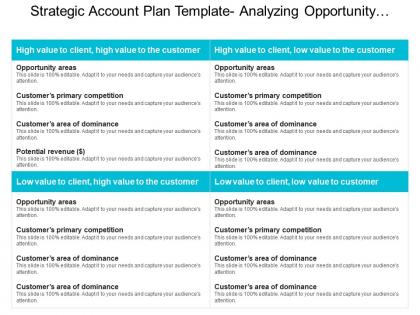
Strategic account plan template analyzing opportunity areas ppt example




Try Before you Buy Download Free Sample Product
 Impress Your
 Audience
 100%
100% Editable
 Save Hours
 of Time


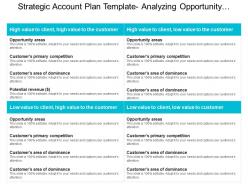
Uniquely highlight key account management plan including market opportunity analysis results with our fully professional, business oriented strategic account plan template analyzing opportunity areas PPT example PPT template. PPT template is being used by small and big companies to make one-page account plan to keep their accounts planned. Key account management teams use this wonderful PPT template to gain pertinent and predictable sales and business ideas regarding the accounts to operate the relationships and revenue by defining factors of opportunity analysis. You can also use this key account management plan template to provide sales leadership a keen insight into the account’s plans and how to provide solutions to the accounts. You can display key information about customer’s business such as account name, business, account manager, region etc. along with market opportunity and consumer analysis with this wonderful PPT in most organized way. So, just download this amazing strategic account plan template and use in your upcoming presentations to deliver your strategic plans in most structured way. Our Strategic Account Plan Template Analyzing Opportunity Areas Ppt Example ensure fewer gaps. It will cut down the intervals.
People who downloaded this PowerPoint presentation also viewed the following :
Strategic account plan template analyzing opportunity areas ppt example with all 5 slides:
Facilitate comprehension with our Strategic Account Plan Template Analyzing Opportunity Areas Ppt Example. Their ability to grasp will become better.


FAQs for Strategic account plan template analyzing opportunity
You need customer analysis first - their business, goals, pain points. Map out all the key stakeholders too. Most people skip this part but it's huge - you gotta know who actually makes decisions and how they're all connected. Also do competitive research and craft your value prop specifically for them. Oh, and set clear objectives with timelines and ways to measure success. My advice? Pick one solid account and build your template around that. Way less overwhelming than trying to nail some perfect framework right off the bat. Once you've got one working, you can adapt it for others.
Look, I'd rank your accounts based on three things: how much money they bring in, how strategically important they are, and whether you actually have a good relationship there. Growth potential matters too - and honestly, keep an eye on competitive threats because nobody wants that surprise. Put your energy into high-revenue accounts where the relationship is decent but there's still room to grow. Don't waste time on accounts that are either bulletproof or completely dead in the water. Be brutal about creating your A, B, C tiers. A-tier gets quarterly reviews and real attention. That's where the magic happens.
So basically you gotta figure out which accounts deserve your attention most. Can't give everyone the VIP treatment or you'll burn out fast. Rank your accounts into maybe 3-4 buckets based on revenue potential and how much they could grow. Top tier gets the full court press - dedicated time, personal calls, whatever they need. Smaller ones? More like standard check-ins and email updates. I learned this the hard way when I was trying to baby every single client. Build different playbooks for each segment and you'll actually see results instead of just staying busy.
Honestly, the data insights alone are game-changing for account planning. CRM systems track every touchpoint so you'll spot patterns you'd never catch otherwise. AI tools can actually predict which accounts might expand or bail - pretty wild stuff. Analytics dashboards save me hours now, no joke. Collaboration platforms keep everyone on the same page with real-time updates, which is clutch when you're juggling multiple accounts. Just don't go crazy with new tools though. Pick stuff that works with what you're already using or you'll end up drowning in admin work instead of actually selling.
Look, you gotta track both sides of this thing. Revenue stuff is obvious - account growth, how fast deals close, expansion opps. But honestly? The relationship metrics matter just as much, maybe more. Are you getting pulled into their planning sessions? Meeting their key people regularly? What slice of their big projects are you involved in? The soft stuff tells you if you're really becoming their go-to partner or just another vendor. I'd do quarterly check-ins to see what's actually working - sometimes the numbers look good but you're not as embedded as you think.
Honestly? Every quarter minimum, but the really good account managers are always messing with theirs. I'd say do major overhauls twice a year or whenever something big changes - like new decision makers come in, budgets get slashed, or a competitor starts sniffing around. Those quarterly reviews are clutch for catching relationship shifts before they blindside you. Oh, and don't be one of those people who creates a plan then ignores it for months - that's how you miss the good stuff. Actually, set those calendar reminders right now while you're thinking about it.
Don't assume you know what your accounts need - actually ask them first. I learned this the hard way lol. Pick maybe 2-3 big things to focus on per account instead of chasing everything. You'll spread yourself too thin otherwise. Keep updating your plan too because stuff changes constantly. Oh and definitely loop in your contacts when you're planning - they know what's actually doable vs what sounds good on paper. I've watched reps make these mistakes over and over. Save yourself the headache.
Dude, you'll get way better account plans when you bring other teams into the mix early. Product folks know what's coming down the pipeline. Finance can tell you about budget cycles that'll mess with your timing. I learned this the hard way - trying to get buy-in after you've already planned everything is such a pain. Set up quarterly sessions with 2-3 key people from each team. Don't just hit them up when you need favors though, that's annoying. Marketing and customer success have insights you'd never think of on your own. Makes execution so much smoother.
Get them involved in actually building the roadmap with you - don't just present finished plans. Bring their key people into workshops where you're co-creating everything together. Share your research, your challenges, even some behind-the-scenes thinking. People eat that stuff up, honestly they love feeling like insiders. Use their frameworks and language when you can. Oh, and always double-check assumptions with them before you lock anything down. The whole point is making them feel like real partners instead of just another client getting pitched to. Next time, start by asking what success looks like from their angle first.
First thing - figure out what your company's actually trying to hit this year. Revenue numbers, new markets, keeping customers happy, whatever. Then look at your accounts and see which ones help you get there. So if they're pushing healthcare hard, focus there even if those accounts aren't your cash cows yet. Each major account should tie into 2-3 company goals minimum. Here's what I'd do though - actually write down how each account supports the bigger strategy in your planning docs. Sounds boring but trust me, when your boss asks why you're spending time somewhere, you'll have a solid answer ready.
First thing - dig deep into your customer's actual business. What are they trying to achieve? What's keeping them up at night? Figure out who calls the shots and who whispers in their ear. Pick 3-5 real opportunities where you can make a difference (yeah, obviously you want sales, but think bigger). Set deadlines, assign owners, track results. Keep it simple enough that your team won't ignore it. Honestly, the quarterly review part is where most people fail - you can't just write this thing once and forget about it. Update based on what's actually happening out there.
Don't just dump customer feedback in some random appendix - weave it throughout your entire account plan. Break their input into themes first: what's working, what sucks, what's missing. Map those directly to growth opportunities and risks. Honestly, their complaints are usually your best expansion leads (weird but true). When presenting internally, use their exact words - way more powerful than summarizing everything yourself. Oh, and create a loop where you actually circle back with them later. Check if your initiatives hit the mark on what they originally told you.
So many good options for this! Salesforce and HubSpot are solid starting points - they'll handle your basic account tracking. Kapta's really built for account planning specifically if you want something more focused. Don't sleep on spreadsheets though, seriously. Sometimes simple works best when you're figuring things out. Lucidchart helps map org structures, which is clutch. Crayon's decent for competitive intel. Oh, and Miro's great for those visual brainstorming sessions where everyone's throwing ideas around. Pick whatever your team will actually stick with - the fanciest tool means nothing if it just sits there collecting digital dust.
Honestly, you've gotta bake this stuff into your planning right from the start. Map out what could go wrong - competition heating up, key people leaving, budget getting slashed, the usual suspects. I'm a fan of those simple probability vs impact grids because they actually make sense when you're looking at them later. Give someone ownership over each big risk and write down real mitigation steps, not just "we'll keep an eye on it" BS. Oh, and review quarterly with your team - can't stress this enough. Things change fast out there. Don't let it become another dusty document nobody touches.
Yeah, competitive analysis is huge - you've gotta know who else is fighting for that same budget. Map out the other vendors they're considering and figure out what makes you different. I've watched so many deals fall apart because people ignored what the competition was doing. Smart move is finding those gaps where nobody else is playing and owning that space. Your client contacts will usually tell you straight up who else they're talking to if you just ask. It's wild how many account plans skip this step entirely.
-
Professional and unique presentations.
-
Editable templates with innovative design and color combination.