


Strategic journey initiatives ppt examples




Try Before you Buy Download Free Sample Product
 Impress Your
 Audience
 100%
100% Editable
 Save Hours
 of Time


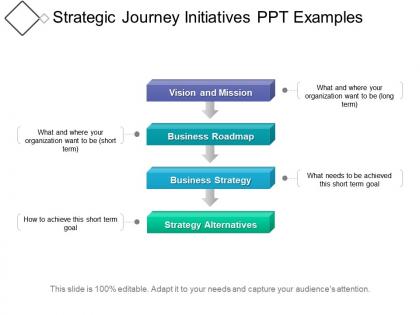
Manage a high level plan to achieve one or more goals of your organizations with the help of our professionally designed business presentation that is strategic journey initiatives PPT examples slideshow. This key business venture Powerpoint template is a compact of several subsets of skills including tactics, siegecraft, logistics etc., which requires setting the goals, determining the actions to achieve the goals and mobilizing resources to execute the actions. It is needless to say that the strategy describes how the ends (goals) will be achieved by the means (resources) and can be intended or can be emerged as a pattern of activity as the organization adapts its environment or competes, for this purpose, avail this business program survey PPT slide which further provides you to perform the other activities also such as business strategic planning and business strategic thinking. This PPT consists of four stages which are; strategic alternatives, business strategy, business roadmap and vision and mission. The user of this presentation shall feel the difference from other commonly designed PPT slides as the same is a complete platform crafted from planning to implementation of business strategies and business dynamics from time to time. You will be happy with the facilities included in our Strategic Journey Initiatives Ppt Examples. Get to feel a lot of joy.
People who downloaded this PowerPoint presentation also viewed the following :
Content of this Powerpoint Presentation
Description:
This slide is designed as a strategic planning tool for organizations looking to structure their approach to achieving goals. The slide is titled "Strategic Journey Initiatives PPT Examples" and has a flow that begins with "Vision and Mission," which anchors the organization's long-term aspirations. The "Business Roadmap" follows, indicating a timeline or plan that details the progression towards the vision. Moving on, "Business Strategy" outlines specific objectives necessary for the short-term attainment of the roadmap's milestones. The final level, "Strategy Alternatives," presents various tactics or methods that can be adopted to meet the short-term goals outlined previously.
Use Cases:
It's suitable for many industries aiming to set a strategic direction, from companies in their foundational stages to established entities seeking to revamp or reassess their strategic orientation.
1. Technology:
Use: Clarifying long-term vision and outlining step-by-step technological development strategies
Presenter: Chief Technology Officer
Audience: Company stakeholders and development team
2. Healthcare:
Use: Defining healthcare service delivery objectives and strategic plans for patient care improvement
Presenter: Hospital Administrator
Audience: Hospital board members and healthcare staff
3. Education:
Use: Setting educational goals and curriculum development pathways for institutions
Presenter: Director of Education
Audience: Academic staff and board of education
4. Finance:
Use: Illustrating financial growth targets and investment strategies for the company
Presenter: Chief Financial Officer
Audience: Investors and financial analysts
5. Retail:
Use: Planning retail expansion and market penetration strategies
Presenter: Business Development Manager
Audience: Marketing team and retail partners
6. Manufacturing:
Use: Outlining production goals and efficiency-improvement methods
Presenter: Operations Manager
Audience: Plant managers and production staff
7. Non-Profit:
Use: Establishing mission objectives and resource allocation strategies for programs
Presenter: Program Director
Audience: Donors and program beneficiaries
Strategic journey initiatives ppt examples with all 5 slides:
Ensure the basics are abundantly clear with our Strategic Journey Initiatives Ppt Examples. It helps address the fundamentals.



FAQs for Strategic journey
Effective strategic initiatives require clear objective definition, stakeholder alignment, resource allocation frameworks, performance metrics, and timeline establishment. These components work together by ensuring organizational focus, enabling cross-functional collaboration, and delivering measurable outcomes, with many organizations finding that well-defined initiatives drive competitive advantage and operational efficiency.
Organizations align strategic initiatives with their long-term vision by establishing clear objectives, conducting regular assessments, and implementing robust governance frameworks that ensure every project supports overarching goals. Through strategic mapping and milestone tracking, companies can streamline resource allocation, enhance operational efficiency, and maintain focus on core mission elements, with many finding that this alignment ultimately delivers competitive advantage and sustainable growth.
Strategic initiatives can be prioritized using methodologies like portfolio scoring matrices, strategic alignment assessments, resource capacity analysis, risk-return evaluations, and stakeholder impact mapping. These frameworks enable organizations to systematically evaluate competing priorities by weighing strategic fit, resource requirements, and potential outcomes, with many companies finding that structured prioritization processes ultimately deliver better resource allocation and measurable competitive advantage.
Strategic initiatives significantly enhance organizational performance by aligning resources with long-term objectives, streamlining operations, and fostering innovation across departments. These focused efforts enable companies to adapt to market changes, improve competitive positioning, and accelerate growth trajectories, with many organizations finding that well-executed initiatives deliver measurable improvements in revenue, efficiency, and market share.
Stakeholder engagement drives strategic initiative success by securing buy-in, providing critical insights, identifying potential roadblocks, and ensuring resource allocation aligns with objectives. Through collaborative planning and transparent communication, organizations enhance project outcomes, minimize resistance, and accelerate implementation timelines, with many companies finding that early stakeholder involvement ultimately delivers smoother execution and sustainable competitive advantage.
Organizations measure strategic initiative success through key performance indicators, milestone tracking, financial metrics, stakeholder feedback, and regular progress assessments against defined objectives. These measurement approaches enable companies to evaluate ROI, operational efficiency, and market impact, with many businesses finding that comprehensive dashboards and quarterly reviews ultimately deliver greater accountability and strategic course correction capabilities.
Organizations face challenges including unclear objectives, insufficient resource allocation, poor communication across departments, resistance to change, and inadequate progress monitoring. These obstacles often stem from competing priorities, limited stakeholder buy-in, and misaligned expectations, with many companies finding that structured change management and regular milestone reviews significantly enhance implementation success rates.
Technology and digital transformation enhance strategic initiative execution by automating workflows, providing real-time analytics, and enabling seamless collaboration across departments and locations. Through cloud platforms, AI-driven insights, and integrated project management systems, organizations streamline resource allocation, accelerate decision-making, and improve stakeholder communication, ultimately delivering faster implementation timelines and measurable competitive advantages.
Sustainability strategies include stakeholder engagement, resource allocation planning, performance monitoring systems, change management protocols, and continuous improvement frameworks. These approaches streamline long-term success by embedding initiatives into organizational culture, securing ongoing funding, and adapting to market changes, with many organizations finding that regular assessment and stakeholder communication ultimately delivers sustained competitive advantage.
Cultural factors significantly influence strategic initiative acceptance through shared values, communication patterns, risk tolerance, and change readiness within organizations. Companies with collaborative cultures, open communication channels, and innovation-focused mindsets typically see faster adoption, while those with hierarchical structures or risk-averse tendencies may face resistance, ultimately requiring tailored change management approaches for successful implementation.
Best practices for communicating strategic initiatives include establishing clear messaging frameworks, utilizing multiple communication channels, providing regular progress updates, ensuring two-way dialogue opportunities, and aligning communications with organizational values. Through town halls, digital platforms, and targeted presentations, leadership teams enhance transparency, build stakeholder confidence, and accelerate initiative adoption, ultimately delivering stronger organizational alignment and improved strategic outcomes.
Organizations leverage data analytics in strategic initiatives by identifying market trends, assessing operational performance, predicting customer behaviors, and measuring initiative outcomes in real-time. Through advanced analytics platforms, companies streamline resource allocation, enhance decision-making accuracy, and minimize strategic risks, with many finding that data-driven approaches deliver faster implementation timelines and significantly improved competitive positioning.
Leadership and management styles significantly influence strategic initiative success through vision communication, resource allocation, team alignment, and change management approaches. Transformational leaders often drive innovation-focused initiatives more effectively, while transactional managers excel at operational improvements, with many organizations finding that adaptive leadership styles matching initiative complexity ultimately deliver higher implementation success rates and sustainable competitive advantage.
Feedback loops can be established through regular stakeholder reviews, performance metric tracking, customer satisfaction surveys, and cross-departmental progress assessments. These mechanisms enable organizations to identify implementation challenges early, adjust resource allocation, and refine strategic approaches, with many companies finding that continuous feedback ultimately delivers more agile execution and better strategic outcomes.
Successful strategic initiatives include Amazon's cloud transformation with AWS, Disney's digital streaming pivot with Disney+, Microsoft's subscription model shift to Office 365, Starbucks' mobile-first customer experience strategy, and Tesla's vertical integration approach. These initiatives demonstrate how organizations can revolutionize their markets by embracing technological innovation, reimagining customer touchpoints, and strategically repositioning their core offerings, ultimately delivering sustainable competitive advantage and significant revenue growth across diverse industries.
-
I discovered this website through a google search, the services matched my needs perfectly and the pricing was very reasonable. I was thrilled with the product and the customer service. I will definitely use their slides again for my presentations and recommend them to other colleagues.
-
Easy to edit slides with easy to understand instructions.
-
Unique research projects to present in meeting.
-
Unique design & color.