


Strategies For Forecasting And Ordering Inventory Powerpoint Presentation Slides




Try Before you Buy Download Free Sample Product
 Impress Your
 Audience
 100%
100% Editable
 Save Hours
 of Time


Gain access to our meticulously designed Strategies for forecasting and ordering inventory template, which facilitates real-time inventory tracking, efficient stock procurement, and supplier management. Our comprehensive Warehouse Management deck highlights processes for maintaining optimal stock levels by accurately purchasing merchandise from suppliers. It also explores demand forecasting techniques, such as historical sales data analysis, and methods like economic order quantity and reorders point to determine inventory requirements. Additionally, our Inventory Tracking PPT delves into warehouse optimization strategies like ABC analysis, warehouse automation, and automated tracking systems to minimize inventory waste and optimize order timings. It addresses order fulfillment strategies and stock-out prevention measures while shedding light on inventory management challenges and associated costs. Lastly, our Automated inventory tracking module also includes informative dashboards and key performance indicators KPIs for tracking warehouse operations and inventory. Do not miss the opportunity to download it now. Download it now.
People who downloaded this PowerPoint presentation also viewed the following :
Content of this Powerpoint Presentation
Slide 1: This slide introduces Strategies for Forecasting and Ordering Inventory. Commence by stating Your Company Name.
Slide 2: This slide depicts the Agenda of the presentation.
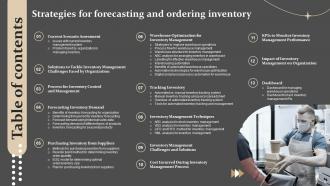
Slide 3: This slide includes the Table of contents.
Slide 4: This slide highlights the Title for the Topics to be discussed further.
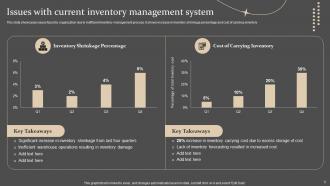
Slide 5: This slide showcases issues faced by organization due to inefficient inventory management process.
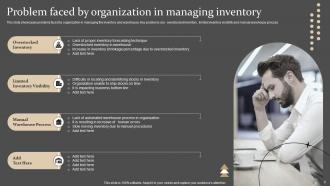
Slide 6: This slide reveals the problems faced by organization in managing the inventory and warehouse.
Slide 7: This slide presents the Heading for the Contents to be covered next.
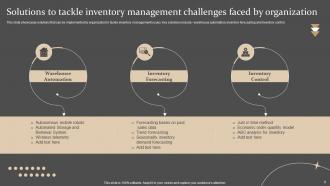
Slide 8: This slide showcases solutions that can be implemented by organization to tackle inventory management issues.
Slide 9: This slide includes the Title for the Ideas to be discussed to be discussed further.
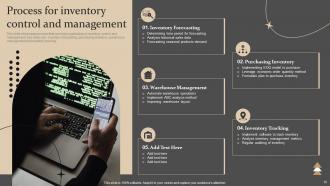
Slide 10: This slide showcases process that can help organization in inventory control and management.
Slide 11: This slide portrays the Heading for the Ideas to be covered next.
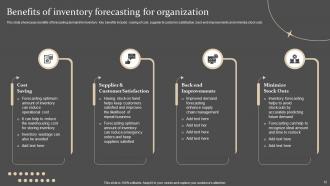
Slide 12: This slide showcases benefits of forecasting demand for inventory.
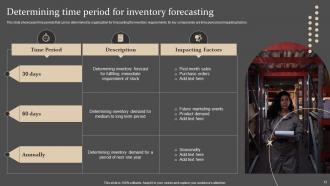
Slide 13: This slide highlights the time periods that can be determined by organization for forecasting the inventory requirements.
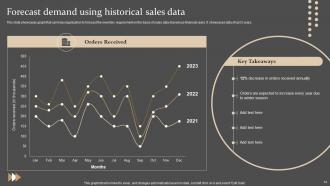
Slide 14: This slide shows graph that can help organization to forecast the inventory requirement.
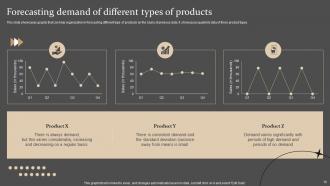
Slide 15: This slide reveals graphs that can help organization in forecasting different type of products on the basis of previous data.
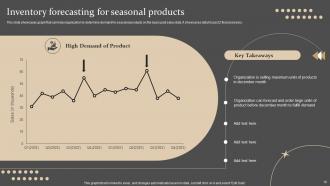
Slide 16: This slide depicts graph that can help organization to determine demand for seasonal products on the basis past sales data.
Slide 17: This slide presents the Title for the Contents to be discussed further.
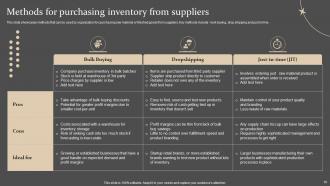
Slide 18: This slide showcases methods that can be used by organization for purchasing raw material or finished goods from suppliers.
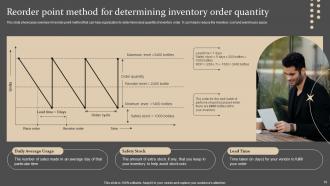
Slide 19: This slide presents the overview of reorder point method that can help organization to determine ideal quantity of inventory order.
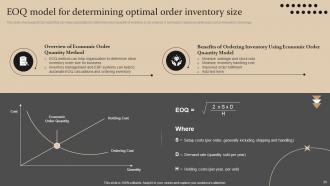
Slide 20: This slide reveals EOQ model that can help organization to determine ideal quantity of inventory to be ordered.
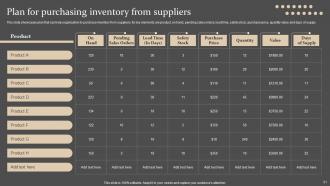
Slide 21: This slide indicates the plan that can help organization to purchase inventory from suppliers.
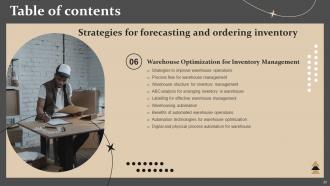
Slide 22: This slide contains the Heading for the Topics to be covered next.
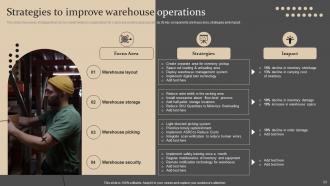
Slide 23: This slide showcases strategies that can be implemented by organization for improving warehousing operations.
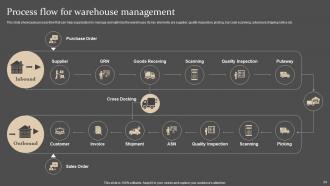
Slide 24: This slide represents process flow that can help organization to manage and optimize the warehouse.
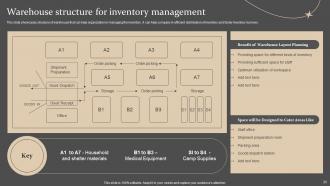
Slide 25: This slide portrays the structure of warehouse that can help organization in managing the inventory.
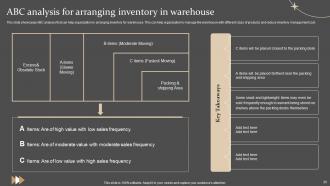
Slide 26: This slide showcases ABC analysis that can help organization in arranging inventory for warehouse.
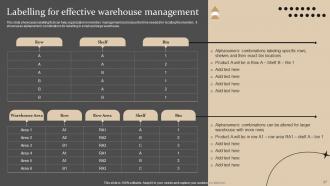
Slide 27: This slide states labelling that can help organization in inventory management and reduce the time needed for locating the inventory.
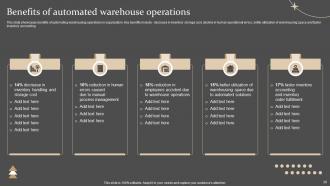
Slide 28: This slide showcases benefits of automating warehousing operations in organization.
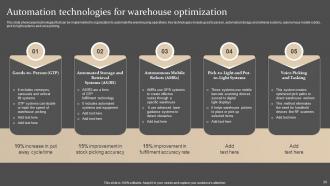
Slide 29: This slide highlights technologies that can be implemented in organization to automate the warehousing operations.
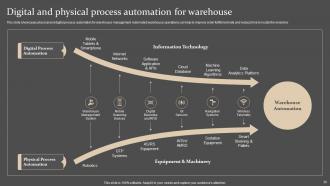
Slide 30: This slide portrays physical and digital process automation for warehouse management.
Slide 31: This slide includes the Title for the Topics to be discussed next.
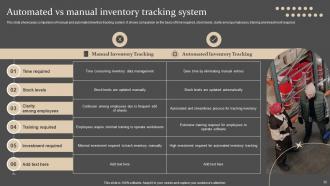
Slide 32: This slide showcases comparison of manual and automated inventory tracking system.
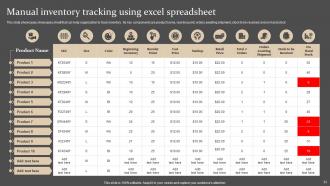
Slide 33: This slide indicates the sheet that can help organization to track inventory.
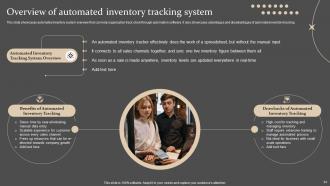
Slide 34: This slide presents automated inventory system overview that can help organization track stock through automation software.
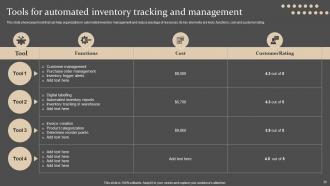
Slide 35: This slide showcases tools that can help organization in automated inventory management and reduce wastage of resources.
Slide 36: This slide portrays the Heading for the Contents to be coveerd further.
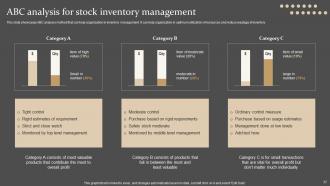
Slide 37: This slide showcases ABC analysis method that can help organization in inventory management.
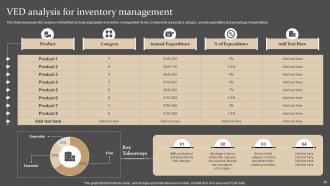
Slide 38: This slide reveals VED analysis method that can help organization in inventory management.
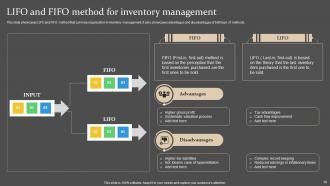
Slide 39: This slide displays LIFO and FIFO method that can help organization in inventory management.
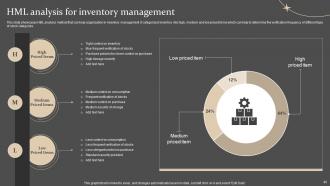
Slide 40: This slide includes HML analysis method that can help organization in inventory management.
Slide 41: This slide portrays the Title for the Ideas to be discussed next.
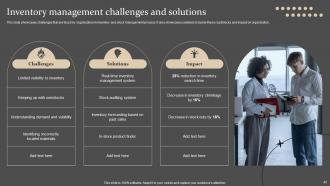
Slide 42: This slide showcases challenges that are faced by organization in inventory and stock management process.
Slide 43: This slide exhibits the Heading for the Ideas to be covered further.
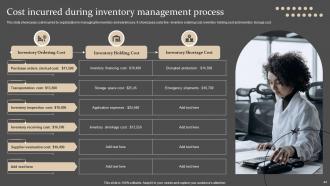
Slide 44: This slide showcases cost incurred by organization in managing the inventory and warehouse.
Slide 45: This slide highlights the Title for the Contents to be discussed next.
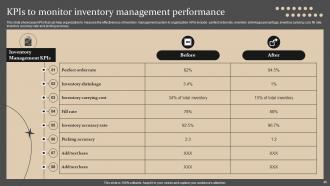
Slide 46: This slide showcases KPIs that can help organization to measure the effectiveness of inventory management system in organization.
Slide 47: This slide portrays the Heading for the Topics to be covered further.
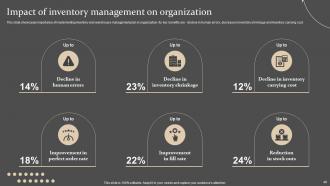
Slide 48: This slide showcases importance of implementing inventory and warehouse management plan in organization.
Slide 49: This slide contains the Title for the Topics to be discussed next.
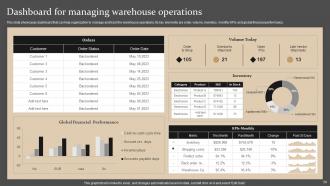
Slide 50: This slide showcases dashboard that can help organization to manage and track the warehouse operations.
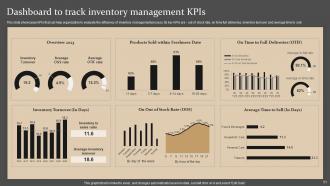
Slide 51: This slide presents KPIs that can help organization to evaluate the efficiency of inventory management process.
Slide 52: This is the Icons slide containing all the Icons used in the plan.
Slide 53: This slide is used for depicting some Additional information.
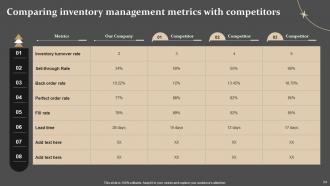
Slide 54: This slide focuses on Comparing inventory management metrics with competitors.
Slide 55: This slide represents the Roadmap of the company.
Slide 56: This is the Venn diagram slide.
Slide 57: This slide contains the Post it notes for reminders and deadlines.
Slide 58: This is the Idea generation slide for encouraging fresh ideas.
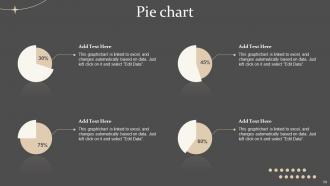
Slide 59: This slide elucidates the Pie chart.
Slide 60: This is our team slide. State your team-related ifnromation here.
Slide 61: This is the Puzzle slide with related imagery.
Slide 62: This is the Quotes slide for motivation.
Slide 63: This slide indicates the organization's targets.
Slide 64: This is the Thank You side for acknowledgement.
Strategies For Forecasting And Ordering Inventory Powerpoint Presentation Slides with all 69 slides:
Use our Strategies For Forecasting And Ordering Inventory Powerpoint Presentation Slides to effectively help you save your valuable time. They are readymade to fit into any presentation structure.















FAQs for Strategies For Forecasting And Ordering Inventory
Inventory forecasting delivers enhanced operational efficiency, reduced carrying costs, minimized stockouts, improved cash flow management, and stronger supplier relationships. Through predictive analytics and demand planning, organizations streamline procurement processes, optimize warehouse space, and enhance customer satisfaction, with many retailers and manufacturers finding that accurate forecasting ultimately provides significant competitive advantage in increasingly complex supply chains.
Historical sales data improves inventory forecasting accuracy by revealing seasonal patterns, identifying demand trends, and highlighting cyclical behaviors across product categories. Through advanced analytics and machine learning algorithms, retailers, manufacturers, and distributors can predict future demand more precisely, optimize stock levels, and reduce both overstock costs and stockouts, ultimately delivering enhanced customer satisfaction and improved profit margins.
Seasonality significantly impacts inventory forecasting by creating predictable demand fluctuations that require strategic planning, historical analysis, and adaptive inventory models. Retailers use seasonal trending algorithms, manufacturers adjust production schedules months ahead, and hospitality businesses leverage past performance data to optimize stock levels, ultimately delivering cost efficiency and preventing both stockouts and overstock situations.
Perishable goods benefit most from short-term forecasting methods like exponential smoothing, moving averages, and demand sensing that account for seasonality, shelf life, and rapid demand shifts. Non-perishable items can leverage longer-term statistical models, trend analysis, and machine learning algorithms, with many retailers finding that perishables require daily forecasting while non-perishables enable monthly planning, ultimately delivering reduced waste and optimized inventory costs.
AI and machine learning enhance inventory forecasting by analyzing vast datasets, identifying complex demand patterns, and automatically adjusting predictions based on real-time market conditions. These technologies enable retailers, manufacturers, and distributors to achieve significantly more accurate forecasts, reduce stockouts and overstock situations, and optimize inventory investments, with many organizations finding that automated forecasting delivers 20-30% improvements in inventory efficiency.
Key metrics include forecast accuracy, inventory turnover ratio, stockout frequency, carrying costs, and demand variability measures. These indicators enable businesses to assess prediction precision, optimize warehouse efficiency, and minimize both excess inventory costs and lost sales opportunities, with many retail and manufacturing organizations finding that regular monitoring of these metrics delivers improved cash flow and enhanced customer satisfaction levels.
External factors significantly influence inventory forecasts by creating variability in demand patterns, supply chain costs, and consumer purchasing behaviors across different market segments. Economic downturns may reduce luxury goods demand while increasing essential items consumption, with retailers in sectors like automotive, electronics, and fashion adjusting forecasting models to account for seasonal trends, competitor actions, and broader market volatility, ultimately enabling more responsive inventory management.
Common challenges include data quality issues, demand volatility, seasonality fluctuations, supply chain disruptions, and integration complexities with existing systems. These obstacles often create forecasting inaccuracies, especially in retail and manufacturing sectors, while many organizations find that combining multiple forecasting methods with real-time analytics ultimately delivers improved accuracy and competitive advantage.
Cross-departmental collaboration enhances inventory forecasting by integrating sales insights, marketing campaign data, production schedules, and customer service feedback into comprehensive demand predictions. When teams from sales, marketing, operations, and finance share real-time information, organizations achieve significantly more accurate forecasts, reduce stockouts and overstock situations, and ultimately deliver improved customer satisfaction while minimizing carrying costs.
Qualitative forecasting relies on expert judgment, market research, and subjective insights, while quantitative methods use historical data, statistical models, and mathematical algorithms to predict inventory needs. Qualitative approaches prove valuable for new products or volatile markets where data is limited, whereas quantitative methods excel in stable environments, with many retailers finding that combining both approaches delivers more accurate forecasts and optimized stock levels.
Businesses balance forecast accuracy with operational flexibility by implementing rolling forecasts, maintaining safety stock buffers, and using multiple forecasting models simultaneously. This strategic combination enables companies to respond quickly to demand fluctuations while minimizing stockouts, with many retailers finding that flexible reorder points and supplier partnerships ultimately deliver both cost efficiency and customer satisfaction.
Customer feedback and behavior provide critical data for inventory forecasting by revealing purchasing patterns, seasonal preferences, product satisfaction levels, and emerging demand trends. Through analyzing customer reviews, purchase history, and behavioral analytics, retailers can identify slow-moving items, predict seasonal spikes, and adjust stock levels accordingly, ultimately reducing overstock costs while improving product availability and customer satisfaction.
Small businesses can implement inventory forecasting through basic spreadsheet templates, free demand planning tools, automated reorder point systems, and simple trend analysis methods. These cost-effective approaches enable retailers, restaurants, and service providers to optimize stock levels, reduce carrying costs, and improve cash flow, with many small enterprises finding that even basic forecasting delivers significant competitive advantages.
Technologies best suited for real-time inventory forecasting include AI-powered predictive analytics, IoT sensors, cloud-based ERP systems, machine learning algorithms, and automated demand planning software. These solutions streamline operations by processing live data feeds, tracking inventory movements automatically, and adjusting forecasts instantly, with retail chains and manufacturing companies finding that real-time visibility reduces stockouts while minimizing excess inventory costs.
Inventory forecasting reduces carrying costs by optimizing stock levels, minimizing excess inventory, preventing overordering, and reducing storage expenses and waste. Through predictive analytics and demand planning, organizations streamline warehouse operations, accelerate inventory turnover, and free up working capital, with many retailers and manufacturers finding that accurate forecasting delivers significantly improved cash flow and operational efficiency.
-
SlideTeam has helped me take my presentation to the next level. Everyone at the office is impressed! I’ll be using their designs for a long-long time.
-
Unique research projects to present in meeting.