


Strategies To Establish Clear Communication To Streamline Implementing Cost Effective Warehouse Stock





Try Before you Buy Download Free Sample Product
 Impress Your
 Audience
 100%
100% Editable
 Save Hours
 of Time


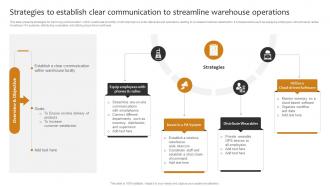
This slide presents strategies for improving communication within warehouse proximity which help improve order deliveries and operations, leading to increased customer satisfaction. It includes tactics such as equipping employees with phones and radios, investing in PA systems, distributing wearables, and utilizing cloud-driven software.
People who downloaded this PowerPoint presentation also viewed the following :
Strategies To Establish Clear Communication To Streamline Implementing Cost Effective Warehouse Stock with all 9 slides:
Use our Strategies To Establish Clear Communication To Streamline Implementing Cost Effective Warehouse Stock to effectively help you save your valuable time. They are readymade to fit into any presentation structure.








FAQs for Strategies To Establish Clear Communication To Streamline Implementing Cost
Clear communication significantly enhances warehouse efficiency by reducing errors, minimizing delays, and streamlining coordination between teams, inventory systems, and logistics partners. Through real-time updates and standardized protocols, warehouses achieve faster order processing, improved inventory accuracy, and seamless workflow transitions, with many operations finding that enhanced communication ultimately delivers reduced operational costs and improved customer satisfaction.
**INPUT**: What tools and technologies can enhance communication among warehouse staff? **OUTPUT**: Communication-enhancing tools include warehouse management systems, mobile devices, digital displays, two-way radios, and voice-picking technology. These technologies streamline operations by enabling real-time updates, coordinating tasks seamlessly, and reducing miscommunication errors, with many distribution centers finding that integrated communication systems ultimately deliver faster order fulfillment and improved operational efficiency. **Word count: 52 words**
SOPs improve warehouse communication clarity by establishing standardized processes, defining role responsibilities, creating consistent terminology, and providing step-by-step task guidance. Through documented procedures, warehouse teams streamline operations, reduce errors, and enhance coordination across shifts, with many distribution centers finding that well-implemented SOPs ultimately deliver faster processing times and improved operational efficiency.
Common communication barriers in warehouse environments include language differences among diverse workforces, noise interference from machinery, shift-change information gaps, technology adoption challenges, and hierarchical communication breakdowns. These obstacles can be overcome through multilingual signage and training, standardized digital communication systems, structured handover protocols, and regular cross-departmental meetings, ultimately enhancing operational efficiency and reducing costly errors.
Effective communication facilitates better inventory management by enabling real-time data sharing, coordinating cross-functional teams, and streamlining reporting processes across warehouse operations. Through integrated communication systems, logistics managers can track stock levels, anticipate demand fluctuations, and optimize resource allocation, while warehouse staff coordinate seamlessly, ultimately delivering improved accuracy and operational efficiency.
Regular training establishes consistent communication protocols, reinforces safety procedures, introduces new technologies, and builds cross-functional understanding among warehouse teams. Through structured programs, organizations enhance operational efficiency, reduce miscommunication errors, and improve coordination between picking, packing, and shipping departments, with many distribution centers finding that ongoing education ultimately delivers faster order fulfillment and stronger team collaboration.
Visual communication strategies in warehouse management include digital displays, color-coded zones, floor markings, signage systems, and dashboard analytics. These approaches streamline operations by reducing confusion, accelerating training processes, and minimizing errors, with many logistics companies finding that visual cues enable faster picking, improved safety compliance, and enhanced operational efficiency across their facilities.
Methods for gathering warehouse staff feedback include anonymous surveys, focus groups, one-on-one meetings, suggestion boxes, and digital feedback platforms. These approaches enable managers to identify communication gaps, assess training effectiveness, and understand operational challenges, with many warehouses finding that regular feedback collection significantly improves workflow efficiency, reduces errors, and enhances overall team satisfaction.
Cross-departmental communication significantly enhances warehouse productivity by streamlining inventory coordination, reducing order fulfillment errors, and accelerating decision-making processes across operations, procurement, and logistics teams. When departments share real-time data seamlessly, organizations experience faster turnaround times, minimize costly bottlenecks, and optimize resource allocation, ultimately delivering improved operational efficiency and competitive advantage.
Miscommunication in warehouse safety protocols leads to increased accident risks, regulatory compliance failures, equipment damage, operational delays, and higher insurance costs. These breakdowns particularly impact high-volume distribution centers and manufacturing facilities, where unclear instructions regarding machinery operation, hazardous material handling, and emergency procedures can result in workplace injuries, costly shutdowns, and ultimately reduced competitive advantage through compromised operational efficiency.
A centralized communication platform streamlines warehouse operations by consolidating order updates, inventory alerts, and task assignments into a single interface, eliminating information silos and reducing miscommunication. Through real-time visibility and automated notifications, warehouse teams coordinate more effectively across receiving, picking, and shipping departments, ultimately delivering faster order fulfillment and enhanced operational efficiency.
Clear communication in warehouse management enhances teamwork by establishing shared protocols, ensuring accurate task delegation, facilitating real-time coordination between shifts, and creating transparent feedback channels for continuous improvement. Through digital communication systems and standardized procedures, warehouse teams streamline operations, reduce errors, and maintain consistent productivity levels, with many logistics organizations finding that structured communication frameworks ultimately deliver faster order fulfillment and improved workplace safety.
**INPUT**: What strategies can be employed to ensure that new employees adapt to the communication culture in warehouses? **OUTPUT**: Effective adaptation strategies include structured onboarding programs, mentorship pairing, hands-on communication training, regular feedback sessions, and cross-departmental shadowing opportunities. These approaches streamline integration by establishing clear protocols, building relationships with experienced staff, and reinforcing safety-focused dialogue, with many warehouses finding that systematic communication training ultimately delivers faster productivity ramp-up and enhanced operational safety.
Data analytics identifies communication gaps by analyzing workflow bottlenecks, tracking information delays between departments, and monitoring real-time operational metrics across warehouse systems. Through predictive analytics and automated reporting dashboards, warehouse managers can pinpoint where miscommunication causes delays, optimize shift handovers, and streamline coordination between receiving, picking, and shipping teams, ultimately delivering faster order fulfillment and enhanced operational efficiency.
Best practices for conducting effective communication in high-pressure warehouse scenarios include establishing clear protocols, using standardized terminology, implementing real-time communication systems, conducting brief team huddles, and maintaining open feedback channels. These approaches streamline operations by reducing errors, accelerating decision-making, and enhancing coordination across shifts, with many distribution centers finding that structured communication protocols ultimately deliver faster order fulfillment and improved safety outcomes.
-
Qualitative and comprehensive slides.
-
I faced no difficulty while searching for the slide I wanted. Honestly, the website’s interface is easy to use and can be navigated easily!