


Strategies To Improve Quality Management Process




Try Before you Buy Download Free Sample Product
 Impress Your
 Audience
 100%
100% Editable
 Save Hours
 of Time


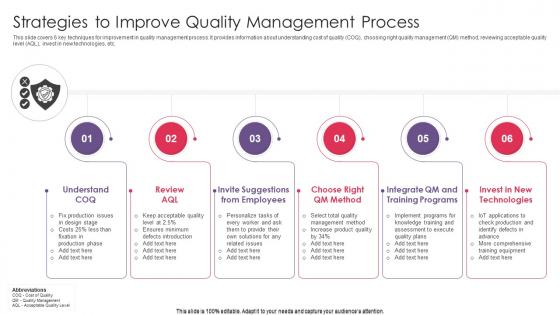
This slide covers 6 key techniques for improvement in quality management process. It provides information about understanding cost of quality COQ, choosing right quality management QM method, reviewing acceptable quality level AQL, invest in new technologies, etc.
People who downloaded this PowerPoint presentation also viewed the following :
Strategies To Improve Quality Management Process with all 6 slides:
Use our Strategies To Improve Quality Management Process to effectively help you save your valuable time. They are readymade to fit into any presentation structure.






FAQs for Strategies To Improve
Core quality management principles include customer focus, total employee involvement, process approach, integrated systems, strategic planning, continuous improvement, fact-based decisions, and supplier partnerships. These principles work together by aligning organizational goals with customer expectations, empowering teams to identify improvements, and creating systematic approaches to excellence, with many organizations finding that this comprehensive framework delivers enhanced operational efficiency and sustained competitive advantage.
Organizations effectively implement TQM through comprehensive employee training, leadership commitment, continuous process improvement, customer feedback integration, and cross-functional team collaboration. Through systematic quality measurement and data-driven decision making, companies in manufacturing, healthcare, and service industries streamline operations, reduce defects, and enhance customer satisfaction, ultimately delivering competitive advantage and sustainable operational excellence.
Continuous improvement serves as the foundation of effective quality management strategies, driving systematic enhancements in processes, products, customer satisfaction, and operational efficiency. Through methodologies like Lean Six Sigma and Kaizen, organizations in manufacturing, healthcare, and financial services streamline workflows, reduce defects, and accelerate delivery times, ultimately delivering sustained competitive advantage and measurable cost reductions.
Data-driven decision-making enhances quality management by enabling real-time monitoring, predictive analytics, and evidence-based process improvements that replace guesswork with measurable insights. Manufacturing companies and healthcare organizations increasingly leverage quality metrics, defect tracking, and performance dashboards to streamline operations, reduce waste, and deliver consistent outcomes, ultimately achieving competitive advantage through operational excellence.
Quality assurance focuses on preventing defects through systematic process design, standards development, and procedural frameworks, while quality control involves detecting defects through testing, inspection, and product evaluation after completion. QA establishes preventive measures across manufacturing, software development, and service delivery, whereas QC provides corrective actions, with organizations finding that combining both approaches delivers superior customer satisfaction and operational efficiency.
Organizations can utilize employee feedback to improve quality management strategies by implementing regular surveys, suggestion systems, cross-functional feedback sessions, and performance review discussions that capture frontline insights. Through structured feedback mechanisms, companies like manufacturing firms and healthcare institutions identify process bottlenecks, enhance operational efficiency, and reduce quality defects, ultimately delivering improved customer satisfaction and competitive advantage.
Companies can cultivate quality culture through comprehensive training programs, clear quality metrics and accountability systems, employee empowerment initiatives, regular feedback mechanisms, and recognition programs that reward quality achievements. These strategies work by fostering ownership at every level, encouraging continuous improvement mindsets, and integrating quality standards into daily workflows, with many organizations finding that engaged teams ultimately deliver superior customer experiences and sustainable competitive advantage.
Quality management frameworks like ISO 9001 influence business performance by standardizing processes, enhancing operational efficiency, reducing defects, and improving customer satisfaction through systematic quality control measures. These frameworks enable organizations to streamline workflows, minimize waste, and deliver consistent products, with many manufacturing and service companies finding that certification ultimately drives competitive advantage, reduces costs, and strengthens market credibility.
Best practices for measuring quality metrics include establishing clear KPIs, implementing real-time monitoring systems, conducting regular audits, using statistical process control, and creating comprehensive dashboards for visibility. These approaches streamline quality oversight by enabling proactive issue identification, facilitating data-driven decisions, and ensuring consistent performance standards, with many manufacturing and service organizations finding that integrated tracking systems ultimately deliver improved operational efficiency and enhanced customer satisfaction.
AI and machine learning integrate into quality management systems by automating defect detection, predicting equipment failures, and analyzing quality patterns across production lines. These technologies enable manufacturers to identify issues before they occur, optimize processes in real-time, and reduce waste significantly, with many organizations finding faster response times and enhanced product consistency.
Organizations face challenges including resistance to change, inadequate training, resource constraints, lack of leadership commitment, and difficulty measuring ROI when adopting new quality management strategies. These obstacles can be overcome through comprehensive change management programs, phased implementation approaches, and strong executive sponsorship, with many companies finding that investing in employee education, clear communication, and robust performance metrics ultimately delivers improved operational efficiency and sustained competitive advantage.
Customer feedback enables quality management refinement through systematic collection via surveys and reviews, real-time monitoring of service touchpoints, pattern analysis to identify recurring issues, and integration into continuous improvement cycles. Organizations across retail, healthcare, and manufacturing increasingly find that structured feedback loops drive targeted process enhancements, reduce defect rates, and ultimately deliver superior customer experiences while maintaining competitive advantage.
Supply chain management aligns with quality management strategies through supplier audits, quality metrics integration, collaborative planning, and continuous monitoring systems. These approaches streamline operations by establishing clear quality standards, implementing real-time tracking, and fostering supplier partnerships, with manufacturing and retail organizations finding that strategic alignment ultimately delivers enhanced product consistency, reduced defects, and improved customer satisfaction.
Quality management strategies significantly enhance sustainability and environmental responsibility by promoting resource optimization, waste reduction, process efficiency, and circular economy principles. Through systematic quality approaches, organizations streamline manufacturing processes, minimize material consumption, and reduce environmental footprints, with many companies finding that robust quality frameworks ultimately deliver both operational excellence and measurable environmental benefits while strengthening competitive positioning.
Industries approach quality management through sector-specific frameworks like Six Sigma in manufacturing, HACCP in food production, ISO standards in healthcare, and Agile methodologies in software development. These diverse approaches enable cross-industry learning opportunities, with manufacturing's process optimization enhancing healthcare efficiency, tech's rapid iteration improving retail responsiveness, and aviation's safety protocols strengthening financial services compliance, ultimately delivering competitive advantages through strategic quality integration.
-
Nice and innovative design.
-
Attractive design and informative presentation.