


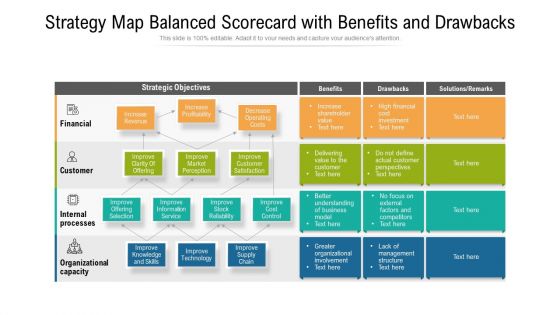
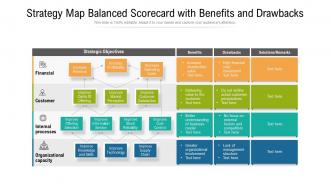
Strategy map balanced scorecard with benefits and drawbacks





Try Before you Buy Download Free Sample Product
 Impress Your
 Audience
 100%
100% Editable
 Save Hours
 of Time


Our Strategy Map Balanced Scorecard With Benefits And Drawbacks are topically designed to provide an attractive backdrop to any subject. Use them to look like a presentation pro.
People who downloaded this PowerPoint presentation also viewed the following :
Strategy map balanced scorecard with benefits and drawbacks with all 2 slides:
Use our Strategy Map Balanced Scorecard With Benefits And Drawbacks to effectively help you save your valuable time. They are readymade to fit into any presentation structure.
FAQs for Strategy map balanced scorecard with
Strategy map components include financial objectives, customer value propositions, internal process capabilities, learning and growth foundations, and strategic linkages connecting these perspectives. These elements enable organizations to visualize cause-and-effect relationships between operational improvements and financial outcomes, with many companies finding that strategic alignment across departments ultimately delivers enhanced performance measurement and competitive advantage.
Organizations align their strategic objectives using a strategy map by creating visual cause-and-effect linkages across four perspectives: financial, customer, internal processes, and learning and growth. This strategic framework enables companies to connect high-level goals with operational activities, ensuring departments work cohesively toward shared outcomes, with many finding that this alignment significantly improves execution and performance measurement.
Visualization transforms abstract strategic concepts into clear, comprehensible roadmaps that enhance understanding, alignment, and execution across organizations. Through visual strategy maps, leadership teams streamline communication of complex objectives, enable faster decision-making, and facilitate better resource allocation, with many companies finding that visual formats significantly improve strategic clarity and employee engagement in achieving business outcomes.
A strategy map enhances organizational communication by visually connecting strategic objectives across financial, customer, internal process, and learning perspectives, making complex strategies easily understandable for all stakeholders. Through clear cause-and-effect linkages, employees across departments can see how their daily activities contribute to broader goals, ultimately improving alignment and execution while reducing miscommunication.
The typical perspectives in a balanced scorecard strategy map include financial, customer, internal process, and learning and growth perspectives, creating a comprehensive framework for strategic alignment. These four interconnected perspectives enable organizations to balance short-term financial outcomes with long-term capabilities, with many companies finding that this approach streamlines performance measurement while delivering enhanced strategic clarity and operational efficiency.
Performance measurement integrates into strategy maps by establishing clear metrics for each strategic objective, linking cause-and-effect relationships between financial, customer, process, and learning perspectives through quantifiable indicators. These measurements enable organizations to track progress across departments, identify bottlenecks in strategic execution, and adjust resource allocation accordingly, ultimately delivering enhanced accountability and faster strategic outcomes.
Collaborative strategy map development techniques include cross-functional workshops, stakeholder interviews, SWOT analysis sessions, objective prioritization exercises, and cause-and-effect mapping activities. These approaches streamline alignment by engaging diverse perspectives, facilitating consensus-building, and ensuring comprehensive coverage of strategic linkages, with many organizations finding that collaborative development enhances buy-in and implementation success.
Different industries adapt balanced scorecard approaches by customizing metrics and strategic themes to their specific operational realities, regulatory environments, and stakeholder priorities. Healthcare organizations emphasize patient outcomes and safety metrics, while manufacturing focuses on operational efficiency and supply chain optimization, and financial services prioritize risk management and customer acquisition, ultimately enabling sector-specific competitive advantages.
Common implementation challenges include unclear strategic objectives, insufficient stakeholder alignment, inadequate performance metrics, poor communication across organizational levels, and resistance to change management processes. These obstacles often arise when organizations rush deployment without proper foundation work, with many finding that successful implementation requires dedicated cross-functional teams, comprehensive training programs, and iterative refinement approaches to ensure sustainable adoption.
Strategy maps improve organizational decision-making by clarifying cause-and-effect relationships between strategic objectives, aligning cross-functional teams around shared priorities, and providing visual frameworks for evaluating trade-offs. Through balanced scorecard integration, organizations streamline resource allocation, accelerate performance monitoring, and enhance strategic communication, with many companies finding that visual strategy mapping reduces decision complexity while improving execution speed.
Strategy maps should prioritize financial metrics like revenue growth and cost reduction, customer metrics including satisfaction scores and retention rates, internal process metrics such as cycle times and quality indicators, and learning metrics like employee engagement and skill development. These interconnected metrics enable organizations to track progress across all strategic dimensions, with many companies finding that balanced measurement drives sustainable performance improvements and competitive advantage.
Organizations should revisit their strategy maps quarterly for performance monitoring and annually for comprehensive revisions, with additional reviews triggered by significant market changes, mergers, or strategic pivots. Many companies find that regular quarterly assessments enable real-time adjustments to objectives and metrics, while annual revisions ensure strategic alignment with evolving business priorities, ultimately delivering sustained competitive advantage.
Best practices for designing effective strategy maps include clearly defining strategic objectives, establishing logical cause-and-effect relationships between perspectives, aligning initiatives with financial outcomes, incorporating stakeholder value propositions, and ensuring measurable performance indicators. These elements work together by creating organizational alignment, enabling resource prioritization, and facilitating performance tracking, with many companies finding that well-designed maps significantly enhance strategic execution and competitive positioning.
Technology streamlines strategy map creation through automated data visualization tools, real-time performance dashboards, collaborative platforms, and integrated analytics systems. Cloud-based solutions enable organizations to seamlessly update objectives and track progress across departments, while AI-powered insights help identify strategic gaps, ultimately delivering enhanced transparency and faster strategic alignment for competitive advantage.
Strategy maps enhance business agility by creating transparent frameworks that enable rapid strategic adjustments, streamlined decision-making processes, and coordinated organizational responses to market changes. Through visual strategy representation, companies can quickly identify performance gaps, reallocate resources efficiently, and pivot strategic initiatives while maintaining alignment, with many organizations finding that clear strategic visualization accelerates adaptation capabilities.
No Reviews