


Structured Data Manager System Architecture





Try Before you Buy Download Free Sample Product
 Impress Your
 Audience
 100%
100% Editable
 Save Hours
 of Time


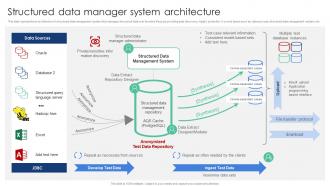
This slide represents an architecture of structured data management system that manages structured data over its entire lifecycle providing data discovery,insight,protection.It covers layers such as data sources,structured data management system,etc.
People who downloaded this PowerPoint presentation also viewed the following :
Structured Data Manager System Architecture with all 6 slides:
Use our Structured Data Manager System Architecture to effectively help you save your valuable time. They are readymade to fit into any presentation structure.





FAQs for Structured Data
Honestly, start with the basics - consistency, accuracy, and making sure people can actually find your data when they need it. Use the same naming conventions across everything and set up regular checks to catch errors early. Documentation is annoying but trust me, future you will thank past you. Data governance sounds like corporate BS but it'll save you from that "wait, which spreadsheet is the current one?" panic. Oh, and backup your stuff from the beginning - learned that one the hard way. I'd audit what you've got first though. You'll probably discover some weird organizational choices that need fixing.
Okay so structured data is basically like having your stuff organized in a spreadsheet - rows, columns, everything has its place. SQL queries work great on it and you'll get answers fast. Unstructured data though? Total mess. We're talking emails, videos, random social posts that don't fit anywhere neat. That stuff usually ends up in data lakes or NoSQL setups where you need fancier tools to make sense of it all. Honestly, I'd start with structured data for your main business numbers since it's way simpler. Save the unstructured headache for later when you've got more bandwidth to deal with the complexity.
Honestly, you'll probably start with SQL databases - MySQL and PostgreSQL are solid choices, though SQL Server's fine too. Tableau and Power BI are great for visualizations, but don't sleep on Excel if you're dealing with smaller stuff. I'd also grab phpMyAdmin or pgAdmin for database management. Those tools have saved my butt more times than I can count when things go sideways. AWS RDS and Google BigQuery handle most of the annoying infrastructure stuff these days. My advice? See what your team's already using first, then branch out.
Ok so first thing - set up validation at every point where data comes in. Your database needs proper constraints and data types enforced. I'd also run automated checks regularly to catch weird stuff. Honestly, bad data in = bad data out, so focus most of your energy on the input side. Get clear policies so everyone's on the same page about standards. Oh and definitely do audits every so often - data quality has a way of slowly getting worse if you're not watching. Start by figuring out what your current situation actually looks like, then build validation around whatever errors keep popping up.
So metadata is just info about your data - what each field means, how it's structured, when someone created it. Like super detailed labels on everything. I honestly can't stress this enough: without it you'll be completely lost trying to figure out what your datasets actually represent. Makes finding the right data way easier too when your team needs something specific. Trust me, start documenting your main data sources right now. Nothing's worse than staring at "field_x" in six months wondering what the hell past-you was thinking.
Dude, structured data is a total game-changer for analytics. Everything runs so much faster when your data's already organized properly - no more wasting hours cleaning up messy files before you can even start. Your reports become way more accurate too since there's zero confusion about what each field actually means. Honestly, once you experience automated dashboards that update themselves, you'll never want to go back to manual reporting. Oh, and start with whatever datasets you use most - don't try to structure everything at once or you'll burn out.
So basically, structured data means you're not just shooting in the dark when you need to make calls. You'll actually see patterns and trends that help guide decisions instead of going with your gut (which honestly can be pretty unreliable). Think GPS vs wandering around lost. Problems become visible before they explode in your face. You can track what's working and ditch what isn't. Just make sure you're consistent with how you collect everything from day one - messy data collection will bite you later. It's way easier to spot good opportunities too.
Data silos are going to be your worst enemy - nothing talks to each other properly. Legacy systems? Don't even get me started, they're ancient and hate everything modern. You'll deal with messy formats, terrible data quality, and honestly nobody ever budgets enough for maintenance afterward. Governance stuff matters too but it's boring. Oh, and scalability becomes a nightmare once things grow. Start with just one department first though. Get that working smoothly, then slowly add more. Trust me, trying to fix everything at once never works out.
Oh man, structured data management is honestly a lifesaver for security stuff. You can actually see what's sensitive and who's touching it instead of playing guessing games. Setting up automated controls becomes super straightforward too. GDPR and HIPAA compliance? Way less painful when you can track everything properly and generate reports without wanting to pull your hair out. I'd start with your most critical data first - like the stuff that would make your boss panic if it got leaked. Get access controls locked down there, then expand out. Trust me, it beats having everything scattered in random folders.
Set up data governance right from the start - schemas, naming rules, clear ownership. Version control is absolutely critical (I've watched teams completely wreck their systems by ignoring this). Run regular quality audits to catch problems early. Document every change you make to field definitions. Automated validation rules will stop garbage data before it gets in. Oh, and don't try to fix everything at once - pick one dataset first and nail the process there. Once you've got that working smoothly, you can expand it out to other areas.
Honestly, structured data is a game changer for personalization. Instead of having customer info scattered everywhere like digital confetti, you organize it properly - purchase history, what they actually like, how they behave on your site. Short sentences work. Then you can segment people and predict what they'll buy next without guessing. The magic happens when your CRM talks to your marketing tools smoothly. I swear, automated messages that don't suck come from good data organization. You'll stop sending random promos to people who'll never want them.
Dude, you absolutely need solid data management if you want your ML stuff to actually work. Clean, organized data means your models train better and don't randomly break later. I've watched so many projects completely tank because people rushed past this part - like, why even bother building something if your data's a disaster? Garbage data equals garbage predictions, plus you'll get weird biased results that make no sense. My advice? Go through your current setup first and spot all the messy inconsistencies. Yeah it's boring work, but you'll thank yourself when everything actually runs smoothly instead of exploding in production.
Honestly, big data has completely changed how we handle structured data - you can't just rely on traditional databases anymore when you're dealing with massive volumes. Hadoop and Spark are pretty much essential now for processing across distributed systems. Petabytes are the new normal, which is crazy to think about. The cool thing is you can do both batch and real-time processing at the same time now. Schema evolution is super important too since your data structures are constantly changing. Oh, and if you're thinking about upgrades, definitely check out data lakehouse architectures - they're like getting the benefits of both data lakes and warehouses rolled into one.
Automation's gonna take over most data governance stuff, which is honestly pretty wild to watch happen. Real-time processing everywhere, cloud-native becoming standard. Your structured data needs to play nice with unstructured sources now - everything's going API-first. Graph databases are blowing up for connecting random data sets (I keep meaning to dive deeper into those). Flexibility's your best friend here. Don't lock yourself into rigid architecture. Start messing around with automated cataloging tools ASAP - seriously, future you will thank present you. It's overwhelming but exciting at the same time.
Honestly, start with what's actually bugging you most right now. Data quality scores are solid - completeness, accuracy, that stuff. Query performance times matter too. But here's what I've noticed: the best indicator is whether your business people actually trust the data enough to make real decisions with it. Everything else is just nice-to-have metrics if that part's broken. I'd pick maybe 2-3 things that match your biggest headaches, track them for like three months, then add more. Oh, and definitely monitor how often users can find what they need vs. having to bug IT - that one's telling.
-
A big thanks to SlideTeam! An incredible and diverse library of templates helped me with my business project presentation.
-
Crisp and neat slides. Makes it fun and easier to curate presentations.