


Success criteria for a project ppt examples




Try Before you Buy Download Free Sample Product
 Impress Your
 Audience
 100%
100% Editable
 Save Hours
 of Time


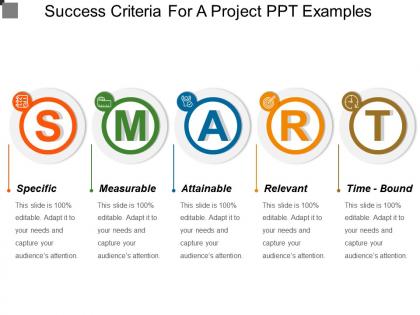
With so many simultaneous activities going on during a project’s life cycle, it is quite difficult to identify the critical success factors in project management. Make it simpler with our content ready success criteria for a project PPT example. With the help of this PPT design, let your team members focus on the key result areas in a project, which are essential to ensure completion and success of a project. Give an oversight of project’s functions to the project team by analyzing project objectives and success criteria uniquely. PPT is useful for project managers, business professionals, when they are planning to develop strategic business and project management plans for their business. PPT can also be used for risk identification and management purposes. By successfully evaluating project success criteria, you can easily prepare the risk assessment and mitigation strategies. So, keeping all these aspects in mind, download this unique presentation design and use it to highlight project management and success criteria to successfully meet your business requirements. Initiate the greenhorns with our Success Criteria For A Project Ppt Examples. Get them going in the field.
People who downloaded this PowerPoint presentation also viewed the following :
Success criteria for a project ppt examples with all 5 slides:
Capture hearts with your views. Set pulses racing with our Success Criteria For A Project Ppt Examples.




FAQs for Success criteria for a
Key performance indicators for project success include budget adherence, timeline compliance, quality metrics, stakeholder satisfaction scores, and resource utilization rates. These KPIs enable organizations to track progress systematically, identify potential issues early, and demonstrate tangible value delivery, with many companies finding that well-defined success metrics ultimately enhance project outcomes and stakeholder confidence.
Stakeholder satisfaction can be quantified through structured surveys measuring specific metrics like communication effectiveness, deliverable quality, timeline adherence, and overall project experience using numerical rating scales. Many organizations implement regular feedback collection, Net Promoter Score assessments, and post-project evaluation interviews, ultimately delivering measurable insights that enhance future project performance and stakeholder relationships.
Time management plays a critical role in project success by ensuring milestone adherence, resource optimization, stakeholder confidence, and budget control throughout the project lifecycle. Effective scheduling enables teams to identify potential delays early, allocate resources strategically, and maintain quality deliverables, with many organizations finding that disciplined time management ultimately delivers competitive advantage and enhanced client satisfaction.
Budget adherence significantly influences project success by ensuring resource allocation remains within approved limits, maintaining stakeholder confidence, and preserving profit margins throughout execution. When projects stay on budget, organizations can reinvest savings into future initiatives, enhance team credibility, and demonstrate fiscal responsibility, ultimately delivering sustainable competitive advantage and operational efficiency.
Quality benchmarks serve as success metrics by establishing measurable standards for deliverables, processes, and outcomes, enabling project managers to track performance against predefined criteria throughout project lifecycles. These benchmarks streamline evaluation processes, enhance stakeholder confidence, and minimize rework costs, with many organizations finding that systematic quality measurement ultimately delivers improved customer satisfaction, reduced project risks, and stronger competitive positioning in their respective markets.
Effective communication significantly enhances project success by ensuring clear expectations, reducing misunderstandings, and facilitating seamless collaboration among stakeholders, team members, and leadership. Through regular updates, transparent reporting, and structured feedback loops, organizations streamline decision-making processes, accelerate problem resolution, and maintain project alignment, ultimately delivering projects on time, within budget, and meeting quality standards.
Team collaboration and engagement contribute to project success by fostering open communication, aligning diverse skill sets toward common goals, and accelerating problem-solving through collective expertise. These elements streamline decision-making processes, enhance resource allocation, and minimize project delays, with many organizations finding that engaged teams deliver 25% better outcomes while maintaining higher quality standards and stakeholder satisfaction.
Aligning project goals with organizational objectives faces challenges including shifting strategic priorities, inadequate stakeholder communication, resource allocation conflicts, measurement inconsistencies, and competing departmental interests. These alignment gaps often result in projects delivering technical success while missing broader business value, with many organizations finding that regular strategic reviews and cross-functional collaboration ultimately streamline objective integration and enhance competitive advantage.
Risk management strategies should be integrated through continuous monitoring of identified risks, measuring mitigation effectiveness, and tracking risk impact on project objectives like timeline, budget, and quality deliverables. Organizations increasingly incorporate risk velocity metrics, contingency utilization rates, and proactive response outcomes into their success frameworks, with many project teams finding that structured risk assessment ultimately delivers enhanced predictability, reduced cost overruns, and improved stakeholder confidence throughout project execution.
Customer feedback is crucial for evaluating project outcomes because it reveals whether deliverables truly meet user needs, identifies gaps between expectations and reality, and provides insights for future improvements. Through direct user input, organizations can measure satisfaction levels, uncover hidden issues, and validate business objectives, ultimately ensuring projects deliver genuine value and competitive advantage.
Cultural and environmental factors significantly influence international project success criteria by requiring adaptations in communication styles, decision-making processes, regulatory compliance, and stakeholder expectations across different regions. These considerations affect timeline flexibility, resource allocation, and quality standards, with many multinational organizations finding that incorporating local cultural norms and environmental regulations ultimately delivers stronger stakeholder buy-in and sustainable project outcomes.
Project adaptability and flexibility can be measured through response time to scope changes, successful pivot rates, stakeholder satisfaction during transitions, and budget variance management during modifications. These metrics enable organizations to assess their project resilience, with many finding that adaptive projects deliver better long-term outcomes, reduced risk exposure, and enhanced competitive positioning in dynamic business environments.
Qualitative metrics provide stakeholder satisfaction insights and strategic alignment assessment, while quantitative metrics deliver measurable performance data like budget adherence, timeline compliance, and ROI calculations. Organizations increasingly find that combining both approaches enhances project evaluation accuracy, with qualitative feedback revealing implementation challenges and quantitative data demonstrating tangible business outcomes, ultimately enabling more comprehensive success assessment.
Project closure processes ensure success criteria are met by conducting comprehensive performance evaluations, stakeholder feedback sessions, deliverable verification audits, and formal sign-off procedures. Through systematic documentation and review protocols, organizations validate project outcomes against original objectives, capture lessons learned for future initiatives, and secure stakeholder acceptance, ultimately delivering measurable value and operational continuity.
Long-term project impacts include organizational capability enhancement, cultural transformation, market position strengthening, stakeholder relationship improvement, and knowledge transfer acceleration. These strategic outcomes revolutionize operational efficiency, competitive advantage, and innovation capacity, with many organizations finding that sustained value creation, improved decision-making frameworks, and enhanced adaptability ultimately deliver greater returns than initial deliverables alone.
-
Appreciate the research and its presentable format.
-
Graphics are very appealing to eyes.