

Supervised Unsupervised And Reinforcement Learning Generative Ai Artificial Intelligence AI SS




Try Before you Buy Download Free Sample Product
 Impress Your
 Audience
 100%
100% Editable
 Save Hours
 of Time


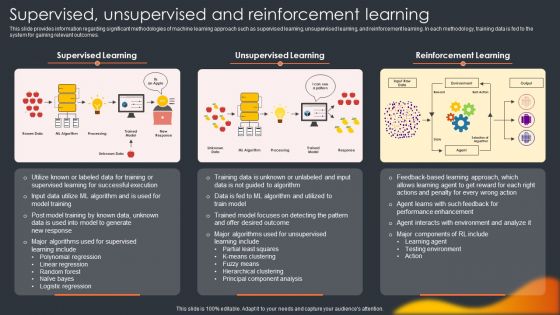
This slide provides information regarding significant methodologies of machine learning approach such as supervised learning, unsupervised learning, and reinforcement learning. In each methodology, training data is fed to the system for gaining relevant outcomes.
People who downloaded this PowerPoint presentation also viewed the following :
Supervised Unsupervised And Reinforcement Learning Generative Ai Artificial Intelligence AI SS with all 9 slides:
Use our Supervised Unsupervised And Reinforcement Learning Generative Ai Artificial Intelligence AI SS to effectively help you save your valuable time. They are readymade to fit into any presentation structure.








FAQs for Supervised Unsupervised And Reinforcement Learning Generative Ai Artificial
Okay so narrow AI is basically what we have now - stuff that's really good at one thing. Like Siri understands what you're saying but she can't suddenly become a chess master, you know? General AI would be more like... actual human-level smarts across everything. Which honestly sounds terrifying lol. But that's still science fiction territory - doesn't exist yet despite what movies make you think. Right now all the AI tools you're using? They're narrow. Really impressive at their specific job but pretty useless outside that domain.
So machine learning is basically teaching computers to make complex decisions that humans used to handle. Healthcare's gotten crazy with it - AI can spot diseases in scans faster than doctors, predict when patients might crash, and create personalized treatments using your DNA. Finance is probably even further ahead though. They're catching fraud instantly, doing high-speed trading, and your credit score now uses like a million data points instead of just payment history. The systems literally learn and improve as they go. If you're working in either field, just think about what boring repetitive decisions you make daily - that's probably perfect for automation.
Honestly, the bias thing is huge - your training data can't be garbage or you'll get discriminatory results. Privacy's another headache since people freak out (rightfully) when you're not upfront about data collection. The black box problem is probably the worst though? Like, you can't explain why your AI did something, which makes stakeholders lose their minds. I learned this the hard way - do bias audits constantly during development. Way less painful than trying to fix everything after launch. Oh, and transparency isn't optional anymore, people expect it.
Honestly, AI's pretty solid for this stuff. Chatbots can actually get context now instead of being useless, and recommendation engines are getting scary good at predicting what people want. You can catch problems before customers even realize they're annoyed using predictive analytics. Real-time sentiment analysis from reviews helps too - like, you'll know immediately when people are pissed. Oh, and those behavioral email campaigns that adapt? They work surprisingly well. I'd start small though, maybe just customer support or recommendations first. Don't go crazy with it right away - test one thing and see how it goes.
Dude, you can't just ignore privacy when building AI stuff. Regulations are getting crazy strict, and users will bail if your system feels creepy or invasive. You'll need proper consent before using personal data to train models. The technical side gets interesting though - federated learning and differential privacy let you extract insights without exposing individual data points. Honestly, I've seen too many projects where privacy was an afterthought and it bit them hard later. Just bake it in from the start. Trust me on this one.
Dude, neural networks totally changed the game for text processing. They actually get context and meaning instead of just hunting for keywords like the old systems did. The transformer stuff - GPT, BERT, all that - processes whole sentences at once rather than plodding through word by word. Translation and summarization got crazy good because of this. Honestly, if you're doing any text work, just grab a pre-trained model. Don't torture yourself building one from scratch - I learned that the hard way. The sentiment analysis alone will blow your mind compared to what we had before.
Look, some jobs will definitely get automated - mainly the repetitive stuff like data entry and basic customer service. But it's not like robots are taking over tomorrow. Manufacturing's already been hit pretty hard though. The thing is, new roles keep popping up too: people who train AI systems, folks who audit algorithms, that kind of thing. Jobs needing creativity or emotional smarts are still pretty safe. My advice? Don't panic, but maybe start learning skills that work WITH AI instead of against it. Way better strategy than just hoping for the best.
So AI's actually pretty cool for climate stuff. It optimizes energy grids to cut waste, predicts weather for renewable planning, and spots emission hotspots in huge datasets. Smart buildings use it to auto-adjust heating/cooling. Supply chains optimize delivery routes to burn less fuel. Machine learning even speeds up finding new solar panel materials - which is honestly way cooler than I thought when I first heard about it. Basically anywhere you've got messy, complex systems that need tweaking, AI can probably help make them more sustainable.
So AI bias happens when your algorithms start discriminating against certain groups - usually without you realizing it. Training data is a huge culprit here. Say your hiring tool only learned from resumes of one type of person? Yeah, it'll keep picking similar candidates forever. Feature selection can mess things up too, or even just how you define the problem in the first place. Honestly, the worst part is you won't see it unless you're actively hunting for it. You've gotta audit your models regularly and get people with different perspectives on your team. They'll catch stuff you'd totally miss.
So AI is basically like having this crazy fast security guard watching your network constantly. It catches malware, phishing, weird user stuff - all in real-time while humans are still figuring out what happened. The smart part? It learns from every attack and gets better at predicting what's coming next. Plus it handles the routine threats automatically, which honestly saves IT teams from going insane with alerts. I mean, my buddy works in cybersecurity and he swears by this stuff. You should probably ask your IT people if they're using any AI security tools yet.
Dude, robotics is crazy right now. Machine learning basically lets them figure stuff out on their own instead of needing step-by-step programming. Boston Dynamics still has the flashiest demos - their robots doing backflips is wild - but honestly the real money's in boring warehouse stuff. They're handling unpredictable situations way better than before. You'll see them doing surgery, prepping food, working next to people without crushing anyone. If you're thinking about this for work, definitely look into what's out there. The payback periods aren't terrible anymore, which is saying something for robotics.
Just grab some AI tools that already exist - way easier than building stuff yourself. Customer service chatbots work great, or try automated email marketing. Most "AI" is honestly just decent software with better marketing lol. Pick one problem to solve first, like booking appointments or writing social media posts. Don't hire data scientists or anything crazy like that yet. Free trials are your friend here - test them out before spending money. Only scale up when you actually see it helping your business. Oh, and inventory management with AI features is pretty solid too if that's relevant for you.
Honestly, the biggest thing to watch is AI getting baked into regular business decisions - not just basic stuff, but actual complex reasoning. Multimodal systems are where it's at right now, handling text, images, and voice all at once. Regulations are definitely coming whether we like it or not, so compliance planning is smart. What's interesting is companies are moving away from those massive general models toward smaller, focused ones. Makes it way more realistic for mid-sized businesses to actually use this stuff. I'd start thinking about governance frameworks now and how you'll train your team - better to get ahead of it.
Honestly, AI just makes business decisions way less of a headache. It tears through data in minutes that would take your team forever to sort through manually. Sales patterns, customer stuff, market changes - all that gets spotted super fast. The prediction side is pretty solid too, which surprised me at first. Companies usually pick one problem area to test it out - maybe inventory or pricing or whatever's driving them crazy. Then they expand from there once they see it actually works. I'd probably start with your biggest data mess and see how it goes from there.
Dude, AI creativity stuff is crazy right now. You've got tools pumping out art, music, even scripts in like seconds. Anyone can make professional-looking content now without needing years of training - which is cool but also kinda scary for actual artists losing gigs. Some creators are rolling with it, using AI to speed up their workflow. Others hate it completely. Honestly? I think the "originality" debate is overblown - humans have always built on existing work. Just play around with some tools yourself and see what's happening in your specific field. Better to understand it than ignore it.
-
It makes easy work of my work presentations. I’ve never had to be nervous about my presentations for meetings.
-
Extensive range of templates! Highly impressed with the quality of the designs.