


Generative AI Technologies And Future Of Work Powerpoint Presentation Slides AI CD V




Try Before you Buy Download Free Sample Product
 Impress Your
 Audience
 100%
100% Editable
 Save Hours
 of Time


Explore our professionally crafted Generative AI technologies and future of work deck, which are comprehensive resources utilizing advanced neural networks to recognize patterns and structures within existing data, enabling the creation of innovative and original content. This AI tools PPT offers a detailed overview of the global market landscape, key statistics, the latest trends, challenges, and solutions. Moreover, our Generative AI Industry PowerPoint presentation delves into the practical applications of this transformative technology across diverse sectors such as supply chain, E commerce, fintech, healthcare, and banking. Lastly, the Natural Language Processing presentation explores the realm of Natural Language Processing NLP by shedding light on various Generative AI tools such as Bard, Jasper AI, ChatGPT, Synthesia, and others. Stay ahead of the curve by learning about the impact and potential of Generative AI on jobs and industries, including its future implications in marketing, finance, healthcare, education, and beyond. Get instant access and stay at the forefront of technological innovation.
People who downloaded this PowerPoint presentation also viewed the following :
Content of this Powerpoint Presentation
Slide 1: This slide introduces Generative AI technologies and future of work.
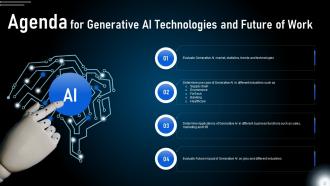
Slide 2: This slide depicts the Agenda of the presentation.
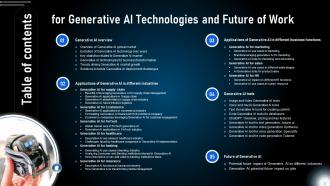
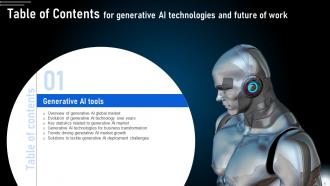
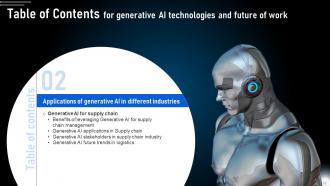
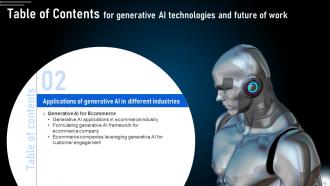
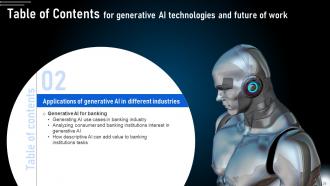
Slide 3: This slide includes the Table of contents.
Slide 4: This slide highlights the Title for the Topics to be covered further.
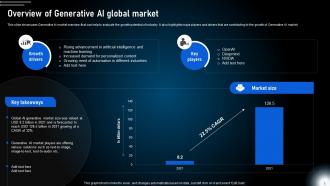
Slide 5: This slide showcases Generative AI market overview that can help to evaluate the growth potential of industry.
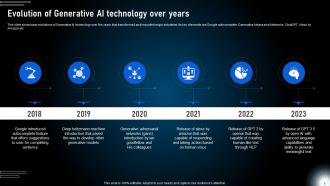
Slide 6: This slide reveals the evolutions of Generative AI technology over the years that transformed and impacted major industries.
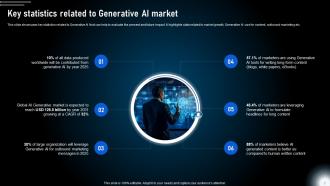
Slide 7: This slide highlights the key statistics related to Generative AI that can help to evaluate the present and future impact.
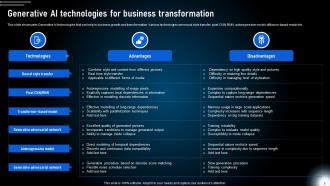
Slide 8: This slide presents Generative AI technologies that can help in business growth and transformation.
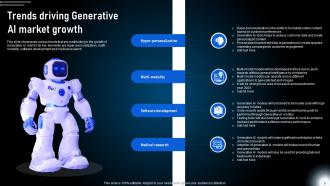
Slide 9: This slide showcases various trends that are contributing to the growth of Generative AI market.
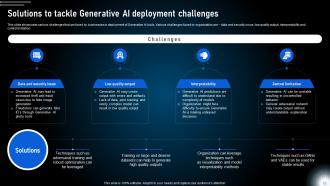
Slide 10: This slide states the various challenges that are faced by businesses in deployment of Generative AI tools.
Slide 11: This slide includes the Heading for the Contents to be discussed next.
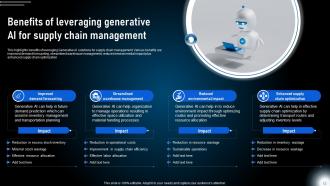
Slide 12: This slide exhibits the Benefits of leveraging Generative AI for supply chain management.
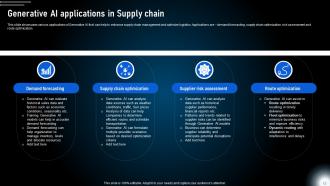
Slide 13: This slide showcases various applications of Generative AI that can help to enhance supply chain management and optimize logistics.
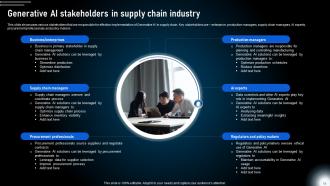
Slide 14: This slide portrays various stakeholders that are responsible for effective implementation of Generative AI in supply chain.
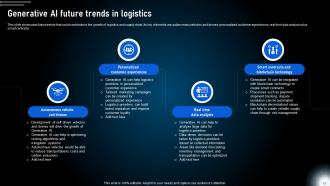
Slide 15: This slide showcases highlights the future trends that could contribute to the growth of logistics and supply chain.
Slide 16: This slide indicates the Title for the Ideas to be covered in the upcoming template.
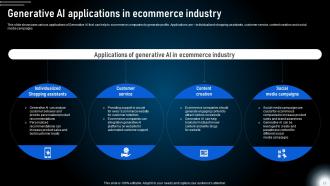
Slide 17: This slide presents the various applications of Generative AI that can help to ecommerce companies to generate profits.
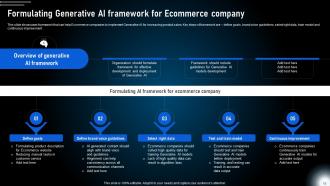
Slide 18: This slide reveals framework that can help Ecommerce companies to implement Generative AI for increasing product sales.
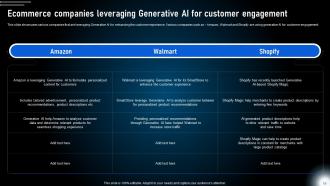
Slide 19: This slide showcases various companies that are leveraging Generative AI for enhancing the customer experience.
Slide 20: This slide displays the Heading for the Ideas to be discussed next.
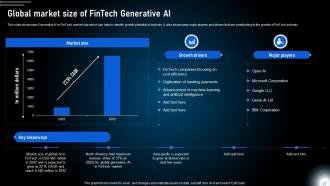
Slide 21: This slide presents the Generative AI in FinTech market size which can help to identify growth potential of industry.
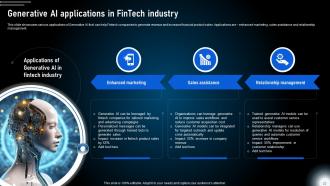
Slide 22: This slide showcases various applications of Generative AI that can help Fintech companies to generate revenue and increase financial product sales.
Slide 23: This slide outlines the Title for the Contents to be covered in the following template.
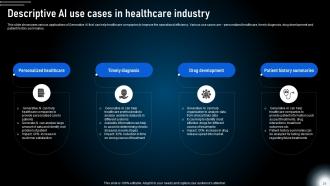
Slide 24: This slide showcases various applications of Generative AI that can help healthcare companies to improve the operational efficiency.
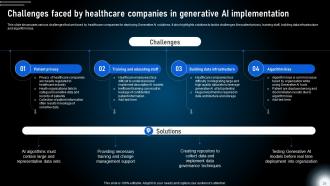
Slide 25: This slide exhibits the challenges faced by healthcare companies in generative AI implementation.
Slide 26: This slide indicates the Heading for the Topics to be discussed next.
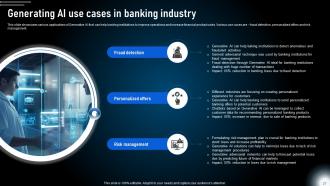
Slide 27: This slide showcases various applications of Generative AI that can help banking institutions to improve operations and increase financial product sales.
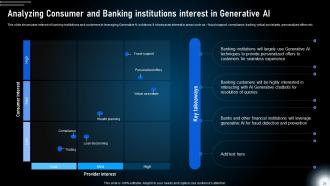
Slide 28: This slide highlights interest of banking institutions and customers in leveraging Generative AI solutions.
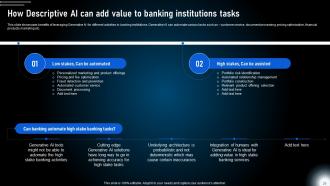
Slide 29: This slide showcases benefits of leveraging Generative AI for different activities in banking institutions.
Slide 30: This slide reveals the Title for the Topics to be covered in the following template.
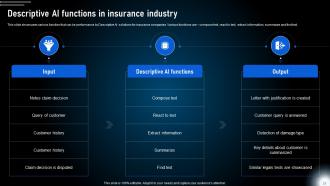
Slide 31: This slide presents various function that can be performance by Descriptive AI solutions for insurance companies.
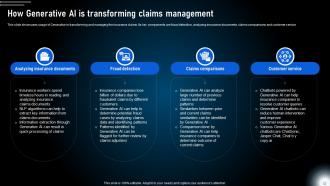
Slide 32: This slide displays usage of Generative in transforming and managing the insurance claims.
Slide 33: This slide portrays the Heading for the Contents to be discussed further.
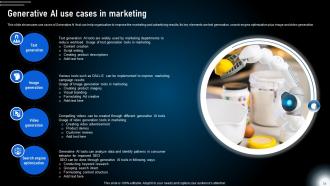
Slide 34: This slide showcases use cases of Generative AI that can help organization to improve the marketing and advertising results.
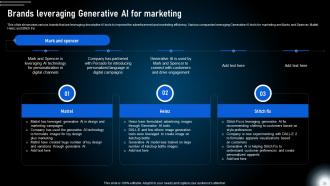
Slide 35: This slide highlights various brands that are leveraging descriptive AI tools to improve the advertisement and marketing efficiency.
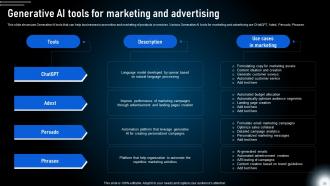
Slide 36: This slide presents Generative AI tools that can help businesses in promotion and marketing of products or services.
Slide 37: This slide outlines the Title for the Ideas to be covered next.
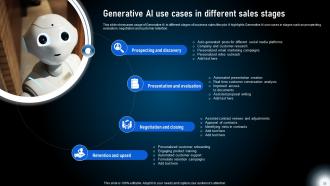
Slide 38: This slide showcases usage of Generative AI in different stages of business sales lifecycle.
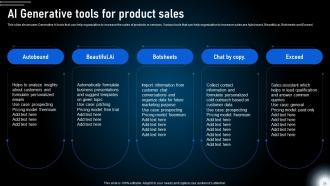
Slide 39: This slide portrays Generative AI tools that can help organization to increase the sales of products or services.
Slide 40: This slide exhibits the Heading for the Ideas to be discussed further.
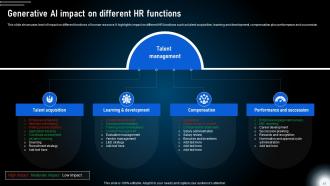
Slide 41: This slide showcases level of impact on different functions of human resource.
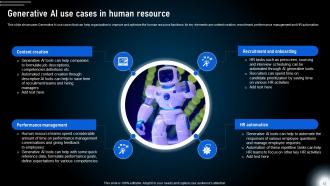
Slide 42: This slide highlights the Generative AI use cases that can help organization to improve and optimize the human resource functions.
Slide 43: This slide includes the Title for the Contents to be covered in the upocming template.
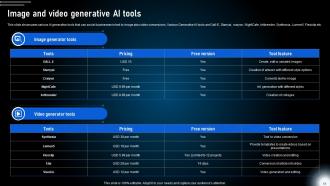
Slide 44: This slide showcases various AI generative tools that can assist businesses in text to image plus video conversions.
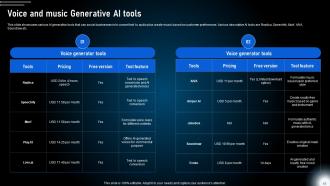
Slide 45: This slide reveals various AI generative tools that can assist businesses in to convert text to audio plus create music based on customer preferences.
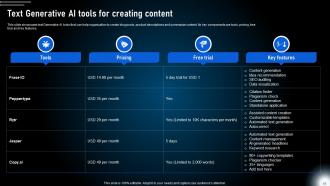
Slide 46: This slide presents text Generative AI tools to create blog posts, product descriptions and summarize content.
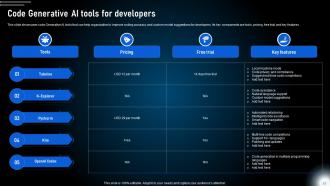
Slide 47: This slide showcases code Generative AI tools that can help organization to improve coding accuracy and custom model suggestions for developers.
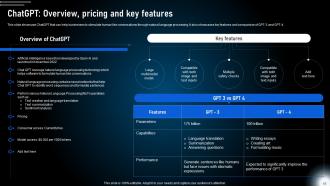
Slide 48: This slide represents ChatGPT that can help businesses to stimulate human like conversations through natural language processing.
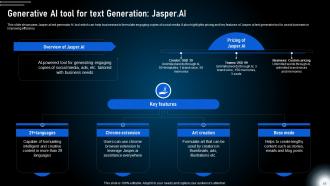
Slide 49: This slide reveals Jasper.ai text generator AI tool which can help businesses to formulate engaging copies of social media.
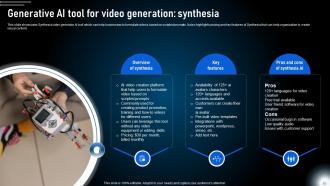
Slide 50: This slide highlights Synthesia video generator AI tool which can help businesses to formulate videos based on scripted prompts.
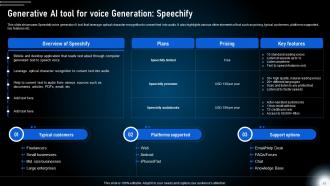
Slide 51: This slide showcases Speechify voice generator AI tool that leverage optical character recognition to convert text into audio.
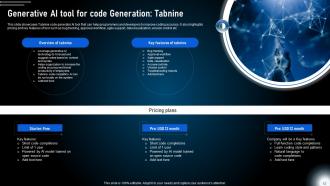
Slide 52: This slide portrays Tabnine code generator AI tool that can help programmers and developers to improve coding accuracy.
Slide 53: This slide depicts the Heading for the Topics to be discussed next.
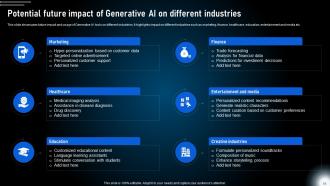
Slide 54: This slide showcases future impact and usage of Generative AI tools on different industries.
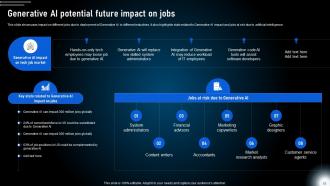
Slide 55: This slide states the impact on different jobs due to deployment of Generative AI in different industries.
Slide 56: This is the Icons slide containing all the Icons used in the plan.
Slide 57: This slide is used for displaying some Addtional information.
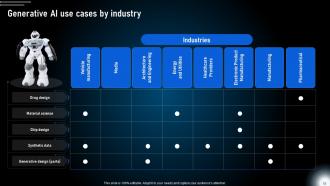
Slide 58: This slide talks about Generative AI use cases by industry.
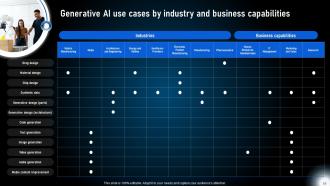
Slide 59: This slide contains Generative AI use cases by industry and business capabilities.
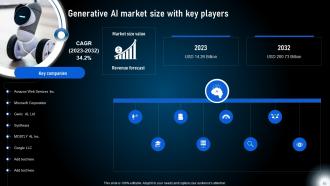
Slide 60: This slide exhibits Generative AI market size with key players.
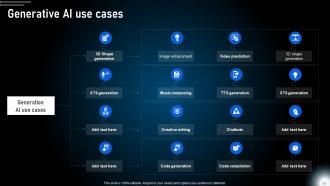
Slide 61: This slide shows the Generative AI use cases.
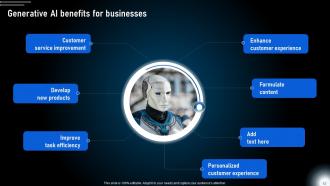
Slide 62: This slide focuses on the Generative AI benefits for businesses.
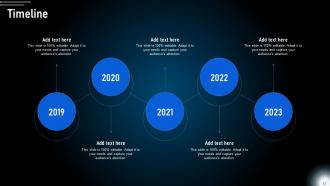
Slide 63: This slide presents the organization's Timeline.
Slide 64: This is the Venn Diagram slide.
Slide 65: This is Our team slide. State your team-related information here.
Slide 66: This slide contains the Post it Notes for reminders and deadlines.
Slide 67: This is the Idea generation slide for encouraging fresh ideas.
Slide 68: This is the Thank you slide for acknowledgement.
Generative AI Technologies And Future Of Work Powerpoint Presentation Slides AI CD V with all 76 slides:
Use our Generative AI Technologies And Future Of Work Powerpoint Presentation Slides AI CD V to effectively help you save your valuable time. They are readymade to fit into any presentation structure.










FAQs for Generative AI Technologies And Future Of Work Powerpoint Presentation Slides
Content creation and design are huge right now. Marketing copy, social posts, logos, music - AI's doing it all. Game studios use it for concept art, which is pretty wild when you see the results. Film people are doing storyboards and effects with it too. Oh, and publishers are cranking out book covers like crazy. I'd mess around with Midjourney or ChatGPT if you're in anything creative. Runway's solid for video stuff. Honestly, even if you're just curious, it's worth trying to see what clicks with your work.
Dude, generative AI is a game changer for template design. Just tell it something like "modern sales deck with blue accents" and boom—you get tons of layout options right away. No more staring at blank slides forever. The AI figures out colors, fonts, spacing, all that design stuff you probably don't want to mess with anyway. You can just keep tweaking your description until something looks right. Honestly gets pretty addictive trying different prompts. Start simple—describe the vibe you want and who's gonna see it, then go from there.
Honestly, the copyright stuff is probably the biggest headache - these AI models basically scraped everything without asking permission first. Super messy legally. You've also got the whole transparency thing where people argue about whether you need to say "hey, AI helped with this." Job displacement is another big one if you're basically cutting human creators out of the loop entirely. Oh, and definitely check if your company has rules about this stuff before diving in. I'd probably use it more like a writing buddy than a replacement, you know? That way you're not totally stepping on anyone's toes.
Honestly, generative AI is a game-changer for content creation. I've been using it for email campaigns and social media posts - you can personalize stuff for different customer segments without losing your mind. Product descriptions too, which used to take forever. The trick is writing good prompts that capture your brand voice. Oh, and definitely use your customer data to make it more targeted. I'd start with something simple like email subject lines or maybe Instagram captions. Once you figure out what resonates with your audience, you can go bigger with ad copy and visual content. It's wild how much creative grunt work it handles.
Dude, you can literally just throw your messy spreadsheet data at generative AI and tell it "make this look good." It'll spit out charts, graphs, whole dashboards - no design skills needed on your part. What's crazy is it actually catches patterns you'd probably scroll right past. Just describe what you want like "show me sales trends over time" and boom, presentation-ready stuff appears. The AI does all the boring formatting work while you get to play with the actual insights. Honestly beats staring at rows of numbers for hours. Start simple with whatever dataset you've got lying around.
Honestly, GANs are amazing for crazy realistic images - perfect for creative stuff. But training them? Total nightmare sometimes, like dealing with a drama queen. VAEs are way more chill and actually let you understand what's happening under the hood. You get better control too, which is clutch for scientific work or when you need to tweak specific things. Oh and transformers like GPT totally dominate text now - that's a no-brainer. So yeah, go GANs for photorealistic output, VAEs when you want control, transformers for anything language-related.
Ugh, data quality is gonna be your worst enemy - half your data probably sucks and you just don't know it yet. Integration with existing systems is a nightmare too. Most workflows weren't built for this stuff, so expect to rebuild processes and retrain people. Oh, and generative AI? It straight up lies sometimes, which you'll definitely find out at the worst possible moment. Compliance gets messy depending on your industry. Honestly, just start small with a pilot project. Way better than diving headfirst and discovering all these issues when you're already committed.
Honestly, start with the basics - thumbs up/down buttons are your friend here. Users can flag bad outputs or suggest better alternatives, then you feed that back into your training. RLHF is pretty solid too (reinforcement learning from human feedback) - basically you're teaching the model what good looks like based on what people actually want. Oh, and don't forget to track usage patterns. The trick is making feedback super easy to give and then actually doing something with it. I'd say build simple rating first, get some data flowing, then worry about fancier correction stuff later.
Ugh yeah, copyright and AI is such a mess right now. Nobody really knows who owns what when AI generates stuff. Plus there's the whole training data thing - these models basically learned from tons of copyrighted content without asking permission first. Courts are still trying to figure it out, and every country's doing something different. Honestly it's kind of a nightmare. If you're making money off AI-generated work, I'd definitely keep track of which tools you used. Maybe check with a lawyer for the big stuff? Better to be paranoid than get hit with a lawsuit later.
So basically, generative AI looks at how people behave online and creates custom content just for them. It's crazy how it works in real-time. You could use it for personalized emails, product suggestions, or even chatbot responses that actually make sense for each person. I've seen companies do custom website layouts too - honestly didn't think that was possible until recently. My advice? Don't go all-in right away. Pick something simple like email subject lines first and see how it compares to your usual generic stuff. The AI learns from user data patterns, so it keeps getting better at knowing what clicks with different people.
Honestly, data quality is everything - it's like the foundation of your whole AI project. You can have the fanciest model in the world, but if you're training it on junk data, you're gonna get junk results. Garbage in, garbage out, right? When your training data is solid, your AI actually produces stuff that makes sense and isn't totally biased or weird. But crappy data? That's how you end up with those hilarious AI fails where it just makes things up. I learned this the hard way on my last project. Spend way more time than you think cleaning up your datasets first - trust me on this one.
Dude, AI is totally changing graphic design right now. You're seeing hyper-realistic images everywhere, plus all these abstract patterns and surreal compositions that used to take ages to make by hand. The speed is honestly insane. Designers are getting way more experimental since you can test ideas so fast now. There's actually this whole "AI-assisted" aesthetic that clients specifically want - which is kinda funny if you think about it. My take? Jump in and start playing with these tools now. Better to figure it out while it's still relatively new than scramble to catch up later when everyone's already using them.
Honestly, there's so much stuff out there now that doesn't need any coding. ChatGPT and Claude are perfect for writing - just type what you want. DALL-E and Midjourney are crazy good for images, though Midjourney's Discord setup is kinda weird at first. If you're already using Canva, they've got AI built right in which is super convenient. Oh, and for connecting things together, Zapier has these AI actions that can automate workflows between your apps. I'd just pick one tool that solves your biggest problem right now, then branch out once you get comfortable with it.
Start with brand guidelines before you do anything else. Make prompts that include your voice and messaging - basically like training a new hire who doesn't know your company yet. I'd honestly test everything first with internal stuff to get the hang of it. Have someone review outputs because AI can go rogue sometimes. Short bursts work better than long content at first. The whole point is making AI follow your brand, not the other way around. Don't just throw it at customer-facing content right away - you'll regret that.
Honestly, multimodal AI is gonna be huge for presentations. These systems will pump out slides, voiceovers, and animations all at once - plus they'll write your speaker notes based on who's actually in the room. Real-time audience analysis means your deck can adapt as you're presenting, which is pretty nuts if you think about it. You'll be able to sketch something rough or just record a voice memo and boom - polished slides. My advice? Start messing around with current AI presentation tools now. That way you won't be totally lost when all this fancy stuff actually drops.
-
They helped us design the pamphlets for our church’s food drive! The people loved the design, and I’m happy to say it was successful. Thank you, SlideTeam!
-
Use of different colors is good. It's simple and attractive.