


Supply Chain Management Building Blocks




Try Before you Buy Download Free Sample Product
 Impress Your
 Audience
 100%
100% Editable
 Save Hours
 of Time


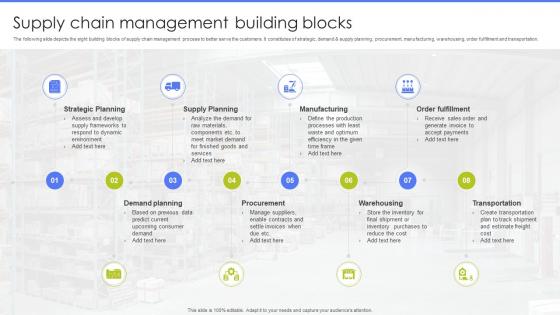
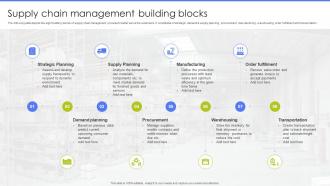
The following slide depicts the eight building blocks of supply chain management process to better serve the customers. It constitutes of strategic, demand and supply planning, procurement, manufacturing, warehousing, order fulfillment and transportation.
People who downloaded this PowerPoint presentation also viewed the following :
Supply Chain Management Building Blocks with all 6 slides:
Use our Supply Chain Management Building Blocks to effectively help you save your valuable time. They are readymade to fit into any presentation structure.





FAQs for Supply Chain
Key components of an effective supply chain management system include demand forecasting, supplier relationship management, inventory optimization, logistics coordination, and performance analytics. These integrated elements streamline operations by reducing costs, minimizing delays, and enhancing transparency across the entire network, with many manufacturing and retail organizations finding that strategic coordination ultimately delivers competitive advantage and improved customer satisfaction.
IoT and AI enhance supply chain transparency by providing real-time tracking, predictive analytics, and automated data collection across all stages. These technologies enable organizations to monitor inventory levels, predict potential disruptions, and streamline communications with suppliers, ultimately delivering improved operational efficiency and faster response times to market changes.
Supplier relationship management enhances supply chain optimization by fostering collaboration, ensuring quality consistency, reducing procurement costs, and enabling strategic partnerships that drive innovation. These collaborative approaches streamline operations by improving communication transparency, accelerating problem resolution, and creating mutual value propositions, with many manufacturing and retail organizations finding that strong supplier partnerships ultimately deliver competitive advantages and operational resilience.
Demand forecasting and inventory management intersect by enabling organizations to optimize stock levels, reduce carrying costs, and minimize stockouts through predictive analytics and real-time data integration. Accurate forecasting allows companies to align inventory purchases with anticipated demand patterns, with manufacturers and retailers finding that this strategic combination delivers improved cash flow, reduced waste, and enhanced customer satisfaction.
Major global supply chain challenges include geopolitical disruptions, climate-related risks, supplier reliability issues, demand volatility, and regulatory compliance complexities across different markets. These interconnected factors create operational inefficiencies and cost pressures, with many organizations finding that strategic diversification, enhanced visibility technologies, and agile planning processes help mitigate risks while maintaining competitive advantage.
Companies mitigate supply chain risks through diversified supplier networks, real-time monitoring systems, strategic inventory buffers, scenario planning, and flexible logistics partnerships. These approaches enable organizations to maintain operational continuity during disruptions, with manufacturers and retailers finding that proactive risk management delivers faster recovery times, reduced costs, and sustained competitive advantage in increasingly volatile markets.
Sustainable practices in modern supply chains reduce environmental impact, enhance brand reputation, ensure regulatory compliance, minimize long-term costs, and strengthen stakeholder relationships. These approaches enable companies to streamline resource usage, reduce waste, and improve operational efficiency, with many organizations finding that sustainable initiatives ultimately deliver competitive advantage while meeting increasingly demanding consumer and investor expectations.
Regulations and compliance significantly reshape global supply chain strategies by requiring enhanced traceability, stricter quality controls, and comprehensive documentation across all operational touchpoints. Companies increasingly diversify supplier bases, invest in compliance technology platforms, and restructure logistics networks to meet varying regional standards, with many organizations finding that proactive compliance management ultimately delivers competitive advantages and reduced operational risks.
Businesses should prioritize metrics including inventory turnover rates, order fulfillment accuracy, supplier lead times, cost per unit delivered, and customer satisfaction scores. These performance indicators streamline operations by identifying bottlenecks, optimizing resource allocation, and enhancing supplier relationships, with many organizations finding that strategic metric tracking delivers improved efficiency and competitive advantage.
Lean principles improve supply chain processes by eliminating waste, reducing inventory levels, and streamlining workflows through just-in-time delivery, continuous improvement practices, and supplier collaboration. Manufacturing companies and retailers increasingly find that implementing value stream mapping, standardized processes, and demand-driven production ultimately delivers faster order fulfillment and significantly reduced operational costs.
Essential supply chain management tools include ERP systems, warehouse management software, transportation management platforms, demand forecasting analytics, and supplier relationship management systems. These technologies streamline operations by automating inventory tracking, optimizing delivery routes, and enhancing supplier collaboration, with many manufacturing and retail organizations finding that integrated platforms deliver significant cost reductions and improved customer satisfaction.
Economic fluctuations significantly influence supply chain decision-making by driving organizations to reassess supplier diversification, inventory levels, transportation modes, and cost structures. During economic uncertainty, companies often prioritize resilience over efficiency, with many manufacturers and retailers finding that strategic flexibility in sourcing and distribution ultimately delivers competitive advantage.
Customer feedback drives supply chain optimization by identifying delivery pain points, product quality issues, demand patterns, and service gaps that directly impact operational decisions. Through analyzing customer insights, organizations enhance inventory management, streamline logistics networks, and improve supplier relationships, with many retail and manufacturing companies finding that feedback-driven strategies ultimately deliver faster fulfillment and competitive advantage.
Collaboration among supply chain partners creates competitive advantages by enhancing visibility, reducing costs, accelerating innovation, and improving responsiveness to market changes. Through shared data platforms and integrated planning, organizations streamline operations, minimize inventory redundancies, and deliver faster customer service, with many manufacturers and retailers finding that strategic partnerships ultimately reduce lead times by 20-30% while enhancing overall market agility.
Key trends shaping supply chain management's future include AI-driven demand forecasting, blockchain for transparency, autonomous logistics, sustainability initiatives, and resilient network designs. These technologies streamline operations by reducing costs, minimizing disruptions, and enhancing visibility, with many manufacturers and retailers finding that strategic combinations ultimately deliver competitive advantage in an increasingly complex global marketplace.
-
Illustrative design with editable content. Exceptional value for money. Highly pleased with the product.
-
The templates are the best in class. Very clear and innovative graphics! I am excited to explore and download more presentations.