


SWOT Analysis Apple Company Profile Ppt Elements CP SS




Try Before you Buy Download Free Sample Product
 Impress Your
 Audience
 100%
100% Editable
 Save Hours
 of Time


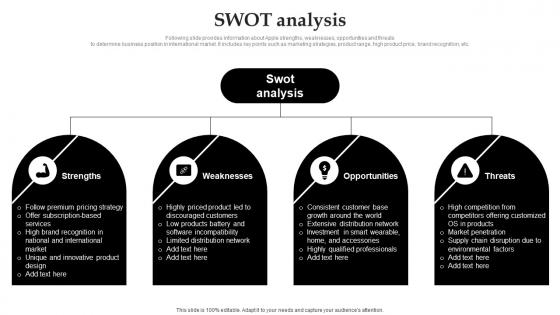
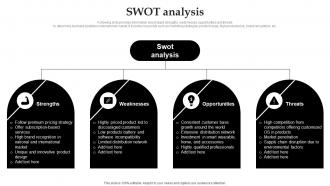
Following slide provides information about Apple strengths, weaknesses, opportunities and threats to determine business position in international market. It includes key points such as marketing strategies, product range, high product price, brand recognition, etc.
People who downloaded this PowerPoint presentation also viewed the following :
SWOT Analysis Apple Company Profile Ppt Elements CP SS with all 9 slides:
Use our SWOT Analysis Apple Company Profile Ppt Elements CP SS to effectively help you save your valuable time. They are readymade to fit into any presentation structure.








FAQs for SWOT Analysis Apple Company Profile Ppt
SWOT Analysis comprises four primary components: Strengths (internal advantages), Weaknesses (internal limitations), Opportunities (external possibilities), and Threats (external challenges). These elements can be effectively identified through comprehensive stakeholder interviews, competitive market research, financial performance analysis, and customer feedback assessment, with many organizations finding that cross-departmental collaboration ultimately delivers more accurate strategic insights.
Organizations can leverage SWOT-identified strengths by aligning them with market opportunities, investing in core competencies, and differentiating from competitors through superior capabilities. By strategically positioning these strengths in marketing, operations, and product development, companies enhance customer value propositions, streamline resource allocation, and build sustainable competitive advantages that are difficult for rivals to replicate.
Common SWOT analysis pitfalls include being overly optimistic about strengths, underestimating threats, lacking specific evidence, and conducting analysis in isolation without diverse perspectives. Organizations often create generic assessments that miss nuanced industry dynamics, with many finding that successful SWOT requires regular updates, cross-functional input, and actionable insights rather than superficial observations.
Businesses can transform SWOT weaknesses into actionable strategies by conducting detailed root cause analysis, prioritizing weaknesses based on business impact, establishing specific improvement metrics, and creating targeted action plans with clear timelines and ownership. Companies across sectors like retail, manufacturing, and financial services find that linking weakness remediation to strategic initiatives, allocating dedicated resources, and implementing regular progress reviews ultimately delivers competitive advantage and operational efficiency.
Organizations can utilize SWOT-identified opportunities by aligning them with existing strengths to create competitive advantages, developing strategic initiatives that address market gaps, and allocating resources toward high-potential areas like emerging technologies or underserved customer segments. Through strategic planning and cross-functional collaboration, companies across industries streamline their growth trajectories, enhance market positioning, and ultimately deliver sustainable expansion while minimizing risks associated with new ventures.
External factors directly shape opportunities and threats by creating market conditions, regulatory changes, technological advances, and competitive dynamics that organizations must navigate. Economic shifts, industry trends, consumer behavior changes, and technological disruptions present both growth prospects and potential risks, with many businesses finding that proactive external environment monitoring enables strategic positioning and competitive advantage in an increasingly dynamic marketplace.
Market research provides the factual foundation for SWOT analysis by delivering comprehensive data on customer preferences, competitor strategies, industry trends, regulatory changes, and market opportunities. Through surveys, focus groups, competitive intelligence, and trend analysis, organizations can objectively assess their market position, identify emerging threats, and uncover strategic opportunities, ultimately ensuring their SWOT analysis reflects current market realities rather than internal assumptions.
SWOT Analysis integrates into strategic planning by conducting comprehensive assessments during initial planning phases, aligning findings with organizational objectives, and incorporating insights into goal-setting frameworks. Strategic planners leverage SWOT matrices to inform resource allocation decisions, priority-setting processes, and risk management strategies, with many organizations finding that regular SWOT reviews enhance decision-making agility and competitive positioning.
Technology companies, healthcare organizations, retail businesses, financial services, and manufacturing firms benefit most from regular SWOT analyses, as these sectors face rapid market changes and competitive pressures. These industries leverage SWOT frameworks to navigate digital transformation, regulatory shifts, and consumer behavior evolution, with many organizations finding that systematic analysis enhances strategic decision-making and maintains competitive advantage.
SWOT Analysis for startups focuses heavily on potential and market opportunities, while established companies emphasize historical performance data, existing market position, and resource optimization. Startups typically identify threats like funding challenges and market validation risks, whereas established companies analyze competitive pressures and market disruption, with many finding that established firms leverage operational strengths while startups capitalize on agility and innovation opportunities.
SWOT and PESTLE analyses work together as complementary strategic planning tools, with PESTLE examining external macro-environmental factors like political, economic, social, technological, legal, and environmental influences, while SWOT focuses on internal strengths and weaknesses alongside external opportunities and threats. Many organizations use PESTLE insights to inform their SWOT external factors, ultimately delivering more comprehensive strategic assessments and competitive positioning.
Organizations can involve team members through structured workshops, cross-departmental surveys, anonymous feedback systems, focus groups, and tiered input sessions that capture perspectives from executives to frontline staff. This inclusive approach enhances accuracy by incorporating diverse viewpoints, from operational insights to strategic perspectives, ultimately delivering more comprehensive analysis and stronger organizational buy-in for strategic initiatives.
SWOT Analysis supports risk management by identifying internal weaknesses and external threats that could impact business operations, while highlighting strengths and opportunities that can mitigate these risks. Through systematic evaluation, organizations can develop contingency plans, allocate resources strategically, and build resilience frameworks, with many companies finding that regular SWOT assessments enable proactive risk identification and competitive positioning.
Companies can ensure SWOT relevance by conducting quarterly reviews, integrating real-time market data, and involving cross-functional teams in continuous analysis updates. Through dynamic assessment frameworks, organizations in sectors like technology and retail actively monitor competitive shifts, regulatory changes, and consumer trends, while leveraging automated data collection tools, ultimately maintaining strategic agility and competitive positioning in increasingly volatile markets.
Tools that complement SWOT analysis include Porter's Five Forces for competitive dynamics, PESTLE analysis for external factors, balanced scorecards for performance metrics, gap analysis for strategic planning, and scenario planning for future uncertainties. These frameworks enhance SWOT's foundational insights by providing deeper market context, operational clarity, and strategic direction, with many organizations finding that combining multiple analytical approaches delivers more comprehensive decision-making capabilities.
-
The customer care of SlideTeam is very responsive. I was having a payment issue and they fixed it for me in no time.
-
I was never satisfied with my own presentation design but SlideTeam has solved that problem for me. Thank you SlideTeam!