


Swot Analysis Unilever Company Profile CP SS




Try Before you Buy Download Free Sample Product
 Impress Your
 Audience
 100%
100% Editable
 Save Hours
 of Time


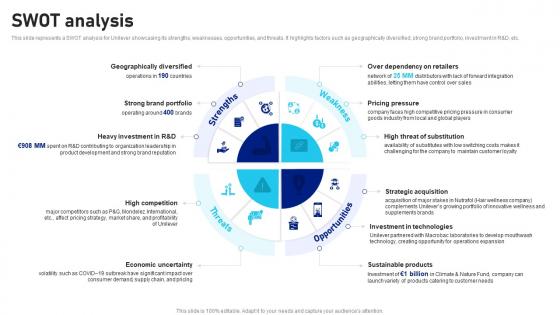
This slide represents a SWOT analysis for Unilever showcasing its strengths, weaknesses, opportunities, And threats. It highlights factors such as geographically diversified, strong brAnd portfolio, investment in RAndD, etc.
People who downloaded this PowerPoint presentation also viewed the following :
Swot Analysis Unilever Company Profile CP SS with all 9 slides:
Use our Swot Analysis Unilever Company Profile CP SS to effectively help you save your valuable time. They are readymade to fit into any presentation structure.








FAQs for Swot Analysis Unilever Company
Unilever's key strengths include its extensive global brand portfolio with over 400 brands, strong sustainability initiatives through the Sustainable Living Plan, robust distribution networks across 190 countries, significant R&D capabilities, and deep emerging market penetration. These strategic advantages enable enhanced consumer loyalty, operational efficiency, and market adaptability, with many retail partners finding that Unilever's brand diversity and sustainability focus ultimately deliver competitive differentiation and consistent revenue growth.
Unilever's global supply chain enhances operational efficiency by leveraging economies of scale, optimizing distribution networks, and implementing advanced demand forecasting across multiple markets. Through strategic supplier partnerships and automated inventory management, the company minimizes costs, reduces delivery times, and ensures product availability worldwide, ultimately delivering competitive pricing and improved customer experiences across diverse geographic regions.
Unilever faces significant weaknesses including heavy dependence on emerging markets with economic volatility, complex organizational structure slowing decision-making, and intense price competition from local brands and private labels. These challenges, particularly in markets like India and Southeast Asia, require strategic restructuring and innovation acceleration to maintain competitive advantage while balancing cost pressures with brand premium positioning.
Unilever's diverse product portfolio delivers competitive advantage through risk mitigation across market fluctuations, enhanced distribution leverage with retailers, and strategic cross-selling opportunities between categories like personal care and food products. This diversification enables sustained revenue streams during economic downturns, streamlines supply chain efficiencies, and creates powerful brand ecosystems, with many multinational companies finding that portfolio breadth ultimately strengthens market resilience and accelerates global expansion.
Unilever's sustainability commitment significantly enhances its brand image by positioning it as a responsible leader in consumer goods, attracting environmentally conscious consumers and building trust through transparent environmental initiatives. This strategic approach delivers increased customer loyalty, premium pricing opportunities, and competitive differentiation, with many consumers increasingly choosing sustainable brands over traditional alternatives, ultimately strengthening market position.
External threats to Unilever's market share include intense competition from P&G and local brands, economic downturns affecting consumer spending, regulatory changes on sustainability practices, and shifting consumer preferences toward niche products. These market pressures challenge traditional FMCG models by demanding faster innovation, increased price competitiveness, and enhanced digital engagement, with many multinational companies finding that agile adaptation ultimately determines long-term competitive advantage.
The increasing popularity of vegan and cruelty-free products presents significant opportunities for Unilever's product development strategy, enabling them to expand market reach, enhance brand reputation, and capture growing consumer segments demanding ethical alternatives. Through strategic reformulation and new product launches across personal care, food, and home care categories, Unilever can leverage this trend to drive innovation while meeting evolving consumer values, ultimately delivering competitive advantage in increasingly conscious markets.
Unilever can leverage digital marketing through personalized content campaigns, social media storytelling, influencer partnerships, interactive mobile apps, and data-driven customer segmentation strategies. These approaches enable deeper brand connections by delivering targeted messaging across multiple touchpoints, with consumer goods companies increasingly finding that integrated digital strategies drive higher engagement rates, foster brand loyalty, and ultimately deliver measurable growth in competitive markets.
Unilever can expand in emerging markets through localized product development, strategic partnerships with regional distributors, digital-first marketing approaches, and affordable pricing strategies targeting growing middle-class populations. These markets present significant opportunities for personal care and food products, with companies increasingly finding that sustainable practices, local manufacturing, and culturally adapted offerings deliver competitive advantage and accelerated growth.
Unilever measures CSR effectiveness through comprehensive sustainability metrics, third-party audits, stakeholder feedback surveys, environmental impact assessments, and social outcome tracking across its value chain. The company leverages data analytics to evaluate programs like sustainable sourcing and community development, with many initiatives demonstrating measurable improvements in resource efficiency, brand reputation, and stakeholder trust, ultimately delivering competitive advantage.
Innovation serves as Unilever's primary competitive differentiator through sustainable product development, digital transformation initiatives, breakthrough packaging solutions, and advanced supply chain technologies. These innovation streams enable faster market responses, reduced environmental impact, and enhanced consumer experiences, with many consumer goods companies finding that systematic innovation investment ultimately delivers sustained market leadership and operational efficiency in an increasingly competitive landscape.
Unilever can address changing consumer preferences by accelerating product innovation, expanding sustainable and health-conscious offerings, leveraging data analytics for trend prediction, and strengthening direct-to-consumer channels. Through strategic R&D investments and agile supply chains, the company can rapidly adapt formulations and launch targeted products, while digital platforms enable real-time consumer feedback integration, ultimately delivering personalized experiences and sustained market relevance.
Strategic partnerships can enhance Unilever's growth potential by accelerating market entry, sharing innovation costs, accessing new distribution channels, leveraging complementary expertise, and expanding product portfolios. Through strategic alliances with local retailers, technology companies, and sustainability-focused organizations, Unilever streamlines operations while reducing investment risks, ultimately delivering enhanced market reach and competitive advantage in an increasingly interconnected global marketplace.
Unilever adapts its marketing strategy through localized product formulations, culturally relevant messaging, regional brand positioning, and partnerships with local influencers and distributors. This approach enables the company to resonate with diverse consumer preferences across markets, from beauty standards in Asia to sustainability priorities in Europe, ultimately delivering stronger brand loyalty and competitive advantage in an increasingly globalized marketplace.
Regulatory changes significantly impact Unilever's operations through evolving sustainability requirements, packaging standards, ingredient restrictions, and data privacy laws across different markets. These regulatory shifts compel strategic adaptation in product formulation, supply chain management, and marketing approaches, with many regions finding that compliance drives innovation in sustainable packaging and clean labeling, ultimately delivering competitive advantage and enhanced consumer trust.
-
Attractive design and informative presentation.
-
I took a chance with SlideTeam. I never looked back. Great products and great service.