


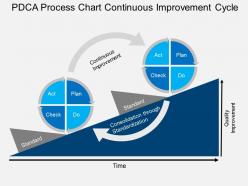
Sy pdca process chart continuous improvement cycle flat powerpoint design





Try Before you Buy Download Free Sample Product
 Impress Your
 Audience
 100%
100% Editable
 Save Hours
 of Time


In an organisation It is extremely vital to keep a track on the ongoing processes and tasks to evaluate the performance of the entire system, therefore bearing this in mind our expert team has come up with a sy plan-do-check-act process map continuous improvement cycle flat PPT diagram. This presentation slide is loaded with all the essential features that must be present in a high quality and class presentations. Also, only after getting deep down into understanding the needs of the businesses and the viewers, these amazing templates have been crafted. Apart from this, performance wise, there will never be an issue or error that could deviate the working of the presentation. Moreover, the combination of these layouts with your reports can create a never seen and felt presentation experience that will impose an everlasting impact on the members of the audience. Not enough can be said about these extraordinary illustrations so simply download and enjoy the complete benefits. The gist gets clear with our Sy PDCA Process Chart Continuous Improvement Cycle Flat Powerpoint Design. The audience will decipher the core aspects.
People who downloaded this PowerPoint presentation also viewed the following :
Sy pdca process chart continuous improvement cycle flat powerpoint design with all 4 slides:
Keep clear of difficult circumstances with our Sy PDCA Process Chart Continuous Improvement Cycle Flat Powerpoint Design. Avoid any harrowing conditions.
FAQs for Sy pdca process chart continuous improvement cycle
The PDCA Cycle consists of Plan (establishing objectives and processes), Do (implementing the plan on a small scale), Check (monitoring results against expected outcomes), and Act (standardizing successful changes or adjusting failed ones). These stages streamline project management by enabling systematic testing, continuous improvement, and risk mitigation, with organizations in manufacturing, healthcare, and software development finding that this iterative approach ultimately delivers enhanced quality, reduced waste, and sustainable competitive advantage.
The PDCA Cycle facilitates continuous improvement by establishing systematic Plan-Do-Check-Act phases that create iterative learning loops, standardize problem-solving approaches, and embed improvement into daily operations. Through structured experimentation and data-driven adjustments, organizations in manufacturing, healthcare, and financial services streamline processes, reduce waste, and enhance quality outcomes, ultimately delivering sustained operational excellence and competitive advantage.
Teams can measure PDCA Cycle success through key performance indicators, process efficiency metrics, customer satisfaction scores, defect reduction rates, and cycle time improvements. Through systematic tracking, organizations in manufacturing, healthcare, and service industries enhance operational efficiency, streamline workflows, and deliver measurable cost savings, with many finding that regular measurement cycles ultimately create sustainable competitive advantages.
Organizations commonly face challenges including resistance to change, inadequate data collection, insufficient planning time, lack of leadership support, and poor communication across teams during PDCA implementation. These obstacles can be overcome by fostering a culture of continuous improvement, investing in proper training and data systems, and ensuring leadership actively champions the process, with many manufacturing and healthcare organizations finding that structured change management and cross-functional collaboration ultimately deliver sustainable operational improvements.
Technology and software tools enhance PDCA effectiveness by automating data collection, providing real-time analytics, and streamlining documentation processes across all four phases. Through project management platforms, data visualization dashboards, and automated reporting systems, organizations accelerate cycle iterations, improve accuracy in problem identification, and enable faster decision-making, ultimately delivering more responsive continuous improvement programs.
Yes, the PDCA Cycle integrates seamlessly with Six Sigma and Lean methodologies, serving as a foundational improvement framework within their structured approaches. In Six Sigma's DMAIC process, PDCA operates within each phase for continuous refinement, while in Lean environments, it drives kaizen activities and waste elimination efforts, with manufacturing, healthcare, and financial services organizations finding that this strategic combination enhances operational efficiency and accelerates sustainable improvements.
Manufacturing, healthcare, software development, financial services, and retail industries benefit most from PDCA implementation because they require continuous quality improvement, regulatory compliance, and operational efficiency. These sectors leverage PDCA's systematic approach to streamline processes, reduce defects, and enhance customer satisfaction, with many organizations finding that regular Plan-Do-Check-Act cycles deliver measurable cost reductions and competitive advantages.
Leadership promotes PDCA culture by modeling continuous improvement behaviors, establishing clear metrics for plan-do-check-act phases, and rewarding experimentation alongside learning from failures. Through regular review sessions, cross-functional collaboration initiatives, and transparent communication about improvement outcomes, organizations create environments where iterative problem-solving becomes embedded in daily operations, ultimately delivering enhanced operational efficiency and sustainable competitive advantage.
**Plan phase metrics** include baseline performance data, resource allocation targets, timeline milestones, and success criteria definitions, while **Do phase** tracks implementation progress, resource utilization, and initial outcome indicators. **Check phase** measures results against objectives through variance analysis and performance gaps, and **Act phase** monitors standardization adoption rates, process improvement sustainability, and cycle completion times, with many organizations finding that consistent metric tracking across phases delivers enhanced operational efficiency and accelerated continuous improvement outcomes.
Feedback loops within the PDCA Cycle can be optimized through real-time data collection, cross-functional team collaboration, standardized metrics tracking, and regular review intervals that enable immediate course corrections. Many organizations in manufacturing, healthcare, and retail find that integrating digital dashboards and automated reporting systems streamlines the Check phase, while structured feedback sessions enhance Plan refinement, ultimately delivering faster improvement cycles and sustained operational excellence.
Manufacturing companies like Toyota use PDCA for continuous improvement in production lines, healthcare organizations apply it for patient safety protocols, and software development teams leverage it for iterative product enhancement. These implementations demonstrate how systematic planning, testing, and refinement cycles deliver measurable quality improvements, reduced waste, and enhanced operational efficiency across diverse industries.
The PDCA Cycle enhances risk management by systematically identifying risks during Plan, implementing mitigation strategies in Do, monitoring effectiveness through Check, and refining approaches in Act. This iterative framework enables project teams to proactively address emerging risks, adapt controls based on real-time feedback, and continuously strengthen risk mitigation strategies, ultimately delivering more resilient project outcomes.
Employee training plays a crucial role in PDCA implementation by ensuring teams understand systematic problem-solving methodologies, data collection techniques, and continuous improvement principles. Through comprehensive training programs, organizations enable staff to effectively execute each cycle phase, identify improvement opportunities, and sustain long-term process enhancements, ultimately delivering enhanced operational efficiency and competitive advantage.
The PDCA Cycle adapts to remote environments through digital collaboration tools, virtual check-ins, cloud-based data tracking, and flexible communication protocols that maintain continuous improvement momentum. Remote teams leverage video conferencing for Plan sessions, project management software for Do phase tracking, and real-time dashboards for Check analysis, ultimately delivering enhanced transparency and accountability across distributed workforces.
Common misconceptions about the PDCA Cycle include viewing it as a one-time activity, expecting immediate results, thinking it only applies to manufacturing, believing it requires extensive resources, and assuming it's purely reactive. These misunderstandings prevent organizations from leveraging PDCA's iterative nature for continuous improvement, with many companies finding that consistent application across departments ultimately delivers sustained operational efficiency and competitive advantage.
-
Perfect template with attractive color combination.
-
Innovative and attractive designs.