


Tactics To Draft Functional Level Strategy Plan




Try Before you Buy Download Free Sample Product
 Impress Your
 Audience
 100%
100% Editable
 Save Hours
 of Time


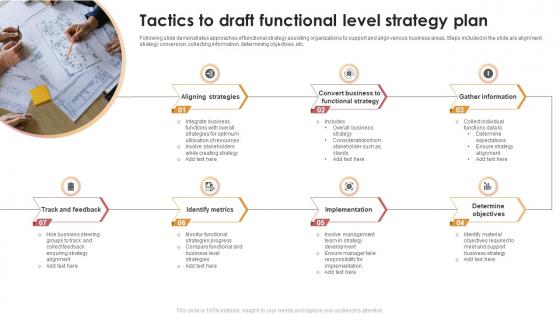
Following slide demonstrates approaches of functional strategy assisting organizations to support and align various business areas. Steps included in the slide are alignment, strategy conversion, collecting information, determining objectives, etc.
People who downloaded this PowerPoint presentation also viewed the following :
Tactics To Draft Functional Level Strategy Plan with all 6 slides:
Use our Tactics To Draft Functional Level Strategy Plan to effectively help you save your valuable time. They are readymade to fit into any presentation structure.





FAQs for Tactics To Draft Functional
Functional level strategy plans encompass areas like marketing, finance, HR, and IT, each designed to support broader organizational goals through focused initiatives. These strategies streamline operations by optimizing resource allocation, enhancing process efficiency, and fostering skill development, with many institutions finding that integrated functional plans deliver significant cost reductions and improved customer experiences.
Functional level strategy differs from business-level strategy by focusing on improving efficiency within specific departments, such as marketing, finance, and operations, while business-level strategy addresses how to compete in an industry. These approaches work in tandem, with functional strategies enabling business strategies through streamlined processes, resource allocation, and enhanced operational efficiency. Ultimately delivering cost advantages and improved customer experiences, with many organizations finding that integrated strategies yield sustainable competitive advantage.
Functional level strategies enhance operational efficiency within an organization by streamlining processes, optimizing resource allocation, and fostering cross-departmental integration. These approaches, encompassing marketing, finance, and HR, deliver significant cost reductions, faster turnaround times, and improved customer experiences, with many manufacturing and financial services institutions finding that focused functional plans minimize redundancies. Ultimately, this delivers a competitive advantage and increased profitability.
Employee engagement significantly impacts functional level strategy development by fostering innovation, improving operational efficiency, and enhancing customer experiences. While strategic planning often focuses on market analysis and resource allocation, it also requires actively soliciting employee input, with many organizations finding that engaged teams deliver better insights. These collaborative approaches streamline implementation, accelerate problem-solving, and ultimately deliver a competitive advantage and increased profitability.
Organizations can measure functional level strategy effectiveness through key performance indicators (KPIs) like cost reduction, revenue growth, and customer satisfaction, alongside metrics tracking operational efficiency and innovation output. While quantitative data provides crucial insights, it also necessitates qualitative assessments—such as employee feedback and market share analysis—across industries like banking and retail. These technologies streamline performance monitoring by enabling real-time data analysis, ultimately delivering improved resource allocation and a sustained competitive advantage.
Functional level strategy implementation presents both challenges and opportunities, often involving siloed departmental goals, resource allocation conflicts, and difficulties in cross-functional coordination. While streamlining processes helps, it also requires significant cultural shifts, with many organizations finding that overcoming resistance to change and ensuring consistent communication are critical. These approaches enhance operational efficiency by integrating marketing, finance, and HR, ultimately delivering improved performance and a sustainable competitive advantage.
Technology can enhance functional level strategies across departments by streamlining communication, automating tasks, and improving data analytics. These advancements facilitate better resource allocation, accelerate decision-making, and optimize operational efficiency, with many financial services institutions finding that integrated systems deliver significant cost reductions and enhanced customer experiences.
Functional level strategies demonstrate success at companies like Starbucks, where consistent employee training enhances customer experiences, and at Toyota, with its lean manufacturing streamlining operations. These approaches involve optimizing resources by focusing on marketing, finance, and HR, ultimately delivering cost advantages and improved market positioning with many organizations finding that integrated functional plans boost overall performance.
Functional level strategies significantly impact performance by streamlining operations, enhancing resource allocation, and fostering innovation. While independent functional plans can deliver short-term gains, alignment with overarching corporate strategy enables synergistic efforts across departments—marketing, finance, and HR—ultimately delivering competitive advantage and sustained organizational growth, with many institutions finding that integrated planning boosts profitability.
Functional level strategies are most effectively communicated through cascading goals, cross-functional meetings, and dedicated communication platforms. These approaches streamline information flow by ensuring alignment between departmental objectives and overall company vision, with many organizations finding that transparent updates foster greater employee engagement. Ultimately delivering enhanced operational efficiency and a competitive advantage through cohesive team efforts.
Data analytics informs functional level strategy planning by revealing insights into customer behavior, operational efficiency, and market trends, enabling organizations to refine resource allocation, optimize processes, and enhance decision-making. While requiring investment in infrastructure and skilled personnel, it also streamlines workflows across departments like marketing, finance, and HR, ultimately delivering a competitive advantage and improved profitability with many institutions finding that data-driven strategies significantly enhance performance.
Functional level strategies should be adapted for market conditions by prioritizing cost reduction during recessions, enhancing differentiation during growth, and focusing on innovation amidst intense competition. These approaches streamline operations, improve customer experiences, and accelerate product development, with many organizations finding that agility delivers a significant competitive advantage. Ultimately, this enables sustained performance in an increasingly dynamic landscape and fosters long-term resilience.
Cross-functional collaboration improves functional level strategy outcomes by breaking down silos, fostering innovation, and enhancing resource allocation across departments. While individual functions possess specialized expertise, it also requires integrated workflows, with marketing, sales, and operations finding that shared insights streamline processes and accelerate decision-making, ultimately delivering enhanced efficiency and competitive advantage.
Functional level strategies require consistent review, encompassing performance metrics, resource allocation, and competitive benchmarking, while also demanding alignment with overarching corporate objectives. These reviews should be conducted quarterly, incorporating insights from cross-functional teams—like marketing and finance—to ensure strategic combination and ultimately delivering operational efficiency and a sustained competitive advantage with many institutions finding that agile adaptation is key.
Functional level strategies support innovation by fostering specialized expertise, streamlining workflows, and enabling resource allocation within departments. While departmental silos can hinder cross-functional collaboration, a well-defined plan enhances focused research and development, such as marketing’s A/B testing or finance’s algorithmic modeling. Ultimately delivering enhanced product development and operational efficiency, with many organizations finding that empowered teams drive significant competitive advantage.
-
Unique and attractive product design.
-
I was able to find the right choice of PPT template for my thesis with SlideTeam. Thank you for existing.