


Tags for smart goals flat powerpoint design





Try Before you Buy Download Free Sample Product
 Impress Your
 Audience
 100%
100% Editable
 Save Hours
 of Time


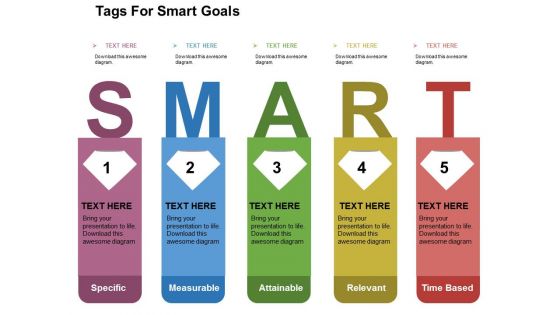
Insert our tags for smart goals PowerPoint design to present your business in the most innovative way. In corporate world, the term smart stands for specific, measurable, attainable, relevant and timely. This presentation graphic assist you to demonstrate this concept to your viewers in the well-organized way. Mostly project managers use this approach to analyze project phases as well as outcomes. Use of this PPT template increase your chances of achieving success. The PowerPoint visual is also useful in showcasing as how your planning process, project duration, tasks and end results will be achieved. Our PPT image is useful in understanding as what is required to achieve success and then share that information with others. The five stage smart presentation diagram is the great tool when it you are looking to complete a project or want to improve your performance. You may download it and share it with your viewers in the way you want it as it is amendable. Browse through our entire website to search more design options for your next presentation. Cultivate ideas with our Tags For Smart Goals Flat Powerpoint Design. They will cause them to germinate.
People who downloaded this PowerPoint presentation also viewed the following :
Tags for smart goals flat powerpoint design with all 4 slides:
Give your thoughts some locomotion. Pump the pistons with our Tags For Smart Goals Flat Powerpoint Design.



FAQs for Tags for smart goals
SMART goals comprise Specific, Measurable, Achievable, Relevant, and Time-bound components that create clear, actionable objectives with defined parameters and deadlines. These components enhance planning effectiveness by eliminating ambiguity, enabling progress tracking, and ensuring realistic resource allocation, with many organizations finding that SMART frameworks streamline project management and significantly improve goal achievement rates across departments.
Individuals can ensure measurable goals by defining specific metrics, quantifiable outcomes, numerical targets, clear deadlines, and trackable milestones within their objectives. This approach enables progress monitoring through concrete data points like percentages, dollar amounts, or completion rates, while providing regular checkpoints that maintain accountability and motivation, ultimately delivering clearer focus and higher achievement rates across personal and professional endeavors.
SMART goals enhance team performance by establishing clear expectations, improving accountability, aligning individual efforts with organizational objectives, and creating measurable benchmarks for success. These structured targets enable teams to prioritize tasks more effectively, track progress systematically, and celebrate achievements strategically, with many corporations finding that departments using SMART frameworks deliver projects faster and exceed quarterly targets more consistently.
Maintaining motivation for long-term SMART goals requires breaking objectives into smaller milestones, celebrating incremental achievements, and regularly reviewing progress against measurable benchmarks. Through strategic milestone mapping and consistent progress tracking, organizations and individuals streamline momentum by visualizing advancement, adjusting timelines when necessary, and reinforcing commitment, ultimately delivering sustained engagement and higher goal completion rates across extended timeframes.
Assessing goal relevancy involves evaluating alignment with broader objectives, available resources, current priorities, and organizational strategy. Goals should directly contribute to personal or business growth while being realistic given time constraints and capabilities, with many professionals finding that relevant goals enhance motivation, streamline focus, and ultimately deliver measurable progress toward strategic outcomes.
Time-bound elements create structured deadlines that transform vague aspirations into actionable commitments, establishing clear completion dates, milestone markers, and accountability frameworks that drive consistent progress. These temporal boundaries generate healthy urgency by compelling prioritization, resource allocation, and focused execution, with many organizations finding that specific deadlines enhance team coordination, prevent procrastination, and ultimately deliver measurable results within strategic timeframes.
Poorly defined goals like "increase sales," "improve customer service," or "reduce costs" lack specificity, deadlines, and measurable criteria, making progress tracking impossible. Well-defined SMART goals transform these into "increase quarterly sales revenue by 15% through targeted digital marketing campaigns by December 31st" or "reduce customer response time to under 2 hours within 90 days," ultimately delivering clear accountability and measurable business outcomes.
The SMART framework enhances project management by establishing specific objectives, measurable milestones, achievable targets, relevant outcomes, and time-bound deadlines for comprehensive deliverable tracking. Through structured goal-setting, project managers streamline resource allocation, monitor progress systematically, and maintain team accountability, with many organizations finding that SMART criteria significantly reduce project delays and ultimately deliver improved completion rates.
Common SMART goal mistakes include setting vague objectives, unrealistic timelines, irrelevant targets, and failing to track progress consistently. These pitfalls can be avoided by defining specific metrics upfront, conducting realistic timeline assessments, aligning goals with strategic priorities, and establishing regular review cycles, with many organizations finding that structured goal-setting frameworks ultimately enhance accountability and deliver measurable results.
SMART goals enhance personal development by providing structured frameworks for tracking progress, maintaining accountability, and achieving measurable self-improvement outcomes. Through specific milestones, realistic timelines, and quantifiable metrics, individuals can streamline their growth across areas like career advancement, health improvements, and skill development, ultimately delivering sustained motivation and tangible results.
Organizations can encourage employee-driven SMART goal setting through regular one-on-one coaching sessions, self-assessment tools, goal-setting workshops, and clear alignment frameworks connecting personal objectives to company strategy. By providing structured templates, ongoing feedback mechanisms, and recognition programs, companies enable employees to take ownership of their development while ensuring goals remain measurable and achievable, ultimately enhancing engagement and performance outcomes.
Cultural differences significantly impact SMART goals through varying communication styles, time orientations, and achievement perspectives across global teams. While Western cultures often emphasize individual accountability and strict deadlines, many Asian and Latin American cultures prioritize collective harmony and flexible timelines, with multinational organizations finding that adapting SMART frameworks to include cultural context and collaborative elements ultimately enhances employee engagement and goal achievement across diverse markets.
SMART goal tracking tools include Asana, Trello, Monday.com, Todoist, and ClickUp, along with specialized platforms like GoalsonTrack and Weekdone. These platforms streamline progress monitoring by automating deadline reminders, visualizing milestone achievements, and enabling collaborative updates, with many organizations finding that integrated dashboard features ultimately enhance accountability and deliver faster goal completion across teams.
Feedback loops enhance SMART goal achievement by providing continuous performance monitoring, enabling real-time adjustments, and maintaining accountability throughout the process. Through regular check-ins and progress assessments, organizations can identify obstacles early, recalibrate strategies when needed, and sustain momentum, with many finding that systematic feedback ultimately accelerates goal completion and improves outcomes.
SMART goals serve as the tactical bridge between high-level organizational strategy and day-to-day execution, translating broad strategic objectives into measurable, actionable targets across departments. This strategic alignment ensures that individual and team efforts directly contribute to organizational priorities, with many companies finding that SMART goal frameworks enhance accountability, resource allocation, and performance tracking throughout their strategic planning cycles.
-
Appreciate the research and its presentable format.
-
Editable templates with innovative design and color combination.