


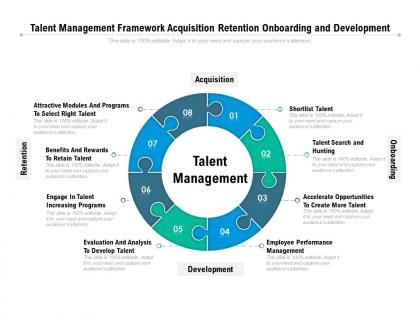
Talent management framework acquisition retention onboarding and development




Try Before you Buy Download Free Sample Product
 Impress Your
 Audience
 100%
100% Editable
 Save Hours
 of Time


Our Talent Management Framework Acquisition Retention Onboarding And Development are topically designed to provide an attractive backdrop to any subject. Use them to look like a presentation pro.
People who downloaded this PowerPoint presentation also viewed the following :
Talent management framework acquisition retention onboarding and development with all 2 slides:
Use our Talent Management Framework Acquisition Retention Onboarding And Development to effectively help you save your valuable time. They are readymade to fit into any presentation structure.
FAQs for Talent management framework acquisition retention
An effective talent management strategy encompasses recruitment, onboarding, training and development, performance management, and retention. These components work together to attract top talent, seamlessly integrate new hires, enhance skills, optimize performance, and cultivate a culture that values and retains valuable employees. By implementing these strategies, organizations can build a highly skilled and motivated workforce, ultimately driving business growth and competitive advantage.
Measuring talent management success goes beyond simple metrics like employee satisfaction; it requires a holistic approach that considers both quantitative and qualitative data. Organizations can track key performance indicators (KPIs) such as employee retention rates, internal promotion rates, and time-to-fill for open positions. Additionally, conducting regular performance reviews, exit interviews, and employee engagement surveys provides valuable qualitative insights into the effectiveness of talent management strategies. By analyzing these combined data points, organizations can gain a comprehensive understanding of their talent management program's impact on overall business performance.
Technology plays a crucial role in enhancing talent management practices by streamlining recruitment, automating performance reviews, and facilitating employee development. These technologies enable organizations to efficiently identify top candidates, provide personalized learning experiences, and track employee progress, ultimately leading to improved retention rates and a more engaged workforce.
Companies can identify and develop high-potential employees through a combination of talent assessments, performance reviews, and targeted development programs. By utilizing psychometric tests, 360-degree feedback, and leadership simulations, organizations can pinpoint individuals with strong potential, while mentorship programs, coaching, and job rotations equip them with the necessary skills and experience to excel in future roles. This strategic approach not only cultivates a robust pipeline of future leaders but also fosters a culture of continuous learning and growth, ultimately enhancing organizational agility and competitiveness.
Talent management systems, while offering great potential, present both challenges and opportunities for organizations. Common hurdles include aligning systems with evolving business goals, ensuring data security and privacy, measuring ROI effectively, and fostering a culture of continuous learning and development. Many organizations find that integrating these systems seamlessly across departments and geographies is crucial for maximizing their impact, ultimately leading to enhanced employee engagement and improved business performance.
Talent management contributes to employee engagement and retention by creating a culture of growth, recognition, and development. It achieves this through structured performance reviews, personalized career paths, and opportunities for skill enhancement, ultimately leading to increased job satisfaction, a stronger sense of belonging, and reduced turnover rates, with many organizations finding that these efforts significantly impact their bottom line.
Integrating diversity and inclusion into talent management frameworks encompasses several key aspects, including recruiting from a wider pool of candidates, implementing bias-free hiring practices, providing equitable training and development opportunities, fostering an inclusive work culture, and establishing mentorship programs that support underrepresented groups. These strategies not only enhance organizational culture and employee engagement but also lead to a more innovative and competitive workforce by leveraging the unique perspectives and experiences of a diverse talent pool.
Effective onboarding in a competitive market involves attracting top talent, engaging them from day one, and setting them up for success. Best practices include a structured onboarding program with clear expectations, mentorship opportunities to foster integration, and ongoing feedback mechanisms to ensure progress and address any challenges. By providing a seamless transition and cultivating a positive work environment, organizations can significantly enhance employee retention and productivity, ultimately giving them a competitive edge.
Companies can leverage employee feedback to shape talent management strategies by actively soliciting input through surveys, focus groups, and regular check-ins. This data reveals employee perceptions of training programs, career development opportunities, and company culture, allowing organizations to identify areas for improvement and tailor their strategies accordingly. For example, a retail company might discover through feedback that employees desire more flexible scheduling options, leading to the implementation of new policies that enhance work-life balance and boost employee morale.
Leadership development significantly impacts overall talent management effectiveness by enhancing employee engagement, fostering a culture of continuous learning, and improving succession planning. Through targeted training programs, organizations cultivate future leaders who can inspire teams, drive innovation, and navigate complex challenges, ultimately leading to increased productivity, reduced turnover, and a stronger competitive advantage.
Succession planning is a key component of effective talent management as it ensures the continuity of leadership and expertise within an organization. By integrating succession planning into broader talent management strategies, companies can identify high-potential employees, provide them with targeted development opportunities, and create a pipeline of qualified individuals ready to step into critical roles. This proactive approach not only mitigates the risks associated with unexpected departures but also fosters a culture of growth and internal mobility, ultimately enhancing organizational agility and competitiveness.
The rise of remote work significantly impacts talent management strategies, presenting both challenges and opportunities. It necessitates a shift from traditional, location-based approaches to strategies that prioritize flexibility, communication, and digital collaboration tools. Many organizations are finding that remote work enables them to access a wider talent pool, reduce overhead costs, and improve employee engagement through greater work-life balance. Ultimately, successful talent management in a remote environment hinges on fostering a strong virtual culture and providing employees with the necessary resources and support to thrive.
Talent management and business goals are inextricably linked; organizations can ensure alignment by clearly defining business objectives and translating them into specific talent needs. This involves analyzing the skills, competencies, and experience required to achieve strategic goals, and then developing talent acquisition, development, and retention strategies that address these needs. Through targeted recruitment, customized training programs, and performance management systems aligned with business outcomes, organizations can effectively cultivate a workforce equipped to drive success.
Fostering a culture of continuous learning requires diverse training and development opportunities, including mentorship programs, online courses, workshops, and job shadowing. These approaches empower employees to enhance their skills, stay current with industry trends, and adapt to evolving business needs, ultimately leading to increased productivity, improved job satisfaction, and a more competitive workforce.
Organizations should adapt their talent management practices by focusing on attracting and retaining diverse talent pools, leveraging technology for personalized learning and development, and fostering flexible work arrangements. By implementing these strategies, companies can attract a wider range of skilled individuals, enhance employee engagement, and ultimately build a more resilient and adaptable workforce, enabling them to thrive in an increasingly competitive global landscape.
No Reviews