


Talent Management Portal Investor Funding Elevator Pitch Deck Ppt Template




Try Before you Buy Download Free Sample Product
 Impress Your
 Audience
 100%
100% Editable
 Save Hours
 of Time


Talent Management Portal Investor Funding Pitch Deck includes solid fundraising strategy to ensure effective chance of getting funded. It focuses on providing customized professional training, and employee data management services. Furthermore, the deck employs slide that can help you offer customized employee benefits, manage perks and employee performance. The pitch deck presentation serves an effective tool in attracting investors by distilling company in condensed and marketable message for potential investors. Grab your investors attention through slides depicting opportunities vs risks in managing human resource, challenges faced, and solutions rendered in managing HR. Use it to talk about the HRM software benefits in reducing HR processes complexities, innovative technology associated, key deliverables of platform, features associated, pricing model for platform, progressive growth of HRM platform. The deck caters investors attention through slides depicting global HRM software market assessment, profitable business model, competitive assessment of major players existing, clients associated, key people involved, board members associated, and future initiatives. Book a free demo with our expert team and grab this 100 percent editable presentation.
People who downloaded this PowerPoint presentation also viewed the following :
Content of this Powerpoint Presentation
Slide 1: This is the cover slide of Talent Management Portal Investor Funding Elevator Pitch Deck.
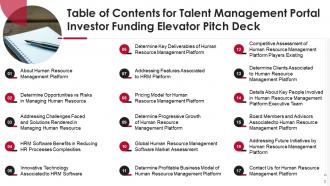
Slide 2: This is the Table of Contents for Human Resource Management Platform Pitch Deck
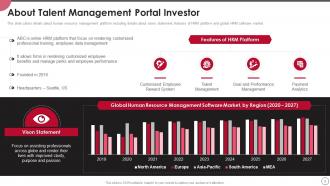
Slide 3: This slide caters details about human resource management platform including details about vision statement, features of HRM platform and global HRM software market.
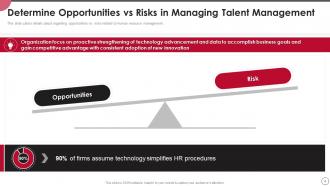
Slide 4: This slide caters details about regarding opportunities vs. risks related to human resource management.
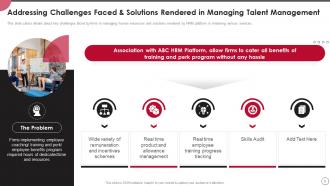
Slide 5: This slide caters details about key challenges faced by firms in managing human resources and solutions rendered by HRM platform in rendering various services.
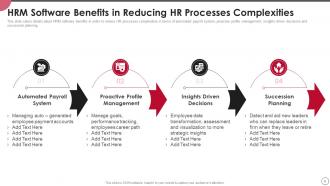
Slide 6: This slide caters details about HRM software benefits in order to reduce HR processes complexities in terms of automated payroll system, proactive profile management, insights driven decisions and succession planning.
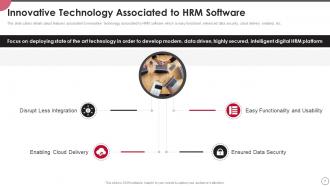
Slide 7: This slide caters details about features associated to innovative technology associated to HRM software which is easy functional, enhanced data security, cloud delivery enabled, etc.
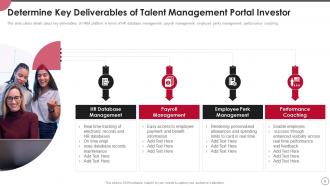
Slide 8: This slide caters details about key deliverables of HRM platform in terms of HR database management, payroll management, employee perks management, performance coaching.
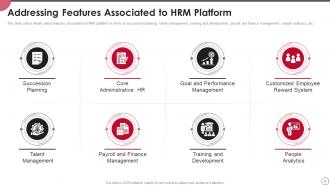
Slide 9: This slide caters details about features associated to HRM platform in terms of succession planning, talent management, training and development, payroll and finance management, people analytics, etc.
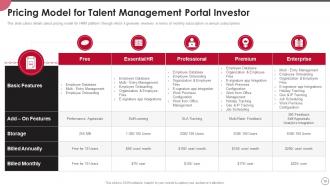
Slide 10: This slide caters details about pricing model for HRM platform through which it generate revenues in terms of monthly subscription or annual subscriptions.
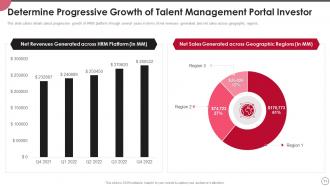
Slide 11: This slide caters details about progressive growth of HRM platform through several years in terms of net revenues generated and net sales across geographic regions.
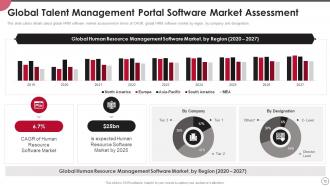
Slide 12: This slide caters details about global HRM software market assessment in terms of CAGR, global HRM software market by region, by company and designation.
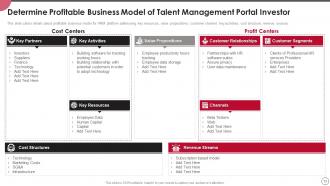
Slide 13: This slide caters details about profitable business model for HRM platform addressing key resources, value propositions, customer channel, key activities, cost structure, revenue sources.
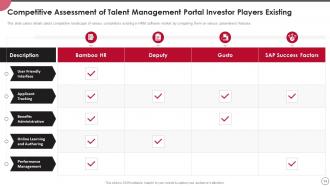
Slide 14: This slide caters details about competitive landscape of various competitors existing in HRM software market by comparing them on various parameters/ features.
Slide 15: This slide caters details about clients associated to HRM platform in terms of major clients and client testimonials.
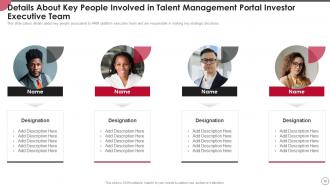
Slide 16: This slide caters details about key people associated to HRM platform executive team and are responsible in making key strategic decisions.
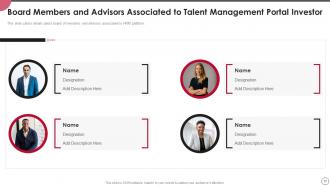
Slide 17: This slide caters details about board of members and advisors associated to HRM platform.
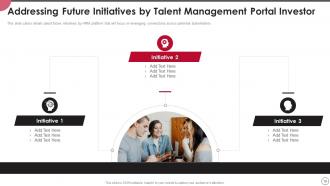
Slide 18: This slide caters details about future initiatives by HRM platform that will focus on leveraging connections across potential stakeholders.
Slide 19: This is the Contact Us slide for Human Resource Management Platform
Slide 20: This is the Icons Slide for Talent Management Portal Investor Funding Elevator Pitch Deck
Slide 21: This is the Additional Slides
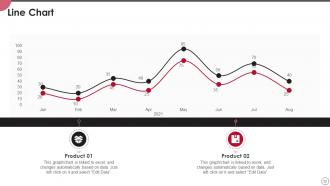
Slide 22: This is the Line Chart slide that can be used to compare data.
Slide 23: This is Our Mission slide to present your company's mission and vision.
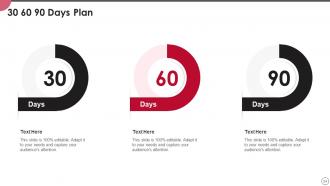
Slide 24: This is a 30 60 90 Days Plan slide to create robust plans.
Slide 25: This is Meet Our Team slide to introduce your staff.
Slide 26: This is Post It Notes slide present important information.
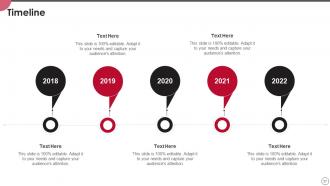
Slide 27: This is a Timeline slide to present series of events.
Slide 28: This is a Venn diagram slide to compare different elements.
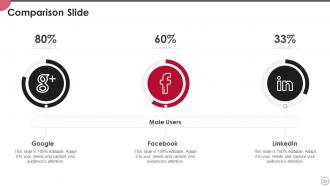
Slide 29: This is a Comparison Slide to conduct a comparative analysis of data.
Slide 30: This is a Puzzle slide for idea generation.
Slide 31: This is a Roadmap slide to present the chronological sequence of events.
Slide 32: This is a Thankyou slide for acknowledgment.
Talent Management Portal Investor Funding Elevator Pitch Deck Ppt Template with all 37 slides:
Use our Talent Management Portal Investor Funding Elevator Pitch Deck Ppt Template to effectively help you save your valuable time. They are readymade to fit into any presentation structure.





FAQs for Talent Management Portal Investor Funding Elevator Pitch
Key features include performance tracking systems, skill assessment tools, career development pathways, succession planning modules, and integrated learning management capabilities. These features streamline talent development by identifying high-potential employees, automating performance reviews, and delivering personalized growth opportunities, with many organizations finding that comprehensive portals enhance employee retention while building stronger leadership pipelines.
A talent management portal improves employee engagement and retention by providing clear career development pathways, transparent performance feedback, and personalized learning opportunities that align individual goals with organizational objectives. Through streamlined communication and accessible growth resources, employees feel more valued and invested in their roles, with many organizations finding that these platforms reduce turnover while enhancing overall workforce satisfaction and productivity.
Data analytics transforms talent management systems by enabling predictive hiring, performance trend analysis, skills gap identification, and retention forecasting through comprehensive workforce insights. Through advanced analytics, organizations streamline recruitment processes, enhance employee development programs, and optimize resource allocation, with many companies finding that data-driven talent strategies ultimately deliver improved retention rates and competitive advantage in securing top talent.
Organizations ensure compliance in talent management portals through automated audit trails, role-based access controls, data encryption, and regular compliance monitoring. These systems streamline regulatory adherence by maintaining detailed documentation, enforcing consistent policies, and generating compliance reports, with many enterprises finding that integrated compliance features significantly reduce administrative burden while enhancing transparency and accountability.
Personalizing talent management portals involves implementing role-based dashboards, customizable interface layouts, AI-driven content recommendations, personalized learning paths, and adaptive workflow configurations. These features enhance user engagement by delivering relevant information, streamlined navigation, and tailored development opportunities, with many organizations finding that personalized experiences significantly increase platform adoption and employee satisfaction.
Integration with other HR systems enhances talent management portals by centralizing employee data, streamlining workflows, and eliminating duplicate data entry across platforms. This connectivity enables seamless information flow between payroll, benefits, performance management, and recruitment systems, ultimately delivering comprehensive employee insights, faster decision-making, and improved operational efficiency for HR teams managing talent at scale.
Companies should adopt practices including automated workflow creation, role-specific training modules, digital document management, progress tracking dashboards, and integrated feedback systems through their talent management portal. These features streamline onboarding by reducing administrative burden, personalizing employee experiences, and ensuring compliance consistency, with many organizations finding that digital onboarding accelerates time-to-productivity while enhancing new hire engagement.
Talent management portals facilitate skills development by providing personalized learning pathways, competency assessments, mentorship matching, performance tracking, and career mapping tools that align individual growth with organizational objectives. Through integrated analytics and feedback systems, employees can identify skill gaps, access targeted training resources, and visualize progression opportunities, while managers gain insights to support strategic workforce development and retention.
Companies face challenges including employee resistance to new systems, data migration complexities, integration issues with existing HR tools, training requirements, and ensuring user adoption across departments. While these obstacles can initially slow implementation, organizations in sectors like healthcare, finance, and retail find that addressing change management early, providing comprehensive training, and phasing rollouts ultimately delivers streamlined workflows and enhanced talent visibility.
Mobile capabilities revolutionize talent management accessibility by enabling real-time performance tracking, instant feedback delivery, and on-the-go learning access from any location. Through mobile-optimized platforms, HR teams streamline recruitment workflows, managers conduct seamless evaluations, and employees access development resources continuously, ultimately delivering enhanced engagement and operational efficiency across distributed workforces.
Key metrics to evaluate talent management portal success include employee engagement scores, time-to-hire reduction, internal mobility rates, performance improvement tracking, and user adoption percentages. These measurements enable organizations to assess recruitment efficiency, retention outcomes, and development program effectiveness, with many companies finding that comprehensive analytics ultimately deliver enhanced workforce planning and competitive talent acquisition advantages.
Talent management portals support diversity and inclusion through unbiased recruitment algorithms, comprehensive diversity analytics, inclusive performance evaluation frameworks, and targeted development programs for underrepresented groups. These platforms enable organizations to track representation metrics across departments, identify advancement gaps, and implement equitable career pathways, with many companies finding significantly improved retention rates and workplace culture through data-driven inclusion strategies.
Organizations can leverage social learning features by incorporating peer mentoring platforms, collaborative project spaces, knowledge sharing forums, discussion boards, and social feedback mechanisms into their talent management systems. These features enhance employee engagement and knowledge retention by enabling real-time collaboration, cross-departmental learning, and community-driven skill development, ultimately delivering faster onboarding, improved performance outcomes, and stronger organizational knowledge networks.
**INPUT**: What strategies can be employed to encourage user adoption of a new talent management portal? **OUTPUT**: Effective adoption strategies include comprehensive training programs, phased rollouts with pilot groups, intuitive user interface design, clear communication of benefits, and ongoing support systems. These approaches streamline implementation by addressing user concerns, demonstrating immediate value through simplified workflows, and ensuring seamless integration with existing processes, with many organizations finding that combining incentives with regular feedback collection ultimately delivers higher engagement and sustained platform utilization. [Word count: 60 words]
User feedback drives continuous improvement by identifying system gaps, revealing user experience pain points, highlighting feature requests, and uncovering workflow inefficiencies within talent management portals. Organizations leverage this feedback to enhance interface design, streamline recruitment processes, and optimize performance management tools, with many HR departments finding that regular feedback cycles ultimately deliver higher user adoption rates and more strategic talent outcomes.
-
Easily Editable.
-
The quality of PowerPoint templates I found here is unique and unbeatable. Keep up the good work and continue providing us with the best slides!