


Talent Strategy Performance Management Talent Capabilities




Try Before you Buy Download Free Sample Product
 Impress Your
 Audience
 100%
100% Editable
 Save Hours
 of Time


Establish your authority at the helm with our Talent Strategy Performance Management Talent Capabilities. Direct them on the course to follow.
People who downloaded this PowerPoint presentation also viewed the following :
Content of this Powerpoint Presentation
Description:
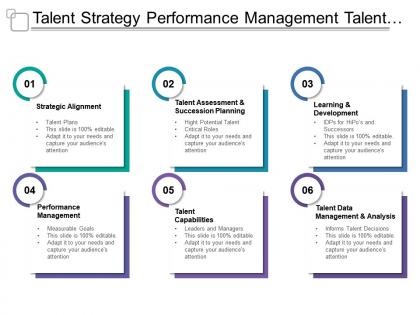
The image depicts a PowerPoint slide titled "Talent Strategy Performance Management Talent..." which outlines six key elements of a talent management strategy. Here are the details for each section:
1. Strategic Alignment:
Focuses on creating talent plans that are aligned with the organization's goals.
2. Talent Assessment & Succession Planning:
Deals with identifying high-potential talent and planning for critical roles within the organization.
3. Learning & Development:
Emphasizes Individual Development Plans (IDPs) for high-potential employees (HiPo's) and successors.
4. Performance Management:
Involves setting measurable goals to track and enhance employee performance.
5. Talent Capabilities:
Aims at developing leadership and managerial skills within the workforce.
6. Talent Data Management & Analysis:
Focuses on using data to inform talent decisions and to analyze workforce capabilities.
Use Cases:
These slides can be utilized across various industries, including:
1. Technology:
Use: Aligning talent with rapid industry innovation.
Presenter: Chief Technology Officer.
Audience: Tech teams, HR specialists.
2. Healthcare:
Use: Planning for critical roles and continuous staff development.
Presenter: HR Director.
Audience: Healthcare administrators, medical staff.
3. Financial Services:
Use: Assessing and planning for leadership succession.
Presenter: Head of HR.
Audience: Executives, managers.
4. Manufacturing:
Use: Enhancing the skills of leaders and managers.
Presenter: Operations Manager.
Audience: Production team leaders, supervisors.
5. Education:
Use: Professional development of academic and administrative staff.
Presenter: Dean or Director of Human Resources.
Audience: Faculty, administrators.
6. Retail:
Use: Managing performance to improve customer service.
Presenter: Retail HR Manager.
Audience: Store managers, team leaders.
7. Consulting:
Use: Showcasing expertise in talent strategy development to clients.
Presenter: Senior Consultant.
Audience: Client companies, stakeholders.
Talent Strategy Performance Management Talent Capabilities with all 5 slides:
Control the conditions with our Talent Strategy Performance Management Talent Capabilities. Don't let anything get out of hand.

FAQs for Talent Strategy Performance
Key components of an effective talent management strategy include talent acquisition, performance management, leadership development, succession planning, and employee engagement initiatives. These interconnected elements work by attracting top performers, developing internal capabilities, and retaining critical talent, with many organizations finding that strategic talent management delivers competitive advantage, reduced turnover costs, and enhanced organizational performance.
Organizations measure talent management success through employee retention rates, internal promotion percentages, performance improvement metrics, engagement survey scores, and time-to-fill for critical positions. These measurements enable companies to track recruitment efficiency, development program effectiveness, and succession planning outcomes, with many finding that comprehensive analytics ultimately deliver enhanced workforce productivity and reduced turnover costs.
Employer branding significantly influences talent acquisition by showcasing company culture, values, career development opportunities, and employee experiences across digital platforms and professional networks. Strong employer brands attract higher-quality candidates, reduce recruitment costs, and improve retention rates, with companies like Google and Microsoft leveraging authentic storytelling to differentiate themselves in competitive talent markets.
Technology enhances talent management through AI-powered recruitment platforms, predictive analytics for performance evaluation, automated onboarding systems, and digital learning management tools. These solutions streamline hiring processes, identify high-potential employees earlier, and deliver personalized development experiences, with many organizations finding that integrated platforms reduce administrative overhead while significantly improving employee engagement and retention rates.
Techniques for identifying high-potential employees include performance evaluations, 360-degree feedback, behavioral assessments, leadership simulations, and succession planning matrices. These strategic approaches enable organizations to evaluate competencies, leadership capabilities, and growth potential systematically, with many companies finding that combining multiple assessment methods delivers more accurate talent identification and enhanced workforce development outcomes.
Diversity and inclusion enhance talent management by expanding recruitment pools, improving decision-making through varied perspectives, and fostering innovation across teams. Organizations increasingly integrate D&I metrics into performance evaluations, succession planning, and leadership development programs, with companies in tech, finance, and healthcare finding that inclusive cultures reduce turnover while attracting top-tier candidates.
Common talent management challenges include skill gaps, employee retention, succession planning, performance management inconsistencies, and adapting to remote work dynamics. Organizations overcome these through strategic workforce planning, personalized development programs, robust mentoring systems, and data-driven performance frameworks, with many companies finding that integrated talent platforms streamline processes while enhancing employee engagement and competitive advantage.
Organizations align talent management goals with business objectives by integrating workforce planning with strategic business plans, establishing performance metrics that directly support company targets, and creating development programs focused on critical business capabilities. Through strategic workforce analytics, companies can identify skill gaps, prioritize talent investments based on business priorities, and measure talent outcomes against revenue growth, ultimately ensuring their human capital strategy drives competitive advantage and operational success.
Employee engagement significantly impacts talent retention by fostering emotional connection, job satisfaction, career development opportunities, and workplace belonging. Engaged employees demonstrate higher productivity, reduced turnover rates, and stronger organizational loyalty, with many companies finding that strategic engagement initiatives, including recognition programs and growth pathways, ultimately deliver competitive advantage through enhanced retention and reduced recruitment costs.
Mentorship programs accelerate talent development by providing personalized guidance, knowledge transfer, and career pathway clarity through experienced professionals. These strategic relationships enhance skill-building, leadership readiness, and employee retention, with many organizations finding that structured mentorship initiatives deliver faster promotion timelines, improved performance outcomes, and stronger succession planning capabilities.
Best practices for conducting talent assessments include structured behavioral interviews, competency-based evaluations, 360-degree feedback, performance simulations, and psychometric testing. These methods enhance objectivity by combining multiple data sources, reducing bias through standardized criteria, and evaluating both current capabilities and future potential, with many organizations finding that comprehensive assessments significantly improve hiring accuracy and internal promotion decisions.
Organizations foster continuous learning cultures by implementing mentorship programs, providing regular training opportunities, encouraging cross-functional collaboration, setting learning goals during performance reviews, and investing in digital learning platforms. These initiatives enhance employee engagement and retention while building critical skills, with many companies finding that systematic learning approaches ultimately deliver improved innovation, adaptability, and competitive advantage in increasingly dynamic markets.
Remote work flexibility, AI-driven recruitment, continuous learning platforms, diversity initiatives, and employee wellbeing programs are reshaping talent management strategies. These trends enable organizations to attract global talent pools, streamline hiring processes, and enhance retention rates, with many companies finding that strategic talent investment delivers competitive advantage in increasingly dynamic markets.
Succession planning is crucial in talent management, ensuring organizational continuity by identifying and developing internal candidates for key leadership positions. This strategic approach reduces recruitment costs, minimizes disruption during transitions, and maintains institutional knowledge, with many organizations finding that robust succession planning delivers competitive advantage through stronger leadership pipelines and enhanced employee retention.
Performance reviews serve as critical touchpoints for evaluating employee progress, identifying development opportunities, setting future goals, and making strategic decisions about promotions, compensation, and succession planning. While traditional annual reviews often feel disconnected from daily work, organizations increasingly find that implementing continuous feedback cycles, incorporating peer input, and focusing on forward-looking development rather than backward-looking evaluation ultimately delivers stronger employee engagement and retention.
-
Unique and attractive product design.
-
Unique research projects to present in meeting.