


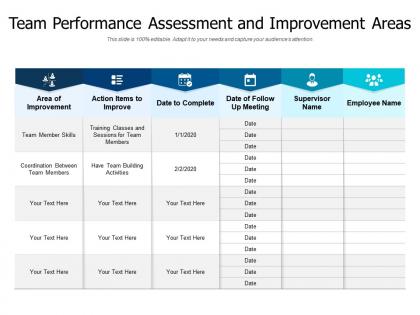
Team performance assessment and improvement areas




Try Before you Buy Download Free Sample Product
 Impress Your
 Audience
 100%
100% Editable
 Save Hours
 of Time


Encourage folks to interact with our Team Performance Assessment And Improvement Areas. Get them to exchange individual ideas.
People who downloaded this PowerPoint presentation also viewed the following :
Team performance assessment and improvement areas with all 2 slides:
Get folks to exchange individual ideas with our Team Performance Assessment And Improvement Areas. Encourage folks to interact.
FAQs for Team performance assessment
Key metrics for measuring team performance include productivity rates, quality scores, goal achievement percentages, collaboration effectiveness, and employee engagement levels. These metrics work together by tracking output consistency, error reduction, and timeline adherence, with many organizations finding that combining quantitative results with team satisfaction surveys ultimately delivers comprehensive insights into both performance outcomes and sustainable team health.
Team diversity enhances overall performance by bringing varied perspectives, skills, experiences, and problem-solving approaches that drive innovation and comprehensive decision-making. While diverse teams may face initial communication challenges, organizations across sectors like technology, healthcare, and consulting find that inclusive environments ultimately deliver improved creativity, better market understanding, and stronger competitive advantage.
Communication serves as the foundation for enhanced team performance by facilitating clear goal alignment, reducing misunderstandings, promoting knowledge sharing, and building trust among members. Effective communication enables teams to coordinate complex projects seamlessly, resolve conflicts quickly, and adapt to changing priorities, with many organizations finding that structured communication protocols ultimately deliver faster decision-making and improved collaborative outcomes.
Leadership styles significantly influence team performance through communication approaches, decision-making processes, delegation methods, and motivational techniques. Transformational leaders often inspire innovation and engagement, while situational leaders adapt their approach based on team needs, with many organizations finding that flexible leadership styles deliver improved productivity, higher employee satisfaction, and stronger collaborative outcomes across diverse business environments.
Strategies to boost team collaboration include establishing clear communication channels, implementing collaborative technologies, creating cross-functional project teams, fostering psychological safety, and setting shared goals with transparent progress tracking. These approaches streamline coordination by breaking down silos, enhancing information flow, and building trust, with many organizations finding that regular team-building activities and structured feedback sessions ultimately deliver stronger relationships and improved project outcomes.
Setting clear goals significantly enhances team performance by establishing shared direction, improving accountability, and enabling better resource allocation. When teams understand specific objectives and success metrics, they coordinate more effectively, reduce duplicated efforts, and maintain focus on priorities, ultimately delivering faster project completion and measurable productivity gains across diverse organizational functions.
Common barriers to optimal team performance include unclear roles and responsibilities, poor communication channels, conflicting priorities, lack of trust among members, and inadequate resource allocation. These challenges can be overcome by establishing clear expectations, implementing structured communication protocols, aligning team goals with organizational objectives, fostering collaborative environments through team-building initiatives, and ensuring adequate training and resources, ultimately delivering enhanced productivity and stronger team cohesion.
Feedback loops enhance team effectiveness by enabling continuous improvement, identifying performance gaps, fostering open communication, and accelerating skill development across all team members. These mechanisms streamline collaboration by providing real-time insights, reducing miscommunication, and aligning individual contributions with team objectives, with many organizations finding that structured feedback processes ultimately deliver higher productivity and stronger team cohesion.
Remote work transforms team dynamics through digital communication channels, asynchronous collaboration tools, and flexible scheduling structures, while requiring stronger emphasis on clear documentation and structured check-ins. Many organizations find that remote teams achieve higher productivity and better work-life balance, though they must invest in robust communication platforms and intentional relationship-building activities to maintain cohesion and performance.
Techniques to foster positive team culture include regular recognition programs, transparent communication channels, collaborative goal-setting, team-building activities, and consistent feedback mechanisms. These approaches enhance trust and engagement by encouraging open dialogue, celebrating achievements, and aligning individual contributions with organizational objectives, with many organizations finding that strategic culture investments ultimately deliver higher productivity and reduced turnover.
Technology tools facilitate better team performance by streamlining communication, enhancing collaboration, automating routine tasks, and providing real-time analytics for decision-making. Through project management platforms, video conferencing, and performance tracking systems, organizations deliver faster project completion, improved transparency, and stronger accountability, with many teams finding that integrated digital workflows ultimately boost productivity and competitive advantage.
Team size significantly impacts performance through communication complexity, coordination challenges, and resource allocation, with research suggesting 5-7 members as optimal for most tasks. While smaller teams enable faster decision-making and clearer accountability, larger teams bring diverse expertise but risk decreased individual contribution, with many organizations finding that strategic team composition matters more than strict numbers for delivering sustained competitive advantage.
Conflict resolution strategies enhance team performance by improving communication, rebuilding trust, and creating structured frameworks for addressing disagreements constructively. These approaches enable teams to transform tensions into collaborative problem-solving opportunities, with many organizations finding that proactive conflict management reduces project delays, increases innovation, and ultimately delivers stronger team cohesion and productivity.
Training initiatives that enhance team performance include skills-based workshops, cross-functional collaboration programs, leadership development courses, communication training, and performance coaching sessions. These programs streamline workflow efficiency, enhance problem-solving capabilities, and strengthen interpersonal dynamics, with many organizations finding that strategic investment in team development ultimately delivers improved productivity, reduced turnover, and sustainable competitive advantage.
Recognizing and rewarding team achievements significantly enhances performance by boosting morale, increasing engagement, and reinforcing desired behaviors across the organization. Through strategic recognition programs, companies streamline motivation, accelerate productivity, and strengthen retention rates, with many businesses finding that consistent acknowledgment creates a competitive culture where teams ultimately deliver superior results and sustained excellence.
No Reviews