


Technical feasibility ppt examples
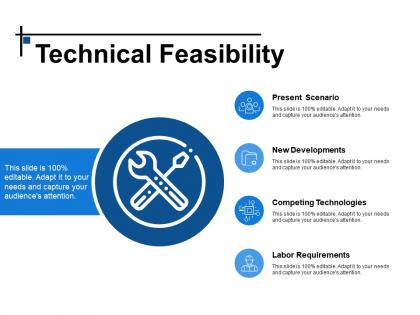




Try Before you Buy Download Free Sample Product
 Impress Your
 Audience
 100%
100% Editable
 Save Hours
 of Time


Groom their capabilities with our Technical Feasibility Ppt Examples. They will be the best in the field.
People who downloaded this PowerPoint presentation also viewed the following :
Technical feasibility ppt examples with all 5 slides:
Increase goodwill with our Technical Feasibility Ppt Examples. Indulge the fancies of your associates.
FAQs for Technical
Start with the biggest risks - does your team actually know this tech stack or are you gambling on something super new? That's usually where projects blow up. Budget constraints matter too, obviously. You'll want to check if this thing can scale and play nice with whatever systems you already have running. Security and compliance stuff can totally blindside you if you don't think about it early. Honestly, I'd just list out your shakiest technical bets first and test those assumptions before getting too deep into planning. Technical debt is real and it adds up stupid fast.
Dude, technology availability literally makes or breaks projects. No joke. The tools you need might not exist yet, or they're way too pricey for what you're working with. Your team also has to actually know how to use whatever tech you pick - I've watched so many projects completely change direction because someone fell in love with some fancy new solution that was basically impossible to implement. Budget for licensing fees too, that stuff adds up fast. Plus there's all the integration headaches and maintenance down the road. Honestly, just be realistic about what you can actually pull off with your timeline and resources before you commit to anything.
Oh dude, you definitely need to get stakeholders involved early - like, before you start drawing any big conclusions. They're sitting on all the real info about budgets, timelines, and what systems you're stuck working with. Business folks know the money situation, tech people know what's actually possible with your current setup. Plus they've usually seen someone try your "brilliant" idea before and can tell you exactly why it crashed and burned. I learned this the hard way on a project last year. Trust me, doing feasibility analysis without their input is basically just making educated guesses in the dark.
Okay so technical feasibility is basically "can we actually pull this off?" Like, do you have the tech, the people who know what they're doing, all that stuff to make it work. Economic feasibility though? That's more like "will this make financial sense?" - whether you'll get enough bang for your buck to justify spending the money. Here's how I think about it: sure, you *could* probably build a rocket in your garage, but should you blow your entire savings account on it? Probably not lol. I'd always figure out the technical side first since there's zero point in doing math on something that's literally impossible to build anyway.
Honestly, I'd start with stakeholder interviews - gotta understand what people actually want first. Then dive into the technical side and see if your current setup can even handle it. Resource mapping is huge too, like what skills and tools you're missing. I'm a big fan of rapid prototyping because you'll catch weird issues that look fine on paper. Risk matrices sound boring but they're clutch for spotting problems early. Oh, and if you can find similar projects to compare against, do it. Pick maybe 3-4 approaches that fit your timeline though - don't get stuck in analysis hell.
Dude, scalability will totally make or break your project later. I learned this the hard way watching stuff crash when it actually got users. Your architecture and database need to handle way more people and data than you think you'll get. Can you add servers without rebuilding everything? Performance bottlenecks are sneaky too - they'll bite you when you least expect it. Honestly, most prototypes work fine until real growth hits. Map out where you think you'll be in a year and test your tech choices against that now. Trust me, it's way easier than fixing it later when everything's on fire.
For your technical feasibility study, grab these docs: technical specs, system architecture diagrams, and resource assessments first. Risk analysis and cost breakdowns are super important for getting buy-in from stakeholders. Proof-of-concept results? Pure gold if you've got them. Technology evaluation matrices help explain why you picked certain tools - honestly, these save you so many headaches later. Don't skip market research and competitive analysis either. Oh, and make a checklist! Tackle everything in chunks instead of drowning yourself trying to do it all at once.
Okay so first thing - make a list of what technical skills you actually need for this project. Then honestly look at what each person on your team can do. Don't just go by their resume either, think about what they've actually built before. Found some big gaps? Now you gotta decide if there's time to train people, maybe bring in some outside help, or hire someone new. Honestly the worst thing is getting halfway through and realizing nobody knows how to build that one thing you really need. Better to figure this stuff out now while you can still do something about it.
Look, just because the tech works doesn't mean you're in the clear. Markets change fast - your brilliant solution might be pointless in six months. Budget overruns happen constantly, honestly it's almost expected at this point. Then there's regulatory stuff that comes out of nowhere, or users just... don't care as much as you thought they would. Competition can pop up while you're still building too. I'd say take that technical win and immediately start poking holes in everything else - demand, costs, timeline. Better to find problems now than later.
Honestly, prototyping saves you from so much pain later. It's like a sanity check - you'll quickly find out if your brilliant idea actually works or if you're missing something obvious. I always go for the scariest technical parts first because why build easy stuff when the hard parts might kill your whole project? You can catch integration nightmares early instead of discovering them when everything's already built. Performance assumptions get tested for real, not just theoretical numbers on a whiteboard. Plus you'll know pretty fast if your team can actually handle the technical complexity or if you need to pivot.
So you'll need to track both the tech stuff and business impact to know if it actually worked. Performance metrics are key - uptime, response times, error rates, how it handles traffic spikes. Business side means adoption rates, productivity bumps, cost savings, ROI targets. User satisfaction surveys are huge though - I've seen projects where everything looked perfect on paper but users absolutely hated it. Oh, and set your baselines before you launch or you won't know what changed. Start grabbing data from day one.
Oh man, compliance stuff will totally derail your project if you're not careful. I've watched entire teams build for months only to find out they can't even launch because of GDPR violations - such a nightmare. You gotta treat data protection laws, security requirements, all that regulatory stuff as actual tech requirements from day one. Don't make it an afterthought. These rules will literally decide your architecture choices and what tech stack you can even use. Honestly, map out every regulation that applies to your project before you write a single line of code.
Oh man, system integration will totally wreck your project if you're not careful. Legacy databases are the worst - they never play nice with new stuff. Your timeline? Expect it to double, honestly I've watched this happen so many times. All those connection points between systems become massive headaches because nothing matches up right. Data formats are different, security doesn't align, performance goes to hell. Here's what saved my butt: map out every single touchpoint before you start coding. Test those connections early, not at the end when you're panicking.
Look, you can't just analyze what's available today - tech moves way too fast for that. Build in different scenarios: best case, worst case, and that nightmare where everything changes halfway through your project. Migration costs are real, so budget for those plus extra time buffers. I've seen so many teams get completely screwed because they picked something that was hot two years ago and now it's basically dead. Research what's coming down the pipeline in your space. How fast might your tech choice become outdated? Set up regular review points where you can pivot if needed. Trust me, flexibility beats perfection every time.
UX totally matters for feasibility - can't just worry about whether the code works. Users actually need to be able to use the damn thing, you know? Slow load times, confusing interfaces, overly complex flows - these become real technical requirements you have to plan for. I've watched so many teams build "functional" features that were basically unusable. Nobody could figure them out. When you're planning your technical approach, factor in the UX stuff early. Test with actual users before you get too far down the rabbit hole. Trust me on this one.
-
Informative presentations that are easily editable.
-
Illustrative design with editable content. Exceptional value for money. Highly pleased with the product.