


Technical Implementation Plan Timeline For Project Management




Try Before you Buy Download Free Sample Product
 Impress Your
 Audience
 100%
100% Editable
 Save Hours
 of Time


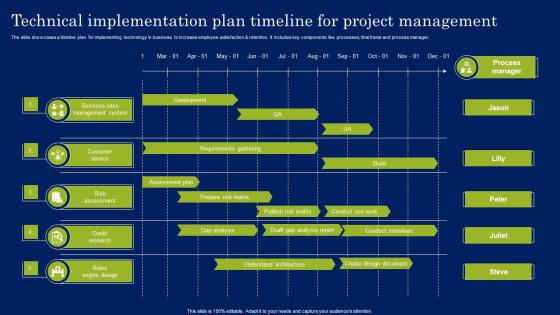
The slide showcases a timeline plan for implementing technology in business to increase employee satisfaction and retention. It includes key components like processes, timeframe and process manager.
People who downloaded this PowerPoint presentation also viewed the following :
Technical Implementation Plan Timeline For Project Management with all 6 slides:
Use our Technical Implementation Plan Timeline For Project Management to effectively help you save your valuable time. They are readymade to fit into any presentation structure.





FAQs for Technical Implementation Plan Timeline
Key components include project scope definition, resource allocation frameworks, milestone scheduling, risk assessment protocols, and stakeholder communication strategies. These elements work together by establishing clear expectations, streamlining development processes, and enabling proactive issue resolution, with many organizations finding that comprehensive planning reduces implementation time by 30-40% while minimizing costly project delays.
Establishing realistic timelines requires breaking implementations into defined phases, assessing resource availability, identifying potential bottlenecks, and building in buffer periods for testing and refinements. Through careful stakeholder consultation and historical project analysis, organizations can create achievable milestones that account for integration complexities, ultimately delivering successful deployments while minimizing disruptions to ongoing operations.
**INPUT**: What tools or software can assist in creating a technical implementation plan timeline? **OUTPUT**: Project management tools for technical implementation timelines include Microsoft Project, Asana, Jira, Gantt charts, and Smartsheet. These platforms streamline planning by enabling resource allocation, milestone tracking, and cross-functional collaboration, with many organizations finding that integrated dashboards ultimately deliver enhanced visibility and accelerated project completion.
Resource allocation is determined by analyzing project complexity, technical requirements, team expertise, and critical path dependencies across each implementation stage. Organizations typically allocate 30% of resources to planning and design, 50% to development and testing, and 20% to deployment and stabilization, with many finding that front-loading planning resources ultimately accelerates delivery timelines and reduces costly revisions.
Stakeholder communication serves as the backbone of technical implementation timelines, ensuring alignment on requirements, milestones, and resource allocation while minimizing costly delays from miscommunication. Regular updates and feedback loops enable project teams to address concerns proactively, adjust timelines based on business priorities, and maintain momentum, with many organizations finding that structured communication reduces implementation time by 20-30%.
Risk management strategies can be integrated by conducting upfront risk assessments, establishing milestone checkpoints with contingency protocols, and building buffer time for critical dependencies throughout the timeline. Through proactive planning, organizations streamline project delivery while minimizing delays, with many finding that embedded risk frameworks ultimately deliver more predictable outcomes and enhanced stakeholder confidence.
Key metrics include milestone completion rates, budget variance tracking, resource utilization percentages, quality assurance scores, and stakeholder satisfaction ratings. These measurements enable organizations to monitor project velocity, identify potential delays early, and adjust resource allocation strategically, with many companies finding that consistent metric tracking ultimately delivers improved project outcomes and enhanced operational efficiency.
Implementation plan timelines should be reviewed weekly during active phases and monthly during stable periods, with immediate updates triggered by scope changes, resource shifts, or technical roadblocks. This regular cadence enables project teams to address bottlenecks proactively, reallocate resources efficiently, and maintain stakeholder alignment, ultimately delivering projects on schedule while minimizing costly delays.
Common pitfalls include underestimating integration complexities, failing to account for data migration timeframes, overlooking stakeholder training requirements, inadequate testing phases, and insufficient buffer time for unexpected issues. Many organizations find that unrealistic resource allocation, poor communication protocols, and lack of contingency planning significantly delay project delivery, while thorough upfront planning with realistic milestones ultimately delivers smoother implementations and better outcomes.
Team collaboration tools enhance timeline management by enabling real-time progress tracking, automated milestone notifications, centralized document sharing, and integrated communication channels. These platforms streamline project coordination through synchronized calendars, task dependencies visualization, and instant status updates, with many organizations finding that enhanced transparency and reduced email chains accelerate delivery timelines significantly.
Milestones serve as critical checkpoints that track progress, identify potential delays, and ensure alignment with project objectives throughout technical implementation. They enable teams to measure deliverables against deadlines, allocate resources effectively, and communicate status to stakeholders, with many organizations finding that well-defined milestones reduce project risks and enhance overall execution success.
**INPUT**: How do you handle unforeseen delays in the implementation process? **OUTPUT**: Handling unforeseen delays requires building buffer time into project timelines, establishing clear escalation protocols, and maintaining flexible resource allocation strategies. These approaches enable organizations to pivot quickly when challenges arise, with many finding that proactive risk assessment, stakeholder communication, and phased rollback plans ultimately minimize disruption while preserving project momentum and stakeholder confidence. [Word count: 54 words]
**INPUT**: What are best practices for documenting changes in the implementation timeline? **OUTPUT**: Best practices include maintaining detailed change logs, conducting impact assessments, updating stakeholder communications, establishing approval workflows, and creating version-controlled documentation with clear timestamps. These practices streamline project management by enhancing transparency, minimizing confusion, and ensuring accountability, with many organizations finding that systematic documentation ultimately delivers better stakeholder alignment and more predictable project outcomes.
Ensuring alignment requires establishing clear milestone checkpoints that directly map to strategic business objectives, conducting regular stakeholder reviews, and maintaining flexible scheduling that accommodates organizational priorities. This approach enables teams to adjust timelines based on evolving business needs, resource availability, and market conditions, ultimately delivering implementations that support long-term competitive advantage and operational efficiency.
Task prioritization should consider system dependencies, resource availability, business impact severity, technical complexity levels, and stakeholder requirements. Organizations typically find success by addressing critical infrastructure components first, followed by user-facing features, while maintaining flexibility for unforeseen challenges that could affect downstream deliverables and overall project momentum.
-
Design layout is very impressive.
-
The designs by SlideTeam are honestly the best I have seen so far. Will be definitely coming back for more.