


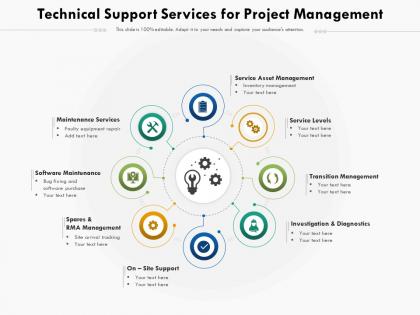
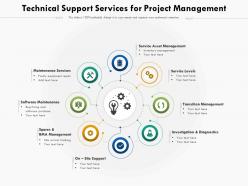
Technical support services for project management




Try Before you Buy Download Free Sample Product
 Impress Your
 Audience
 100%
100% Editable
 Save Hours
 of Time


Our Technical Support Services For Project Management are topically designed to provide an attractive backdrop to any subject. Use them to look like a presentation pro.
People who downloaded this PowerPoint presentation also viewed the following :
Technical support services for project management with all 2 slides:
Use our Technical Support Services For Project Management to effectively help you save your valuable time. They are readymade to fit into any presentation structure.
FAQs for Technical support services
Effective technical support in project management includes real-time troubleshooting assistance, comprehensive documentation systems, user training programs, escalation protocols, and integration support for project tools. These components streamline operations by minimizing downtime, enhancing team productivity, and ensuring seamless technology adoption, with many organizations finding that robust technical support ultimately delivers faster project completion and improved stakeholder satisfaction.
Project managers can leverage technical support by implementing collaborative platforms, establishing communication protocols, and integrating project management tools with real-time messaging systems. Through dedicated technical assistance, teams streamline workflows, reduce miscommunication, and enhance transparency across departments, with many organizations finding that strategic technical support ultimately delivers faster project completion and improved stakeholder engagement.
Technical support plays a crucial role in risk management by providing system monitoring, data backup solutions, security assessments, and rapid incident response capabilities throughout project lifecycles. These services enable project teams to identify potential technical vulnerabilities early, maintain operational continuity during system failures, and ensure data integrity, with many organizations finding that proactive technical support significantly reduces project delays and cost overruns.
Technical support tools improve project scheduling accuracy by providing real-time data analytics, automated resource tracking, predictive modeling capabilities, and integrated timeline management systems. These platforms enable project managers to optimize workforce allocation, anticipate potential bottlenecks, and adjust schedules dynamically, with many organizations finding that automated scheduling reduces project delays by up to 30% while maximizing resource utilization.
AI-based solutions in project management technical support include predictive issue resolution, automated ticket routing, intelligent resource allocation, real-time performance monitoring, and proactive system maintenance. These technologies streamline operations by reducing response times, minimizing manual interventions, and enhancing decision-making accuracy, with many organizations finding that automated support delivers improved project outcomes and significant cost reductions.
Project managers can assess technical support quality through response times, resolution rates, communication clarity, escalation processes, and user satisfaction metrics. By establishing clear service level agreements, tracking incident patterns, and gathering team feedback, organizations streamline operations while ensuring support services enhance project delivery timelines, minimize disruptions, and ultimately deliver improved productivity and stakeholder confidence.
Continuous improvement strategies include regular performance metrics analysis, customer feedback integration, automated ticketing systems, staff training programs, and knowledge base optimization. Through data-driven approaches, organizations streamline response times, enhance first-call resolution rates, and minimize project delays, with many finding that proactive monitoring and cross-functional collaboration ultimately deliver superior customer experiences and operational efficiency.
Technical support significantly enhances stakeholder engagement by providing reliable communication channels, real-time project updates, comprehensive training resources, and responsive issue resolution systems. These capabilities foster transparent collaboration and build stakeholder confidence, with many organizations finding that robust technical infrastructure reduces project friction, accelerates decision-making processes, and ultimately delivers higher satisfaction rates across all project participants.
Cloud-based technical support tools facilitate remote project management by enabling real-time collaboration, centralized documentation, automated workflow tracking, and seamless communication across distributed teams. These platforms streamline project coordination through instant file sharing, integrated video conferencing, and synchronized task management, with many organizations finding that remote teams achieve faster project delivery and enhanced operational efficiency.
Organizations should track response time, resolution rate, user satisfaction scores, ticket escalation frequency, and support cost per project to measure technical support effectiveness. These metrics enable project managers to identify bottlenecks, optimize resource allocation, and enhance team productivity, with many companies finding that comprehensive tracking ultimately delivers faster project completion and improved stakeholder satisfaction.
Technical support adapts through customized workflows, industry-specific templates, specialized integrations, role-based access controls, and tailored reporting dashboards that align with distinct project requirements. Organizations in construction, software development, and healthcare increasingly find that configurable support frameworks streamline operations, enhance team collaboration, and ultimately deliver faster project outcomes while maintaining industry compliance standards.
Project managers handling international projects face challenges including time zone coordination difficulties, language barriers with support teams, varying technical standards across regions, cultural communication differences, and remote troubleshooting limitations. These obstacles can significantly impact project timelines and team productivity, with many organizations finding that establishing dedicated regional support partnerships and implementing standardized communication protocols ultimately delivers faster resolution times and enhanced cross-border collaboration efficiency.
Training and development initiatives enhance technical support staff competency through comprehensive project management methodologies, stakeholder communication skills, risk assessment techniques, and resource allocation strategies. These programs enable staff to streamline project workflows, minimize technical bottlenecks, and deliver faster resolution times, with many organizations finding that well-trained support teams ultimately reduce project costs and improve client satisfaction rates.
In-house technical support offers direct control, immediate availability, deep project knowledge, and seamless team integration, while third-party support provides specialized expertise, cost efficiency, scalability, and access to advanced tools. Many organizations find that in-house support delivers faster response times and better context understanding, whereas outsourced support enables access to broader technical capabilities and reduces overhead costs, ultimately allowing project teams to focus on core deliverables.
Technical support system integration affects project costs by requiring upfront investment in software, training, and implementation, while delivering long-term savings through reduced downtime, faster issue resolution, and improved resource allocation. Organizations in manufacturing, IT services, and healthcare find that integrated support systems streamline operations, minimize project delays, and ultimately reduce total project costs by 15-25% through enhanced efficiency.
-
Graphics are very appealing to eyes.
-
The content is very helpful from business point of view.
-
Very unique, user-friendly presentation interface.
-
Excellent work done on template design and graphics.
-
Informative design.
-
Informative design.