


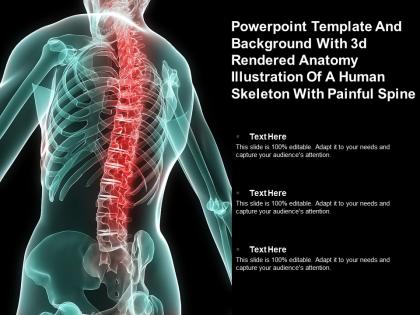
Template with 3d rendered anatomy illustration of a human skeletal back with pain ppt powerpoint




Try Before you Buy Download Free Sample Product
 Impress Your
 Audience
 100%
100% Editable
 Save Hours
 of Time


Our Template With 3d Rendered Anatomy Illustration Of A Human Skeletal Back With Pain Ppt Powerpoint are topically designed to provide an attractive backdrop to any subject. Use them to look like a presentation pro.
People who downloaded this PowerPoint presentation also viewed the following :
Template with 3d rendered anatomy illustration of a human skeletal back with pain ppt powerpoint with all 2 slides:
Use our Template With 3d Rendered Anatomy Illustration Of A Human Skeletal Back With Pain Ppt Powerpoint to effectively help you save your valuable time. They are readymade to fit into any presentation structure.
FAQs for Template with 3d rendered anatomy illustration of a human skeletal back with
So there are four main systems you need to know: skeletal (bones/joints), muscular, nervous, and circulatory. The nervous system basically controls everything - sends signals to your muscles, which then move your bones around. Meanwhile your heart's pumping blood to fuel all this stuff. It's actually wild how they all work together without you thinking about it. Don't just memorize each part separately though, that'll drive you crazy. Focus on how they connect instead - like how your brain tells your leg muscles to contract so you can walk. Makes studying way less painful.
Your bones are basically your body's frame - they keep you upright and give muscles something to pull against (muscles can only pull, never push, which is kinda wild). Joints work like hinges so you can actually move around. What's cool is how bone shape matters - your spine's curved for a reason, it absorbs shock way better than if it was just straight. That's why good posture isn't just for looks, it actually affects how forces hit your body when you move. Plus keeping your bones strong directly impacts how well you'll move as you get older.
So your muscles are like little motors that contract and relax to make you move. When they pull on your bones through tendons, that's what moves your joints around. Your core, back, and neck muscles are constantly doing these tiny adjustments to keep you upright against gravity - it's honestly crazy how much work they're doing without you realizing it. Stronger muscles just mean better movement and way less joint pain throughout the day. I used to have terrible posture until I started working on my core strength, made such a difference.
So your circulatory system is basically your body's delivery service - it carries oxygen and nutrients everywhere while picking up waste and CO2. Your heart pumps blood through vessels that can actually tighten or relax to control blood pressure and temperature, which is honestly pretty amazing when you think about it. Hormones and immune cells get distributed this way too. Plus it balances pH levels in your tissues. The whole thing runs on autopilot to keep your internal environment stable. Pretty wild how it all works together without you having to think about it.
Anatomy is your diagnostic foundation - helps you spot what's normal vs weird when you're examining patients. If someone comes in with nerve symptoms, you'll know exactly which spinal levels or nerves might be acting up. Plus you can see how body systems connect and mess with each other. Honestly, I still review anatomy stuff because it makes such a difference in recognizing patterns. Like, you won't miss referred pain or systemic things when you understand how everything links together. It directly makes you better at clinical work, so definitely worth brushing up on regularly.
So your nervous system is basically your body's control center. Your brain takes in info and shoots signals through nerves to make everything work - breathing, moving, whatever. When something happens around you, sensors pick it up and zap messages to your spinal cord and brain. Then your brain figures out what to do and sends signals back to your muscles. Honestly the speed is crazy impressive when you think about it. The whole thing runs on neurons talking through electrical pulses and chemicals. Oh, and reflexes are weird - some skip your brain completely to save time, which is why you'll jerk your hand away before you even realize you touched something hot.
So basically gross anatomy is the stuff you can actually see - bones, organs, muscles, all that. Microscopic anatomy needs a microscope to look at cells and tissues. It's like zooming way in on a map, you know? Gross anatomy shows you how everything fits together in the body. The microscopic side explains what's actually happening - like how your kidney cells filter stuff or muscle fibers do their thing. Honestly, I'd nail down gross anatomy first since it makes the microscopic processes way easier to understand later.
So basically you breathe in and air hits these tiny sacs in your lungs called alveoli - there's like millions of them. That's where the magic happens. Oxygen jumps into your bloodstream while carbon dioxide (the waste stuff) jumps out. Pretty cool system honestly. Your blood then hauls that oxygen around to every cell that needs it. Meanwhile it's also collecting CO2 to dump when you exhale. The whole thing's like a constant swap meet happening in your chest. When you're huffing after running up stairs? Those alveoli are just doing their job!
Oh man, evolution is wild when you really think about it! Arctic foxes basically turned into fluffy heaters with tiny ears so they don't freeze. Meanwhile desert foxes went the opposite route - huge ears work like little air conditioners. Birds are probably my favorite example though. Hummingbirds literally have beaks that match the exact flowers they eat, and hawks got those crazy sharp talons for grabbing prey. Fish bodies are like nature's sports cars - all streamlined and perfect for water. Deep sea ones even glow in the dark! It's nuts how every weird feature actually serves a purpose.
Your skin is literally like a bouncer for your body - it blocks out bacteria, chemicals, and UV rays before they can mess with you. When you sweat, that's actually temperature control happening automatically. Your skin also makes these natural antimicrobial compounds that just kill germs on contact, which is pretty wild if you ask me. Oh, and it prevents you from losing too much water throughout the day. I never really thought about how much our skin goes through until someone mentioned it. Bottom line though - stay hydrated and protect it, because when your skin's healthy, everything else works way better.
Think of anatomical landmarks as your body's GPS system. They're reference points that help you locate stuff during procedures and exams. Without them, describing where you found something would be a total mess. You'll use them for everything - finding the right spot for spinal taps by counting vertebrae, locating the femoral pulse near the inguinal ligament, giving injections safely. Plus they're clutch for reading imaging and talking with other docs. Honestly, learn the main ones now because you'll be using them nonstop once you start clinical rotations.
Knowing anatomy makes such a difference when you're working out. You'll actually target the right muscles instead of just going through the motions. Plus, proper form becomes way easier when you understand how your joints and muscles work together. I used to wonder why certain exercises felt so awkward - turns out I was basically fighting against my own body mechanics, which is dumb in hindsight. It also helps you avoid those random tweaks and pulls that come out of nowhere. Start with the major muscle groups you want to build. Trust me, it's like finally getting the instruction manual you never knew you needed.
Dude, you literally can't cut into someone without knowing what's underneath. Anatomy is everything in surgery - like, try doing heart surgery without knowing where those coronary arteries are running! Surgeons need to map out tissue layers, where organs sit, blood vessel routes, all of it. Their anatomical knowledge determines how they'll approach the procedure, where to make incisions, which planes are safe to dissect through. The surgeons who really know their stuff inside and out? They're the ones developing new techniques. Oh and definitely mention anatomical variations when you're working with them - that can totally change their game plan mid-surgery.
Yeah, anatomical variation is honestly such a pain when you're reading images. Normal variants can look sketchy at first - like accessory organs, weird vessel patterns, rotated stuff. I've watched attendings puzzle over scans for way too long only to realize it's completely normal lol. Building pattern recognition takes forever but it's crucial. Different populations have different common variants too, so know your patient demographics. Oh and seriously, don't be afraid to look things up or ask someone else - even experienced rads do it all the time.
Dude, anatomy education is getting crazy cool with VR and 3D stuff. You can walk inside a beating heart or zoom into cells - honestly feels like sci-fi. Those digital cadaver tables are clutch because students can practice dissections over and over without dealing with actual bodies (which, let's be real, was always kinda gross). AR apps overlay structures onto real people too. My cousin's in med school and swears by these mobile anatomy apps - way better than lugging around massive textbooks. AI even tracks what you're struggling with and adjusts. If you're teaching, definitely try some VR platforms. Students actually stay awake!
-
Best way of representation of the topic.
-
Topic best represented with attractive design.
-
Innovative and Colorful designs.
-
Great product with effective design. Helped a lot in our corporate presentations. Easy to edit and stunning visuals.
-
Informative design.
-
Great product with highly impressive and engaging designs.
-
Designs have enough space to add content.