


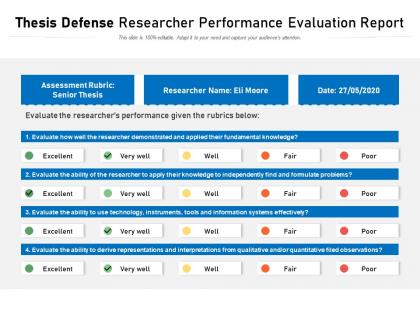
Thesis defense researcher performance evaluation report




Try Before you Buy Download Free Sample Product
 Impress Your
 Audience
 100%
100% Editable
 Save Hours
 of Time


Our Thesis Defense Researcher Performance Evaluation Report are topically designed to provide an attractive backdrop to any subject. Use them to look like a presentation pro.
People who downloaded this PowerPoint presentation also viewed the following :
Thesis defense researcher performance evaluation report with all 2 slides:
Use our Thesis Defense Researcher Performance Evaluation Report to effectively help you save your valuable time. They are readymade to fit into any presentation structure.
FAQs for Thesis defense researcher
Evaluators focus on research methodology rigor, originality of contributions, depth of literature review, clarity of findings, and ability to defend arguments under questioning. During oral examinations, committee members assess candidates' mastery of their field, critical thinking skills, and capacity to articulate complex concepts, ultimately determining whether the work meets doctoral standards and advances knowledge.
Students can effectively present their methodology by clearly explaining their research design, data collection methods, analytical approaches, and validation techniques, while addressing potential limitations upfront. This structured approach enables committee members to understand the study's rigor and reliability, with many students finding that visual aids, concrete examples, and confident delivery ultimately demonstrate methodological soundness and scholarly competence.
Visual presentation significantly influences thesis defense evaluation by enhancing comprehension, demonstrating research clarity, supporting complex explanations, and showcasing professional communication skills. Through well-designed slides and clear data visualization, candidates effectively convey methodologies, findings, and implications while maintaining committee engagement, with many academic institutions finding that strong visual presentations often correlate with successful defense outcomes.
Anticipating challenging questions is crucial for thesis defense success, as it demonstrates thorough understanding, critical thinking abilities, and comprehensive preparation across your research methodology, findings, and limitations. Through strategic preparation, candidates can confidently address evaluator concerns, showcase expertise beyond their written work, and transform potential weaknesses into opportunities for scholarly discussion, ultimately delivering stronger defenses and enhanced credibility.
Common pitfalls include inadequate preparation for challenging questions, overwhelming slides with excessive text, poor time management, weak methodology explanations, and insufficient practice with presentation flow. Students often struggle by reading directly from slides, failing to connect research to broader implications, and becoming defensive during questioning, ultimately undermining their credibility and comprehensive understanding demonstration.
Students can demonstrate significance by clearly articulating their research's contribution to existing knowledge, presenting quantifiable results with supporting data, connecting findings to real-world applications, and addressing how their work advances the field. During defense presentations, candidates should emphasize practical implications, discuss potential for future research directions, and confidently respond to committee questions, ultimately showcasing the strategic value and broader impact of their scholarly contributions.
Strategies include having backup presentation files on multiple devices, testing all technology beforehand, preparing printed handouts of key slides, and knowing the room's technical support contacts. These preparation methods streamline defense proceedings by minimizing disruptions, maintaining professional composure, and ensuring seamless content delivery, with many academic institutions finding that proactive technical planning ultimately enhances candidate confidence and evaluation outcomes.
Feedback from thesis defense helps students refine their arguments, address methodological gaps, clarify unclear sections, and strengthen evidence supporting their conclusions. Through comprehensive evaluation from faculty panels, students enhance their research quality, correct technical errors, and improve overall academic rigor, while many universities finding that incorporating defense insights ultimately delivers stronger final submissions and better prepares graduates for academic publishing.
Engaging with the audience during a thesis defense demonstrates your ability to communicate complex research effectively, handle critical questioning professionally, and adapt your explanations to different expertise levels. This interaction showcases your deep understanding of the work while building credibility with committee members, with many institutions finding that strong audience engagement significantly influences defense outcomes and future academic opportunities.
Students should tailor their thesis defense by presenting core concepts accessibly while preparing detailed technical explanations for follow-up questions, using analogies and visual aids to bridge knowledge gaps. This strategic approach enables clear communication with both technical experts and generalist evaluators, ultimately delivering comprehensive understanding across diverse academic backgrounds while demonstrating mastery through adaptive explanation skills.
Best practices for practicing a thesis defense include rehearsing with mock committees, timing your presentation precisely, preparing for challenging questions, mastering your visual aids, and practicing clear explanations of complex concepts. These preparation methods enhance confidence by identifying weak points, refining delivery techniques, and ensuring smooth transitions, with many graduate students finding that multiple practice sessions ultimately deliver stronger performances and reduced anxiety during the actual defense.
Students can effectively summarize complex ideas by creating clear, hierarchical explanations that progress from core concepts to supporting details, using visual aids and analogies to illustrate key points. Practice sessions with peers and advisors help refine these summaries, ensuring students can articulate their research's significance, methodology, and outcomes concisely while maintaining academic rigor and demonstrating comprehensive understanding.
Thesis defense presentations typically range from 20-45 minutes, including a 15-30 minute presentation followed by questions, with formats varying by institution and discipline requirements. Academic departments increasingly expect structured presentations covering research objectives, methodology, findings, and implications, with many doctoral candidates finding that clear visual aids, concise explanations, and thorough preparation ultimately deliver successful defenses and demonstrate scholarly competence.
Interdisciplinary research can complicate thesis defense evaluation through diverse methodological standards, varying disciplinary vocabularies, conflicting theoretical frameworks, and differing expectations for evidence and analysis. While this complexity presents challenges for evaluation committees, it also delivers innovative perspectives and comprehensive solutions, with many academic institutions finding that interdisciplinary approaches ultimately enhance research depth and real-world applicability.
Evaluators assess presentation clarity, confidence, professional demeanor, effective visual aid usage, and ability to engage the audience through clear explanations of complex concepts. They particularly value candidates who demonstrate poise under questioning, articulate responses to challenges with supporting evidence, and seamlessly navigate between technical detail and broader implications, ultimately showcasing mastery of their research domain.
-
Designs have enough space to add content.
-
The content is very helpful from business point of view.
-
Design layout is very impressive.