


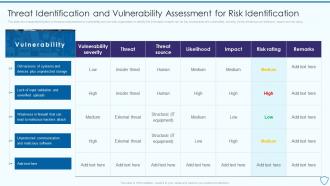
Threat Identification And Vulnerability Assessment For Risk Identification





Try Before you Buy Download Free Sample Product
 Impress Your
 Audience
 100%
100% Editable
 Save Hours
 of Time


This slide showcases identification of threat and assessment of vulnerability and can help organization to identify the information breach risk. Its key components are vulnerability, severity, threat, threat source, likelihood, impact and risk rating
People who downloaded this PowerPoint presentation also viewed the following :
Threat Identification And Vulnerability Assessment For Risk Identification with all 6 slides:
Use our Threat Identification And Vulnerability Assessment For Risk Identification to effectively help you save your valuable time. They are readymade to fit into any presentation structure.





FAQs for Threat Identification And Vulnerability Assessment
Threats are external dangers or malicious actors attempting to exploit weaknesses, while vulnerabilities are internal weaknesses, flaws, or gaps in systems, software, or processes that can be exploited. Together, they create cybersecurity risk, with organizations increasingly finding that understanding both elements enables more strategic defense planning, better resource allocation, and ultimately stronger protection against evolving cyber attacks.
Organizations effectively identify critical vulnerabilities through comprehensive asset inventories, automated vulnerability scanning, threat modeling, and risk-based assessment frameworks that consider exploitability, business impact, and exposure levels. By combining these approaches with continuous monitoring and stakeholder input, companies can streamline resource allocation, enhance security posture, and ultimately deliver stronger protection against evolving threats while maintaining operational efficiency.
Threat modeling serves as the foundational framework for systematic threat and vulnerability assessments, enabling organizations to identify potential attack vectors, prioritize security risks, and map vulnerabilities against realistic threat scenarios. This strategic approach streamlines security resource allocation by focusing on the most critical threats, ultimately delivering more targeted protection strategies and enhanced security posture across enterprise infrastructure.
AI and machine learning enhance vulnerability assessment by automating threat detection, analyzing vast datasets for pattern recognition, and providing predictive analytics to identify potential security gaps before exploitation occurs. These technologies enable organizations to streamline their security operations, reduce manual assessment time, and deliver more accurate risk prioritization, ultimately providing faster incident response and stronger defensive capabilities.
Cloud threat and vulnerability assessments require continuous monitoring, automated scanning tools, identity and access management reviews, data encryption validation, and compliance framework alignment. These practices enable organizations to identify misconfigurations, unauthorized access points, and data exposure risks across multi-cloud environments, with many financial services and healthcare institutions finding that regular assessments significantly reduce security incidents while ensuring regulatory compliance.
Organizations measure threat assessment effectiveness through key performance indicators like vulnerability remediation rates, mean time to detection and response, risk reduction metrics, and security incident frequency. These measurements, combined with regular penetration testing and compliance audits, enable companies across sectors like banking and healthcare to demonstrate improved security posture, ultimately delivering enhanced resilience and competitive advantage.
Common threat and vulnerability assessment tools include Nessus, OpenVAS, Qualys, Metasploit, and Nmap, alongside methodologies like OWASP, NIST frameworks, and penetration testing approaches. These technologies streamline security evaluations by automating scans, identifying weaknesses, and prioritizing risks, with many organizations finding that strategic combinations ultimately deliver comprehensive protection and enhanced operational resilience.
Regulatory requirements significantly shape threat and vulnerability assessments by mandating specific frameworks, documentation standards, audit frequencies, and compliance reporting mechanisms. Organizations in healthcare, finance, and critical infrastructure must align their assessment methodologies with standards like HIPAA, SOX, or NIST, ultimately delivering enhanced security postures while meeting mandatory compliance obligations and avoiding regulatory penalties.
Vulnerability remediation involves prioritizing risks by severity and business impact, applying patches and security updates, implementing compensating controls, and conducting validation testing. Organizations typically address critical vulnerabilities first, deploy fixes during maintenance windows, and verify effectiveness through follow-up scans, ultimately strengthening their security posture while maintaining operational continuity and reducing exposure.
Threat intelligence data integrates into vulnerability assessment processes by prioritizing critical vulnerabilities based on active threats, correlating known attack patterns with system weaknesses, and providing contextual risk scoring. This strategic combination enables organizations to focus remediation efforts on vulnerabilities actively exploited by threat actors, ultimately streamlining security operations and enhancing protective measures against targeted attacks.
Human factors significantly impact threat and vulnerability identification through cognitive biases, information overload, skill gaps, and communication breakdowns that can lead to missed threats or misassessed risks. Organizations increasingly recognize that combining human expertise with automated tools enhances accuracy, reduces oversight errors, and improves response times, with many security teams finding that structured training and decision-support systems ultimately deliver more comprehensive threat detection and strategic security outcomes.
Organizations should conduct threat and vulnerability assessments quarterly for comprehensive reviews, with continuous monitoring for critical systems and monthly scans for high-risk environments. Financial services, healthcare, and government sectors often require more frequent assessments due to regulatory demands, while manufacturing and retail typically find quarterly cycles sufficient, ultimately ensuring proactive security posture and regulatory compliance.
Assessing third-party vendor vulnerabilities presents challenges including limited visibility into vendor security practices, inconsistent security standards across suppliers, difficulty obtaining timely vulnerability disclosures, and complex integration dependencies. These challenges are particularly acute in sectors like healthcare and financial services, where organizations increasingly rely on multiple vendors, ultimately requiring strategic vendor risk management frameworks to maintain operational security.
Threat and vulnerability assessments can be tailored by incorporating industry-specific compliance requirements, regulatory frameworks, operational workflows, and unique threat landscapes that different sectors face. Financial institutions focus on fraud detection and data protection, while healthcare organizations prioritize patient data security and medical device vulnerabilities, ultimately delivering targeted risk mitigation strategies that address each sector's distinct challenges and regulatory obligations.
Security frameworks like NIST Cybersecurity Framework and ISO 27001 provide structured methodologies, standardized risk assessment criteria, comprehensive control baselines, and systematic evaluation processes for threat and vulnerability assessments. These frameworks enable organizations to benchmark security posture, ensure regulatory compliance, and maintain consistent assessment quality across departments, with many financial services and healthcare institutions finding that framework-driven assessments deliver measurable risk reduction and operational efficiency.
-
Informative and engaging! I really like the design and quality of the slides.
-
Best Representation of topics, really appreciable.