


Threat Modelling Process Of Cyber Security Program




Try Before you Buy Download Free Sample Product
 Impress Your
 Audience
 100%
100% Editable
 Save Hours
 of Time


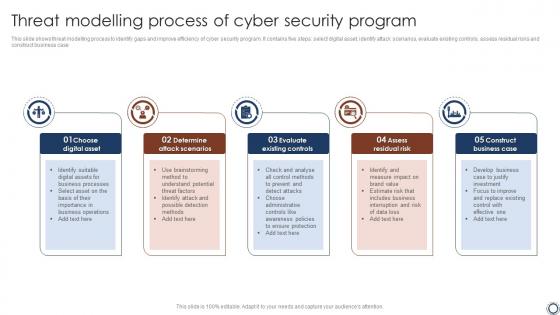
This slide shows threat modelling process to identify gaps and improve efficiency of cyber security program. It contains five steps select digital asset, identify attack scenarios, evaluate existing controls, assess residual risks and construct business case
People who downloaded this PowerPoint presentation also viewed the following :
Threat Modelling Process Of Cyber Security Program with all 6 slides:
Use our Threat Modelling Process Of Cyber Security Program to effectively help you save your valuable time. They are readymade to fit into any presentation structure.





FAQs for Threat Modelling Process Of
A comprehensive threat modeling process includes asset identification, threat analysis, vulnerability assessment, risk evaluation, and mitigation planning. These elements work together by systematically cataloging critical systems, analyzing potential attack vectors, and prioritizing security investments, with many financial institutions and healthcare organizations finding that structured threat modeling delivers enhanced security posture and regulatory compliance.
Organizations effectively identify potential threats through structured threat modeling methodologies like STRIDE, PASTA, and DREAD, combined with comprehensive asset mapping, attack surface analysis, and vulnerability assessments. These approaches enable security teams to systematically evaluate risks across networks, applications, and data flows, while incorporating threat intelligence and stakeholder input, ultimately delivering proactive defense strategies and enhanced security posture.
Common threat modeling tools include Microsoft Threat Modeling Tool, OWASP Threat Dragon, IriusRisk, ThreatModeler, and STRIDE-based frameworks, each offering different visualization capabilities, automation levels, and integration options. These platforms enhance security planning by streamlining risk identification, automating threat detection, and generating actionable reports, with many organizations finding that automated tools significantly reduce assessment time while improving comprehensive coverage.
STRIDE framework helps categorize threats by organizing them into six distinct categories: Spoofing, Tampering, Repudiation, Information Disclosure, Denial of Service, and Elevation of Privilege. This systematic approach enables security teams to methodically assess vulnerabilities across all attack vectors, ensuring comprehensive coverage while streamlining threat identification processes, ultimately delivering more robust security architectures and enhanced risk management capabilities.
Threat modeling integrates into SDLC through requirements analysis during planning phases, architectural risk assessments in design stages, code reviews during development, and security testing before deployment. This strategic combination enables development teams to identify vulnerabilities early, reduce remediation costs, and streamline security protocols, with many software organizations finding that proactive threat assessment ultimately delivers more secure applications and faster development cycles.
Data classification enables organizations to prioritize threats by categorizing information based on sensitivity, regulatory requirements, and business impact, allowing security teams to allocate resources strategically. Through systematic classification frameworks, organizations streamline threat assessment processes, enhance risk-based decision making, and focus protection efforts on critical assets, ultimately delivering more efficient security operations and stronger regulatory compliance across increasingly complex data environments.
Threat modeling assists regulatory compliance by systematically identifying data vulnerabilities, mapping information flows, and documenting security controls required by GDPR, HIPAA, and similar frameworks. This structured approach enables organizations to demonstrate due diligence through comprehensive risk assessments, implement appropriate safeguards for sensitive data, and maintain audit trails that regulatory bodies expect, ultimately streamlining compliance processes while strengthening overall security posture.
Best practices for engaging stakeholders in threat modeling include establishing clear communication channels, conducting collaborative workshops, defining roles and responsibilities, providing regular updates, and ensuring diverse perspectives from security, development, and business teams. These approaches streamline the process by fostering shared understanding, accelerating threat identification, and building organizational buy-in, with many organizations finding that cross-functional collaboration ultimately delivers more comprehensive security strategies and faster implementation.
Different threat modeling methodologies like PASTA, OCTAVE, STRIDE, and VAST each offer unique strengths, with PASTA emphasizing risk-based assessment, OCTAVE focusing on organizational resilience, and STRIDE targeting technical vulnerabilities. These methodologies complement each other strategically, with many organizations finding that combining approaches—such as using OCTAVE for enterprise-wide risk management and STRIDE for application security—delivers comprehensive threat coverage and enhanced security postures.
Common pitfalls include insufficient stakeholder involvement, focusing only on technical threats while ignoring business risks, creating overly complex models that become unusable, and failing to update models regularly. Organizations often struggle with inadequate threat prioritization, incomplete asset identification, and lack of actionable remediation plans, with many security teams finding that iterative, collaborative approaches deliver more practical and sustainable threat management outcomes.
Threat modeling should be revisited quarterly in dynamic environments, with updates triggered by significant system changes, new features, infrastructure modifications, or emerging security threats. Organizations in rapidly evolving sectors like fintech, healthcare, and cloud services often implement continuous threat modeling processes, integrating assessments into development cycles and incident response procedures, ultimately maintaining robust security postures while enabling agile business operations.
Threat modeling significantly enhances incident response planning by identifying potential attack vectors, prioritizing critical assets, and mapping likely breach scenarios before incidents occur. This proactive approach enables organizations to develop targeted response procedures, allocate resources more effectively, and reduce response times, with many cybersecurity teams finding that pre-mapped threat scenarios ultimately deliver faster containment and minimized business disruption.
Threat modeling enhances risk management strategies by systematically identifying potential security threats, assessing vulnerabilities across systems and processes, and prioritizing mitigation efforts based on business impact. Through structured analysis frameworks, organizations streamline resource allocation, reduce exposure to cyberattacks, and strengthen compliance postures, ultimately delivering proactive security measures and competitive advantage in an increasingly complex threat landscape.
Emerging technologies like IoT and AI significantly expand threat modeling scope by introducing new attack vectors, data privacy concerns, interconnected device vulnerabilities, and automated decision-making risks that traditional models didn't address. These technologies require organizations to evolve their threat modeling practices through continuous monitoring, dynamic risk assessment, and cross-platform security integration, with many financial services and healthcare institutions finding that adaptive modeling frameworks ultimately deliver more comprehensive protection and competitive advantage.
Organizations align threat modeling with business objectives by identifying critical assets that directly support revenue streams, customer data, and operational continuity, then prioritizing threats based on potential business impact rather than technical severity alone. This strategic approach enables security teams to focus resources on protecting high-value systems like payment processors in retail or patient records in healthcare, ultimately delivering risk reduction that supports business growth and competitive advantage.
-
Love the template collection they have! I have prepared for my meetings much faster without worrying about designing a whole presentation from scratch.
-
Satisfied with the way SlideTeam resolved my query regarding the right business PPTs that I was having difficulty finding. I found the perfect match with their assistance.