


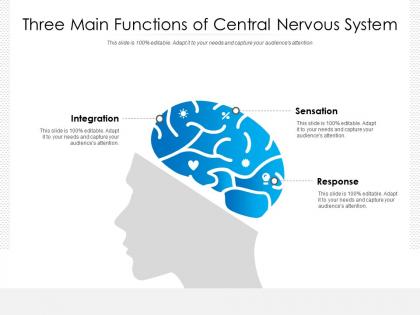
Three main functions of central nervous system




Try Before you Buy Download Free Sample Product
 Impress Your
 Audience
 100%
100% Editable
 Save Hours
 of Time


Our Three Main Functions Of Central Nervous System are explicit and effective. They combine clarity and concise expression.
People who downloaded this PowerPoint presentation also viewed the following :
Three main functions of central nervous system with all 2 slides:
Give your audience a fulfilling experience. They will find our Three Main Functions Of Central Nervous System elevating.

FAQs for Three main functions of
The central nervous system comprises the brain and spinal cord, which serve as the body's primary control and coordination center. These components work together by processing sensory information, coordinating motor responses, and regulating vital functions, with the brain handling complex cognitive processes while the spinal cord facilitates communication between brain and body, ultimately enabling coordinated physiological responses.
The CNS regulates body temperature through the hypothalamus, which monitors internal temperature, activates sweating or shivering responses, and controls blood vessel dilation or constriction. This sophisticated regulatory system enables healthcare facilities, research institutions, and medical device manufacturers to develop targeted therapies, ultimately delivering improved patient outcomes and enhanced treatment precision.
Neurotransmitters serve as chemical messengers that enable communication between neurons in the central nervous system, facilitating signal transmission across synapses, regulating mood and cognition, and coordinating motor functions. These specialized chemicals streamline neural pathways by enhancing synaptic efficiency, maintaining neural plasticity, and ultimately delivering coordinated responses that enable complex behaviors and adaptive learning processes.
The brain's complex folded cortex and specialized regions enable higher-order processing like cognition, sensory integration, and motor planning, while the spinal cord's streamlined columnar organization facilitates rapid signal transmission and reflex responses. These structural adaptations allow healthcare institutions and research organizations to develop targeted therapeutic approaches, with neurological specialists finding that understanding these anatomical differences enhances treatment precision and patient outcomes.
The CNS and PNS interact through bidirectional communication pathways, with the brain and spinal cord processing sensory information from peripheral nerves, integrating data, and sending motor commands back through efferent pathways. This coordination enables reflexes, voluntary movements, and autonomic functions, with healthcare organizations increasingly leveraging this understanding for neurological assessments, rehabilitation protocols, and diagnostic imaging services that enhance patient outcomes.
The brain's lobes serve distinct functions: frontal lobes control executive functions, decision-making, and motor control, parietal lobes process sensory information and spatial awareness, temporal lobes manage memory and auditory processing, while occipital lobes handle visual processing. These integrated systems work together through complex neural networks, enabling comprehensive cognitive performance, sensory integration, and coordinated responses that optimize mental efficiency and adaptive functioning.
Neuroplasticity enables the CNS to strengthen synaptic connections, form new neural pathways, and reorganize brain regions through repeated stimulation and experience-based learning. This adaptive capacity enhances memory consolidation, skill acquisition, and cognitive flexibility, with educational institutions and rehabilitation centers finding that targeted learning strategies and therapeutic interventions significantly accelerate neurological recovery and academic performance.
The CNS employs multiple protective mechanisms including the blood-brain barrier, cerebrospinal fluid circulation, meningeal layers, microglial immune responses, and neuroinflammatory pathways. These sophisticated defense systems work by filtering harmful substances, cushioning neural tissue, and coordinating immune surveillance, ultimately delivering enhanced neurological resilience and maintaining optimal brain function across diverse physiological conditions.
The central nervous system processes emotions through the limbic system, prefrontal cortex, and neurotransmitter networks, which interpret stimuli, regulate responses, and maintain emotional balance. Through structures like the amygdala and hippocampus, healthcare organizations enhance patient care approaches, while mental health professionals deliver more targeted therapeutic interventions, ultimately improving treatment outcomes and emotional wellness strategies.
Chronic stress significantly impairs CNS functioning through elevated cortisol levels, disrupted neurotransmitter balance, reduced neuroplasticity, compromised memory formation, and weakened cognitive processing abilities. These physiological changes ultimately affect decision-making capacity, emotional regulation, and executive functions, with many healthcare organizations finding that stress management programs enhance both neurological health and organizational performance outcomes.
The CNS coordinates voluntary movements through motor cortex planning and pyramidal tract pathways, while managing involuntary movements via brainstem centers, spinal reflexes, and autonomic networks. These integrated systems work by processing sensory input, initiating motor responses, and maintaining homeostatic functions, with healthcare organizations increasingly finding that understanding these mechanisms enhances neurological assessment protocols and patient care outcomes.
Common neurological disorders affecting the central nervous system include Alzheimer's disease, Parkinson's disease, multiple sclerosis, epilepsy, and stroke. These conditions present both diagnostic and treatment challenges, with healthcare institutions increasingly leveraging advanced neuroimaging technologies, personalized medicine approaches, and integrated care protocols to enhance patient outcomes, streamline treatment pathways, and ultimately deliver more precise therapeutic interventions.
Neuroimaging advancements enhance CNS understanding by providing real-time visualization of brain activity, improved spatial resolution, and detailed mapping of neural networks and pathways. These technologies enable researchers and clinicians to observe neuroplasticity, diagnose neurological conditions more accurately, and develop targeted treatments, with many medical institutions finding that enhanced imaging capabilities ultimately deliver better patient outcomes and accelerated research breakthroughs.
The CNS adapts through neuroplasticity, synaptic pruning, myelination, critical period learning, and structural reorganization during development. These adaptive mechanisms enable enhanced cognitive processing, improved motor coordination, and specialized neural pathway formation, with many healthcare institutions finding that understanding these developmental stages ultimately delivers more effective therapeutic interventions and educational approaches.
Lifestyle choices significantly impact central nervous system health through nutrition, exercise, sleep quality, stress management, and substance use habits. Regular physical activity enhances neuroplasticity and cognitive function, while balanced nutrition delivers essential nutrients for brain health, with many healthcare professionals finding that comprehensive lifestyle interventions ultimately improve memory, focus, and neurological resilience.
No Reviews