


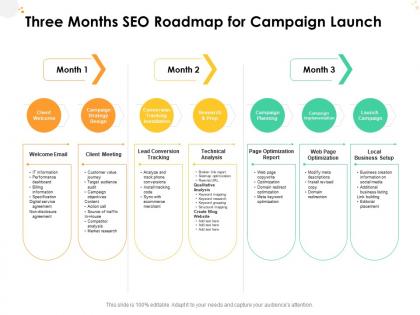
Three months seo roadmap for campaign launch




Try Before you Buy Download Free Sample Product
 Impress Your
 Audience
 100%
100% Editable
 Save Hours
 of Time


The success rate of business plans is hugely dependent on the plan of action, and this editable Three Months SEO Roadmap For Campaign Launch rightly serves the purpose. Encapsulate all the information related to the project in a well structured manner to obtain maximum efficiency by incorporating our stunning PowerPoint theme. State the critical deliverable, steps involved, time frame, workforce allocation, and lots more in an easy to understand manner by utilizing this pre designed roadmap PowerPoint layout. You can also prioritize your tasks and discuss the problem areas with your colleagues by incorporating this tailor made PPT layout. Empower your work plan by employing this professionally designed PPT theme. Entrepreneurs can download Three Months SEO Roadmap For Campaign Launch as a beneficial communication tool that facilitates in collaborating with different tasks and achieve targets.
People who downloaded this PowerPoint presentation also viewed the following :
Three months seo roadmap for campaign launch with all 2 slides:
Give your audience a fulfilling experience. They will find our Three Months SEO Roadmap For Campaign Launch elevating.

FAQs for Three months seo roadmap
An effective SEO roadmap includes keyword research and strategy, technical SEO audits, content planning and optimization, link building strategies, and performance tracking metrics. These components work together by identifying target opportunities, ensuring site functionality, delivering valuable content, and building authority, with many organizations finding that systematic implementation across these areas delivers improved search visibility, increased organic traffic, and sustainable competitive advantage.
Keyword research and analysis directly shape SEO roadmap development by identifying target search terms, revealing content gaps, determining competitive positioning, and establishing priority rankings for optimization efforts. Through comprehensive keyword analysis, organizations streamline their content strategy, enhance page targeting, and allocate resources more effectively, ultimately delivering improved search visibility and organic traffic growth with measurable competitive advantages.
On-page optimization serves as the foundation of SEO strategy by enhancing content relevance, improving site structure, and optimizing technical elements like meta tags, headers, and internal linking. These techniques streamline search engine crawling and indexing while delivering better user experiences, with many businesses finding that strategic on-page improvements significantly boost organic rankings and drive qualified traffic.
Businesses can track SEO roadmap success through organic traffic growth, keyword ranking improvements, conversion rates, bounce rate reductions, and search visibility metrics. These analytics enable companies to measure ROI from their SEO investments, with many organizations finding that consistent monitoring through tools like Google Analytics and Search Console ultimately delivers measurable competitive advantage and sustainable online growth.
**INPUT**: What are the best practices for creating content that aligns with an SEO roadmap? **OUTPUT**: Best practices include keyword research integration, user intent alignment, content optimization for search algorithms, structured data implementation, and consistent publishing schedules. These approaches streamline organic visibility by delivering targeted value, enhancing search rankings, and building domain authority, with many organizations finding that strategic content alignment ultimately drives sustainable traffic growth and competitive advantage. [Word count: 56 words]
Local SEO integrates into overall SEO strategy through consistent NAP citations, location-specific content creation, Google My Business optimization, and targeted local keyword implementation. These approaches enhance search visibility by connecting geographic relevance with broader SEO goals, with many businesses finding that localized content and community engagement ultimately deliver higher conversion rates and stronger regional market presence.
**INPUT**: What tools and software are recommended for building an SEO roadmap? **OUTPUT**: Essential SEO roadmap tools include Google Analytics, SEMrush, Ahrefs, Screaming Frog, and Google Search Console for comprehensive analysis and planning. These platforms streamline keyword research, competitive analysis, and technical auditing, with many digital marketing teams finding that strategic combinations of these tools deliver enhanced visibility, improved rankings, and measurable organic growth outcomes. [Word count: 54 words]
Algorithm updates significantly impact SEO roadmap tactics by requiring continuous strategy refinement, content quality adjustments, and technical optimization updates. These changes compel organizations to maintain flexible roadmaps that prioritize user experience, authoritative content creation, and adaptive keyword strategies, with many digital marketing teams finding that regular roadmap reviews and algorithm monitoring ultimately deliver sustained search visibility and competitive advantage.
Competitor analysis reveals valuable keyword opportunities, content gaps, backlink strategies, and market positioning insights that directly inform SEO roadmap priorities and resource allocation. By analyzing competitors' strengths and weaknesses, businesses can identify untapped niches, benchmark performance metrics, and develop strategic approaches that deliver competitive advantage in search rankings.
SEO roadmaps should be reviewed quarterly and adjusted based on algorithm updates, performance metrics, competitive landscape changes, and business goal shifts. This regular assessment enables organizations to respond to search engine modifications, capitalize on emerging keyword opportunities, and optimize content strategies, ultimately maintaining competitive advantage while ensuring sustained organic growth in an increasingly dynamic digital environment.
Common pitfalls when executing an SEO roadmap include targeting overly competitive keywords, neglecting technical SEO fundamentals, inconsistent content creation, ignoring mobile optimization, and failing to track meaningful metrics. These mistakes often stem from unrealistic timelines and lack of resource allocation, with many organizations finding that sustainable SEO success requires patience, consistent execution, and regular strategy adjustments based on performance data.
Mobile optimization can be incorporated into SEO strategy through responsive design implementation, page speed enhancement, mobile-first indexing preparation, and touch-friendly navigation development. These approaches streamline user experiences by ensuring faster loading times, improved usability, and better search rankings, with many e-commerce and service businesses finding that mobile-optimized sites deliver significantly higher conversion rates and competitive advantage.
Link-building factors into an SEO roadmap through strategic outreach, quality content creation, relationship development, and authority-building initiatives that enhance domain credibility and search rankings. These efforts streamline organic visibility by attracting high-authority backlinks, improving referral traffic, and establishing topical expertise, with many organizations finding that systematic link-building ultimately delivers sustained competitive advantage.
UX improvements significantly boost SEO success by reducing bounce rates, increasing dwell time, enhancing mobile responsiveness, and improving site navigation and page load speeds. Search engines prioritize websites that deliver seamless user experiences, with many businesses finding that strategic UX enhancements lead to higher search rankings, increased organic traffic, and ultimately better conversion rates.
Technical SEO forms the foundational infrastructure of any comprehensive SEO roadmap, encompassing site speed optimization, mobile responsiveness, crawlability improvements, structured data implementation, and URL architecture refinement. These elements streamline search engine indexing, enhance user experience across devices, and ultimately deliver improved rankings and organic visibility, with many organizations finding that technical foundations directly impact their content marketing success.
No Reviews