


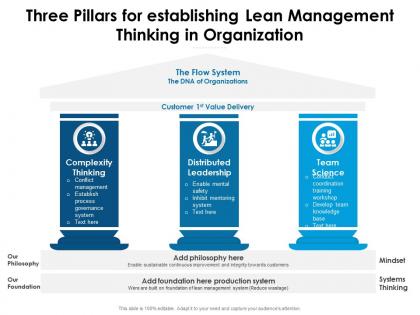
Three pillars for establishing lean management thinking in organization




Try Before you Buy Download Free Sample Product
 Impress Your
 Audience
 100%
100% Editable
 Save Hours
 of Time


Our Three Pillars For Establishing Lean Management Thinking In Organization are topically designed to provide an attractive backdrop to any subject. Use them to look like a presentation pro.
People who downloaded this PowerPoint presentation also viewed the following :
Three pillars for establishing lean management thinking in organization with all 2 slides:
Use our Three Pillars For Establishing Lean Management Thinking In Organization to effectively help you save your valuable time. They are readymade to fit into any presentation structure.
FAQs for Three pillars for establishing lean management
Lean Management principles include eliminating waste, continuous improvement, respect for people, customer value focus, and pull-based production systems. These approaches differ from traditional management by emphasizing employee empowerment over hierarchical control, proactive problem-solving rather than reactive fixes, and streamlined workflows, with many organizations finding that lean methodologies deliver faster response times, reduced costs, and enhanced operational efficiency.
Lean Management improves process efficiency by eliminating waste, streamlining workflows, and optimizing resource allocation across operations. Manufacturing companies reduce production times, healthcare institutions minimize patient wait times, and financial services accelerate loan processing, with many organizations finding that these systematic improvements ultimately deliver cost reductions and enhanced customer experiences.
Value stream mapping serves as a visual diagnostic tool that identifies waste by documenting every step in a process, from raw materials to customer delivery, highlighting non-value-added activities like waiting times, excess inventory, and redundant approvals. Through this comprehensive analysis, organizations in manufacturing, healthcare, and financial services streamline operations by eliminating bottlenecks, reducing cycle times, and optimizing resource allocation, ultimately delivering faster throughput and enhanced customer experiences.
Organizations implement Lean Management in remote environments by digitizing visual management systems, establishing virtual daily standups, and leveraging collaboration platforms to maintain continuous improvement workflows. Through cloud-based Kanban boards and video conferencing, teams streamline communication, eliminate digital waste, and enhance productivity, with many remote organizations finding that virtual Lean practices actually accelerate decision-making and reduce operational inefficiencies.
Common challenges during Lean Management transition include employee resistance to change, inadequate leadership commitment, insufficient training, cultural misalignment, and unrealistic expectations for immediate results. These obstacles can be overcome by fostering open communication, providing comprehensive staff education, securing strong executive support, and implementing gradual process improvements, with many organizations finding that patience and consistent reinforcement ultimately deliver sustainable operational efficiency and competitive advantage.
Lean Management principles enhance service industries by eliminating waste, streamlining processes, and optimizing resource allocation through value stream mapping, standardized workflows, and continuous improvement cycles. Healthcare organizations reduce patient wait times and improve care delivery, while financial institutions accelerate loan approvals and minimize operational costs, ultimately delivering faster services and enhanced customer experiences.
**INPUT**: What metrics can be used to measure the success of Lean Management initiatives? **OUTPUT**: Lean Management success metrics include cycle time reduction, defect rates, inventory turnover, employee productivity, customer satisfaction scores, and overall equipment effectiveness (OEE). These measurements enable organizations to track operational efficiency, cost reduction, and quality improvements across manufacturing, healthcare, and service sectors, with many companies finding that combining multiple metrics delivers comprehensive insights into their competitive advantage. [Word count: 60 words]
Lean Management practices contribute to employee engagement by empowering workers through continuous improvement initiatives, eliminating frustrating inefficiencies, and encouraging collaborative problem-solving across all organizational levels. These approaches enhance job satisfaction by streamlining workflows, reducing waste-related stress, and enabling employees to contribute meaningful innovations, with many manufacturing and service organizations finding that engaged teams deliver significantly higher productivity and retention rates.
Lean Management focuses on eliminating waste and improving flow, while Six Sigma emphasizes reducing variation and defects through statistical analysis. These complementary methodologies can be integrated through Lean Six Sigma approaches, where organizations streamline processes while maintaining quality control, ultimately delivering faster operations, reduced costs, and enhanced customer satisfaction across manufacturing, healthcare, and service industries.
Organizations sustain Lean improvements through continuous monitoring systems, regular employee training programs, leadership commitment, and embedding Lean principles into company culture. Many manufacturing companies and healthcare institutions find that establishing feedback loops, conducting periodic audits, and maintaining cross-functional improvement teams ultimately delivers lasting operational efficiency and competitive advantage.
Essential Lean Management tools include value stream mapping, 5S workplace organization, kanban systems, poka-yoke error prevention, and continuous improvement (kaizen) processes. These methodologies streamline manufacturing operations by eliminating waste, reducing inventory costs, and improving quality control, with many automotive and electronics manufacturers finding that strategic implementation ultimately delivers faster production cycles and enhanced competitive advantage.
Lean Management enhances project deliverables and timelines by eliminating waste, streamlining workflows, and implementing continuous improvement cycles throughout project phases. Through value stream mapping and just-in-time resource allocation, project managers reduce bottlenecks, minimize delays, and optimize team productivity, with many organizations finding that lean principles deliver faster project completion and higher-quality outcomes while maintaining cost efficiency.
Leadership drives Lean culture by modeling continuous improvement behaviors, empowering employees to identify inefficiencies, and creating psychological safety for experimentation and learning. Through regular gemba walks, transparent communication, and strategic resource allocation, leaders enable cross-functional collaboration and sustainable process optimization, with many organizations finding that executive commitment directly correlates with successful Lean transformation outcomes.
Lean Management enhances customer experience by eliminating waste in customer-facing processes, reducing wait times, and streamlining service delivery touchpoints. Through value stream mapping and continuous improvement, organizations in retail, healthcare, and financial services accelerate response times, minimize errors, and deliver more personalized interactions, ultimately creating smoother customer journeys and higher satisfaction rates.
Toyota's Production System revolutionized automotive manufacturing through waste elimination and continuous improvement, while Amazon applies lean principles to warehouse operations and delivery logistics, and hospitals like Virginia Mason have streamlined patient care processes. These implementations demonstrate that lean success requires strong leadership commitment, employee empowerment at all levels, and systematic culture change, with organizations finding that sustained results come from treating lean as a long-term transformation rather than quick fixes.
-
Awesome presentation, really professional and easy to edit.
-
Enough space for editing and adding your own content.
-
Enough space for editing and adding your own content.
-
Appreciate the research and its presentable format.
-
Colors used are bright and distinctive.