


Timeboxing A Time Management Technique Training Ppt





Try Before you Buy Download Free Sample Product
 Impress Your
 Audience
 100%
100% Editable
 Save Hours
 of Time


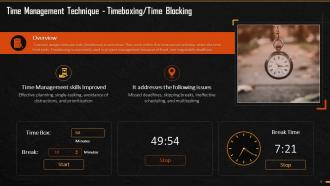
This slide demonstrates Timeboxing and Time Blocking, a time management technique that emphasizes assigning timeboxes to activities with set time limits to accomplish them. It also showcases that the method improves effective planning, single-tasking, distraction avoidance, and prioritization.
People who downloaded this PowerPoint presentation also viewed the following :
Timeboxing A Time Management Technique Training Ppt with all 16 slides:
Use our Timeboxing A Time Management Technique Training Ppt to effectively help you save your valuable time. They are readymade to fit into any presentation structure.







FAQs for Timeboxing A Time Management
Timeboxing is a time management technique that allocates fixed durations to specific presentation activities, preventing overruns and maintaining audience engagement through structured pacing. This approach enhances productivity by ensuring comprehensive content coverage, reducing preparation anxiety, and enabling presenters to deliver focused messages within defined segments, ultimately creating more impactful presentations with better audience retention and clearer outcomes.
Timeboxing integrates into project management by establishing fixed durations for tasks, creating sprint-based workflows, and implementing regular review cycles to maintain momentum. This approach enables teams to prioritize high-impact activities, reduce scope creep, and deliver incremental value, with many organizations finding that structured time constraints ultimately enhance focus and accelerate project completion rates.
Timeboxing delivers significant psychological benefits including reduced anxiety, enhanced focus, increased sense of control, improved work-life boundaries, and greater accomplishment satisfaction. Through structured time allocation, professionals experience decreased decision fatigue and clearer priorities, with many organizations finding that employees report higher job satisfaction, reduced burnout rates, and stronger confidence in meeting deadlines and managing competing demands.
Optimal timebox duration depends on presentation complexity, audience engagement levels, and content depth requirements, typically ranging from 5-10 minutes for pitch decks to 45-60 minutes for comprehensive training sessions. Through systematic testing and audience feedback analysis, organizations can refine these durations by monitoring attention patterns, comprehension rates, and participation levels, ultimately delivering more focused presentations while maximizing audience retention and engagement across different business contexts.
Timeboxing tools include Toggl, RescueTime, Forest, Google Calendar, Notion, and specialized apps like Be Focused and Focus Keeper. These platforms streamline task scheduling, time tracking, and progress monitoring by providing visual timers, automated reminders, and detailed analytics, with many organizations finding that integrated calendar systems ultimately enhance productivity and resource allocation across teams.
Timeboxing helps manage team dynamics by establishing clear boundaries for discussion, preventing dominant speakers from monopolizing time, and ensuring equal participation opportunities for all members. This structured approach reduces presentation anxiety, minimizes off-topic tangents, and creates predictable rhythms that enhance team coordination, ultimately delivering more balanced group presentations and improved collaborative outcomes.
Common timeboxing challenges include underestimating task duration, managing interruptions, maintaining focus during designated periods, and adapting when priorities shift unexpectedly. These obstacles can be overcome by building buffer time into schedules, setting clear boundaries with colleagues, using focused work techniques like the Pomodoro method, and regularly reviewing timebox effectiveness, with many organizations finding that consistent practice and flexible adjustment ultimately deliver improved productivity and better project outcomes.
Timeboxing improves focus by creating structured work periods with defined boundaries, eliminating decision fatigue about task duration, and establishing clear start-stop points that maintain momentum. This approach reduces procrastination by breaking overwhelming projects into manageable segments, with many organizations finding that employees tackle challenging tasks more readily when facing finite, committed time blocks rather than open-ended deadlines.
Timeboxing for virtual presentations involves allocating specific time blocks for content creation, technical setup, rehearsal sessions, and audience engagement planning. This structured approach streamlines preparation by dedicating focused intervals to script development, slide design, platform testing, and backup planning, while many presenters find that timeboxed practice sessions enhance delivery confidence and technical proficiency.
Timeboxing enhances audience engagement by creating structured segments with clear expectations, maintaining attention through varied pacing, and preventing cognitive overload during lengthy presentations. This approach enables speakers to deliver focused content blocks, incorporate interactive elements at strategic intervals, and sustain energy levels, with many public speaking professionals finding that audiences remain more attentive and responsive throughout structured presentations.
Timeboxing can significantly enhance creative brainstorming by establishing focused energy, preventing idea stagnation, and encouraging rapid ideation within defined parameters. These structured intervals create productive pressure that sparks innovation, with many creative teams finding that shorter, intensive sessions generate more diverse concepts than lengthy, open-ended discussions, ultimately delivering actionable ideas.
Timeboxing assists in balancing presentation sections by allocating specific time limits to each segment, preventing overemphasis on certain topics while ensuring comprehensive coverage. Through structured time allocation, presenters can maintain audience engagement, deliver key messages efficiently, and create well-paced presentations, with many organizations finding that this approach ultimately enhances presentation effectiveness and professional delivery.
Best practices for reviewing timebox lengths include analyzing completion rates, gathering team feedback, assessing task complexity variations, monitoring quality outcomes, and tracking energy levels throughout sessions. Teams should adjust durations based on these metrics, with many organizations finding that shorter timeboxes work better for creative tasks while longer ones suit analytical work, ultimately enhancing productivity and sustainable workflows.
Leaders can use timeboxing to foster accountability by assigning specific time blocks for deliverables, creating clear ownership of outcomes, and establishing regular check-ins that track progress against defined deadlines. This structured approach enables team members to take responsibility for their contributions while providing transparency into individual performance, ultimately delivering enhanced productivity and stronger team cohesion.
Successful timeboxing examples include allocating 5 minutes for introductions, 15 minutes per agenda item, 10-minute Q&A sessions, 2-minute elevator pitches, and 30-second decision points. These structured intervals streamline meetings by maintaining focus, preventing tangential discussions, and ensuring comprehensive coverage, with many organizations finding that timeboxed presentations deliver clearer outcomes and enhanced participant engagement.
-
It's always a delight to see new templates from you! I am extremely pleased with the fact that they are easy to modify and fit any presentation layout in seconds!
-
Great product, helpful indeed!