


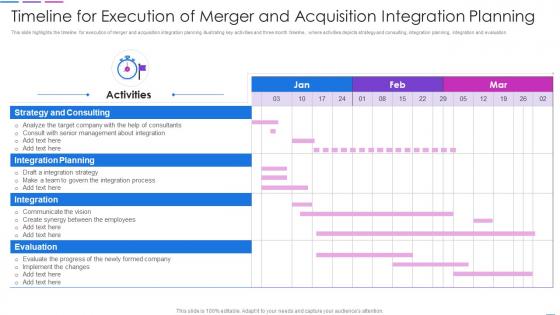
Timeline For Execution Of Merger And Acquisition Integration Planning




Try Before you Buy Download Free Sample Product
 Impress Your
 Audience
 100%
100% Editable
 Save Hours
 of Time


This slide highlights the timeline for execution of merger and acquisition integration planning illustrating key activities and three month timeline, where activities depicts strategy and consulting, integration planning, integration and evaluation.
People who downloaded this PowerPoint presentation also viewed the following :
Timeline For Execution Of Merger And Acquisition Integration Planning with all 6 slides:
Use our Timeline For Execution Of Merger And Acquisition Integration Planning to effectively help you save your valuable time. They are readymade to fit into any presentation structure.





FAQs for Timeline For Execution Of Merger And
M&A integration typically includes pre-closing planning, day-one readiness, early integration (first 100 days), full integration execution, and post-integration optimization phases. These phases streamline organizational alignment, cultural integration, and operational consolidation, with many companies finding that structured timeline management accelerates synergy realization, minimizes business disruption, and ultimately delivers enhanced market position and competitive advantage.
Cultural differences significantly impact M&A integration by creating communication barriers, conflicting management styles, and differing operational approaches that can delay synergy realization. Through strategic cultural assessment and integration planning, organizations streamline workforce alignment, enhance collaboration across teams, and minimize employee turnover, with many companies finding that proactive cultural integration ultimately delivers faster operational efficiency and stronger competitive positioning.
Essential M&A integration metrics include employee retention rates, customer churn, revenue synergy realization, cost reduction targets, and system integration milestones. These metrics enable organizations to monitor cultural alignment, operational efficiency, and financial performance simultaneously, with many companies finding that tracking weekly dashboards across departments ultimately delivers faster decision-making and measurable competitive advantages.
Effective communication strategies significantly accelerate M&A integration timelines by establishing clear expectations, reducing employee uncertainty, and streamlining decision-making processes across merged organizations. Transparent, frequent communication enables leadership teams to address cultural integration challenges early, coordinate operational changes more efficiently, and maintain productivity levels, with many companies finding that proactive communication reduces integration periods by 20-30% while minimizing talent retention risks.
Leadership drives successful M&A integration by establishing clear vision, maintaining transparent communication, and aligning organizational cultures throughout the transition process. Strong leaders navigate competing priorities, address employee concerns proactively, and ensure strategic objectives remain focused, with many organizations finding that executive commitment to integration planning ultimately delivers faster synergy realization and smoother operational consolidation.
M&A integration tools include project management platforms like Microsoft Project, data room software such as Intralinks, communication systems like Slack, financial consolidation tools, and cultural assessment platforms. These technologies streamline integration by automating data migration, enhancing cross-team collaboration, and tracking milestone progress, with many organizations finding that integrated software suites ultimately accelerate deal closure and minimize operational disruption.
Organizations can prioritize integration tasks by focusing on revenue-critical systems first, identifying quick wins that demonstrate early value, and addressing regulatory compliance requirements immediately. Through strategic sequencing, companies streamline operations by tackling customer-facing processes, financial systems integration, and cultural alignment initiatives simultaneously, ultimately delivering faster ROI and minimized business disruption.
Common pitfalls include poor communication planning, rushing cultural integration, inadequate due diligence follow-through, misaligned leadership expectations, and insufficient resource allocation for integration teams. These challenges often derail value creation, with many organizations finding that systematic timeline management, clear milestone tracking, and dedicated integration governance ultimately deliver smoother transitions and faster realization of strategic synergies.
Due diligence findings directly shape integration priorities by identifying operational synergies, cultural compatibility issues, technology gaps, and regulatory requirements that determine sequencing and resource allocation. These insights enable acquirers to develop targeted integration roadmaps, with many organizations finding that thorough due diligence accelerates post-merger value creation and minimizes integration risks.
Best practices for aligning IT systems post-M&A include conducting comprehensive infrastructure assessments, establishing unified data governance frameworks, implementing phased integration approaches, standardizing security protocols, and creating cross-functional integration teams. These strategies streamline operations by minimizing system redundancies, ensuring seamless data flow, and maintaining business continuity, with many organizations finding that structured IT alignment accelerates synergy realization and competitive positioning.
Maintaining employee engagement during M&A integration requires transparent communication, clear role definitions, early involvement in planning processes, and consistent feedback channels. Organizations enhance engagement by establishing integration teams with representatives from both companies, providing regular updates on progress and changes, and offering professional development opportunities, ultimately reducing turnover while accelerating cultural alignment and operational synergies.
An M&A integration checklist should include cultural assessment, technology systems alignment, regulatory compliance verification, talent retention strategies, and financial reporting consolidation. These components streamline the integration process by addressing operational continuity, minimizing disruption to customer relationships, and ensuring regulatory adherence, with many organizations finding that comprehensive checklists ultimately deliver faster integration timelines and enhanced synergy realization.
M&A integration timelines vary significantly by industry complexity and regulatory requirements, with technology mergers often completing within 12-18 months while heavily regulated sectors like banking and healthcare typically require 24-36 months. Financial services face extensive compliance reviews, manufacturing deals involve complex supply chain integration, and pharmaceutical mergers require lengthy regulatory approvals, with many organizations finding that thorough planning ultimately accelerates overall execution.
Stakeholder expectations significantly influence M&A integration success by shaping communication strategies, resource allocation priorities, and timeline management throughout the process. Clear expectation management enables organizations to maintain investor confidence, retain key talent, and preserve customer relationships, while misaligned expectations can derail integration efforts, ultimately determining whether mergers deliver anticipated synergies and competitive advantages.
Companies leverage synergies by identifying operational overlaps, streamlining redundant processes, and consolidating resources across departments like finance, IT, and operations. Through strategic workforce integration and technology alignment, organizations eliminate duplicate costs, accelerate decision-making, and enhance market positioning, with many finding that early synergy capture significantly reduces integration timelines while delivering competitive advantages.
-
The quality of the templates is as fine as it could get. It was a purchase well made!
-
Illustrative design with editable content. Exceptional value for money. Highly pleased with the product.