


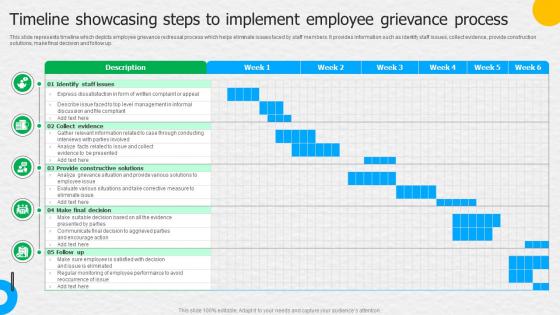
Timeline Showcasing Steps To Implement Employee Grievance Process




Try Before you Buy Download Free Sample Product
 Impress Your
 Audience
 100%
100% Editable
 Save Hours
 of Time


This slide represents timeline which depicts employee grievance redressal process which helps eliminate issues faced by staff members. It provides information such as identify staff issues, collect evidence, provide construction solutions, make final decision and follow up.
People who downloaded this PowerPoint presentation also viewed the following :
Timeline Showcasing Steps To Implement Employee Grievance Process with all 6 slides:
Use our Timeline Showcasing Steps To Implement Employee Grievance Process to effectively help you save your valuable time. They are readymade to fit into any presentation structure.





FAQs for Timeline Showcasing Steps To Implement
An effective employee grievance process should include clear reporting procedures, defined timelines for resolution, multiple escalation levels, impartial investigation protocols, and documented appeal mechanisms. These components work together by ensuring transparency, maintaining fairness, and protecting both employee rights and organizational interests, with many companies finding that structured grievance systems ultimately enhance workplace trust, reduce legal risks, and improve overall employee satisfaction.
Organizations can ensure grievance process accessibility by implementing multiple reporting channels, providing multilingual resources, offering anonymous submission options, and ensuring physical accessibility for employees with disabilities. These approaches streamline communication barriers while accommodating diverse workforce needs, with many companies finding that comprehensive accessibility measures ultimately enhance employee trust, reduce legal risks, and improve overall workplace satisfaction across all organizational levels.
Confidentiality maintains trust by protecting both complainants and respondents from reputational harm, workplace retaliation, and privacy breaches throughout investigations. Organizations with strong confidentiality protocols enable employees to report concerns openly, streamline resolution processes, and preserve professional relationships, ultimately delivering higher employee satisfaction and reduced legal risks across departments.
Employers can train management to handle grievances effectively through active listening workshops, conflict resolution techniques, legal compliance education, documentation best practices, and empathy development programs. These comprehensive training modules enable managers to address employee concerns promptly and fairly, while maintaining workplace harmony and reducing turnover, ultimately delivering improved employee satisfaction and organizational productivity.
Investigating employee grievances involves acknowledging receipt within 24-48 hours, assigning an impartial investigator, conducting confidential interviews with all parties, gathering relevant documentation, and analyzing findings objectively. Through systematic investigation protocols, organizations streamline resolution timelines, enhance workplace transparency, and maintain employee trust, with many companies finding that thorough processes ultimately deliver better outcomes and reduced legal exposure.
The grievance process can be adapted through virtual meeting platforms, digital documentation systems, secure communication channels, and flexible scheduling accommodations for different time zones. Remote environments enable enhanced confidentiality through private digital channels, streamlined record-keeping, and broader access to neutral mediators, with many organizations finding that hybrid models actually improve response times and employee participation rates.
Employee grievance process effectiveness can be measured through resolution time, employee satisfaction scores, grievance recurrence rates, process completion rates, and manager response quality assessments. These metrics enable organizations to identify bottlenecks, streamline resolution workflows, and enhance workplace transparency, with many companies finding that comprehensive tracking ultimately delivers improved employee retention and stronger organizational trust.
Organizations create cultures encouraging grievance communication by establishing transparent reporting channels, training managers in active listening, implementing anonymous feedback systems, and regularly communicating zero-retaliation policies. These approaches streamline conflict resolution by building employee trust, enhancing workplace transparency, and enabling early issue identification, with many companies finding that proactive communication ultimately delivers higher retention rates and improved organizational efficiency.
Organizations failing to address employee grievances face decreased morale, increased turnover, potential legal action, damaged reputation, and reduced productivity. These consequences ultimately impact operational efficiency and competitive advantage, with many companies finding that unresolved grievances escalate into costly litigation, talent flight, and workplace toxicity that undermines long-term business success.
Technology facilitates the employee grievance process by automating case tracking, enabling anonymous reporting, and streamlining communication between employees and HR teams. Through digital platforms, organizations deliver faster resolution times, maintain comprehensive audit trails, and provide real-time status updates, while ensuring confidentiality and transparency, ultimately enhancing employee satisfaction and organizational trust.
HR serves as neutral mediator, investigator, and process facilitator in grievance resolution, ensuring fair hearings, conducting thorough investigations, and maintaining compliance with company policies and legal requirements. Through structured mediation sessions, HR professionals help employees and managers reach mutually acceptable solutions while documenting outcomes, ultimately enhancing workplace harmony and reducing litigation risks.
Protective measures include confidentiality protocols, anti-retaliation policies with clear consequences, independent investigation processes, anonymous reporting options, and witness protection safeguards. These frameworks enhance workplace trust by ensuring transparent documentation, regular follow-up monitoring, and swift corrective action, with many organizations finding that robust protections ultimately deliver higher employee engagement and reduced legal risks.
Feedback from grievance processes reveals systemic workplace issues, policy gaps, and recurring concerns that organizations can address through targeted policy revisions, enhanced training programs, and improved communication protocols. By analyzing grievance patterns, companies streamline HR procedures, strengthen employee relations, and create more inclusive work environments, ultimately reducing future complaints while enhancing overall organizational effectiveness and employee satisfaction.
Legal considerations include compliance with employment laws, anti-discrimination statutes, workplace safety regulations, union agreements, and due process requirements. Organizations must ensure their grievance processes protect both employee rights and company interests, with many finding that well-structured procedures minimize legal risks while enhancing workplace transparency and trust.
The grievance process should be reviewed annually or after significant organizational changes, policy updates, or emerging workplace trends. Regular assessments enable organizations to identify bottlenecks, streamline resolution timelines, and enhance employee satisfaction, with many companies finding that proactive updates reduce formal complaints by 30-40% while strengthening workplace culture and trust.
-
“There is so much choice. At first, it seems like there isn't but you have to just keep looking, there are endless amounts to explore.”
-
One word for SlideTeam–Versatile!